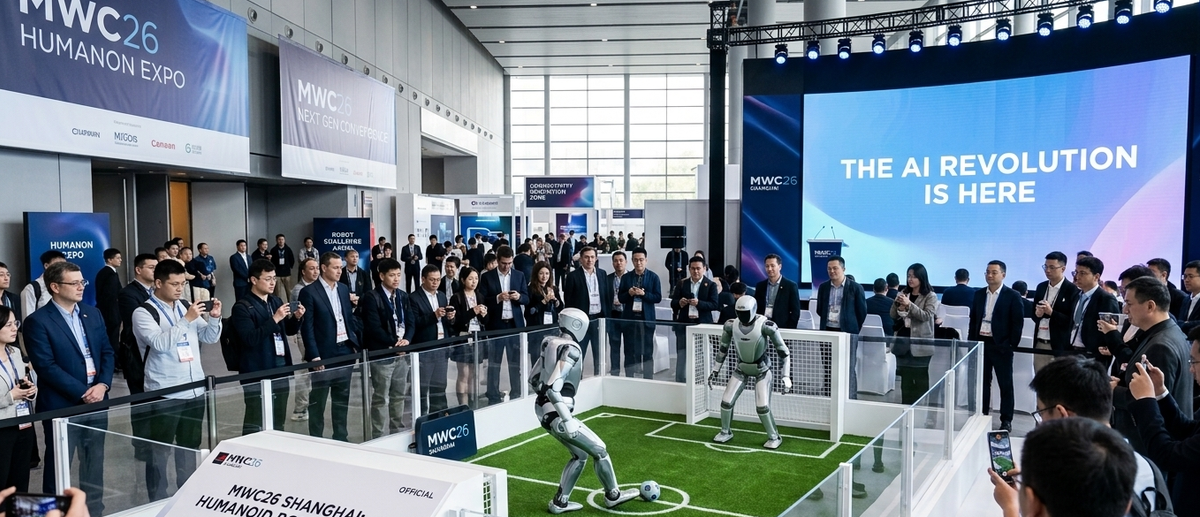
Three days. 37,300 attendees. 143 countries represented. That's what GSMA MWC26 Shanghai AI economy and 6G innovation produced at the Shanghai New International Expo Centre this week - and honestly, the raw numbers only tell part of the story.
This wasn't a routine tech conference. Something shifted this year: a sharpening of focus, a sense that the mobile industry's structural transformation isn't a forecast anymore. It's already underway.
By the Numbers: The Real Scale of MWC26 Shanghai
The stat that keeps coming up: international attendance jumped 33% year-on-year. For a conference already operating at this scale, that's not incremental growth.
Here's who showed up:
- 37,300 total attendees from 143 countries and regions
- 35% held director-level roles or above (36% of those were top management)
- 33% came from industries outside the core mobile sector
- 400+ exhibitors, sponsors, and partners
- Around 300 speakers, with 40% international and 40% from non-mobile industries
That third figure is worth sitting with. A third of attendees weren't telecom people. They came from manufacturing, healthcare, automotive, and logistics. The AI economy mobile industry conversation has stopped being siloed inside telecom, and MWC26 Shanghai 2026 made that visible in a way previous editions didn't quite capture.
Roughly 700 international media outlets covered the event. The GSMA Policy Leaders Forum brought 39 delegations from 35 countries across Latin America, Asia, the Middle East, Eurasia, and Africa, plus four intergovernmental organizations. That's not just industry showing up. That's policy, finance, and governance sitting at the same table.
5G Advanced Is the Foundation - and That's the Whole Point
John Hoffman, CEO of GSMA Ltd., put it plainly: "5G and 5G-Advanced are the foundational layers of the AI stack. They provide the capacity, latency, and reliability required for increasingly demanding systems and services."
That framing is a meaningful shift. For years, 5G was pitched as a speed upgrade - faster downloads, lower latency, bigger pipes. But 5G Advanced as a foundational layer of the AI stack GSMA is now articulating goes deeper. Capacity and reliability aren't features anymore. They're prerequisites for everything running above them - AI inference at the edge, autonomous systems, real-time machine communication at scale.
Hoffman specifically called out manufacturing, healthcare, and the low-altitude economy as verticals where this is already playing out. The 6G innovation and low-altitude economy vertical applications track at MWC26 Shanghai generated serious attention, particularly around drone logistics, urban air mobility, and connected infrastructure. Not speculative roadmap slides - actual deployment windows. The Lingcheng supercomputer architecture developments running parallel to these sessions are a reminder of how serious China's underlying compute bets have become, and how they connect to the connectivity layer being built out at events like this one.
The Robot That Kicked a Penalty Shot - and Got a Million Views
Look, this is the moment everyone will quote from MWC26 Shanghai.
The humanoid robot soccer penalty shootout challenge drew approximately 1 million views across MWC Shanghai's website, social media, and media partner platforms. A humanoid robot, kicking a penalty shot, in front of an audience that had just spent two days discussing enterprise connectivity strategy and b2b telecom tech trends.
It was a spectacle. But it wasn't just a spectacle.
Physical AI business solutions are closing the gap between demonstration and commercial deployment faster than most projections suggested a year ago. The robot soccer moment worked as a visual proof point for something the whole conference kept circling back to: embodied AI is becoming a real product category, not a research exhibit. Whether you find that exciting or mildly unsettling probably depends on your industry.
Why the Broader AI Economy Picture Matters Here
Connectivity-driven innovation was the official theme of MWC26 Shanghai this year. Unlike most conference taglines, it actually described what was happening on the floor.
Sessions covered satellite networks, robotics, and what Hoffman called the AI-driven lexical economy - the idea that AI is fundamentally changing how industries use language, process data, and generate value from communication. If you've been tracking what Chinese AI companies are building in enterprise software and large language models, a lot of what surfaced at MWC26 Shanghai felt like confirmation of a longer-running trend rather than anything surprising.
The AI economy innovation momentum isn't happening in isolation either. It intersects with the automotive AI and chip race, with the growing push toward AI and green energy integration, and with the kind of deep-tech startup activity that Xiongan high-tech startup funding programs are actively accelerating. MWC26 Shanghai was one of the more visible public moments where those threads converged in a single room.
Global telecom industry structural transformation 2026 isn't a single event - but MWC26 Shanghai put a useful frame around it. The MWC26 Shanghai highlights that'll matter six months from now aren't the press releases. They're the partnerships and vertical deployments that quietly got formalized during those three days.
What Comes Next on the Schedule
MWC26 Shanghai is done. The calendar keeps moving.
Up next: M360 ASEAN in Kuala Lumpur, September 9-10, 2026. Then MWC26 Doha in Qatar, November 8-10. The M360 ASEAN Kuala Lumpur event is specifically focused on Southeast Asia's connectivity buildout, which is its own story worth watching closely if you're tracking AI economy expansion into emerging markets. If MWC26 Shanghai was about showing what's possible, the follow-on events are where implementation conversations begin.
The Direction Is Getting Clearer
GSMA MWC26 Shanghai AI economy and 6G innovation didn't produce a single headline breakthrough. What it produced was more durable - a shared picture of where the mobile industry is actually headed, built across 37,300 conversations from 143 countries over three days.
5G Advanced is the foundation. The AI-driven lexical economy is the model emerging above it. And 6G innovation is what the industry is already engineering toward, even while 5G Advanced deployments are still scaling.
The robot kicking the penalty shot? That was just the part people filmed. The structural shift happening underneath it - that's what MWC26 Shanghai was really about.