Summary
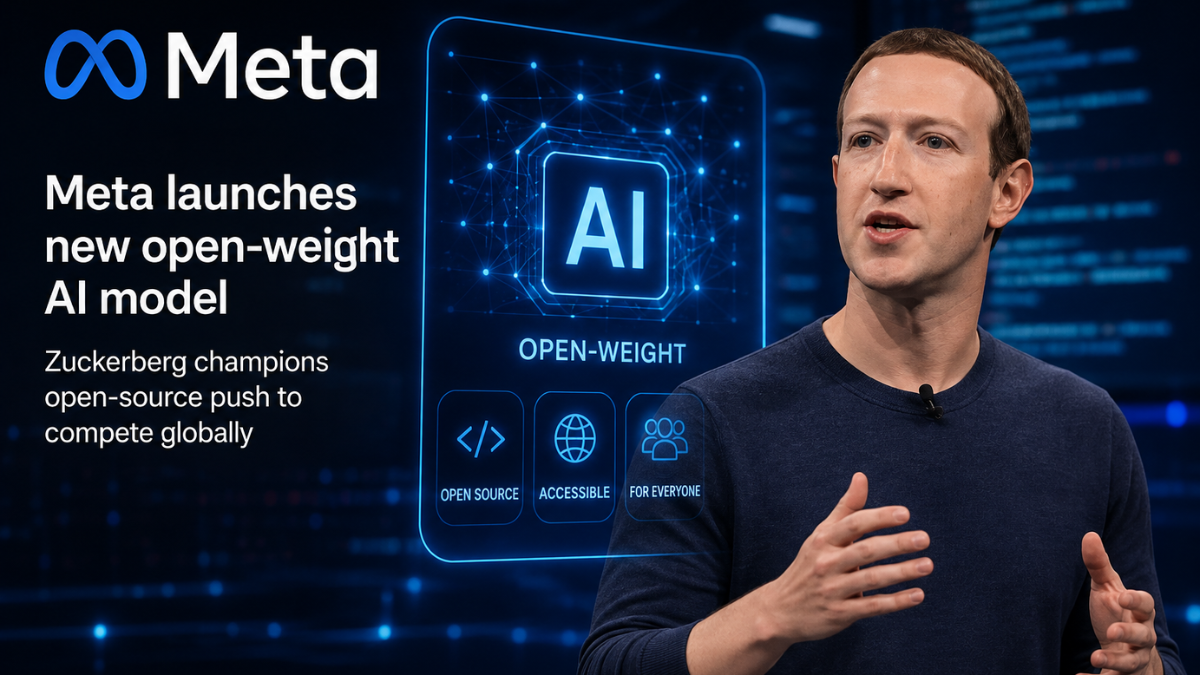
The Meta Muse Glimmer open weight AI model release puts a different kind of AI race in focus. Instead of chasing the biggest possible model, Meta is betting that plenty of people want capable AI agents that can run on their own Mac or PC, without relying entirely on an expensive cloud service.
That’s a meaningful shift.
Muse Glimmer is built to handle agentic tasks with a single graphics card, according to Meta. If that holds up in real-world use, developers and businesses could run useful AI workflows closer to their data, with more control over cost, privacy, and customization.
And Meta says this is only the beginning.
Why the Meta Muse Glimmer open weight AI model release matters
The Meta Muse Glimmer open weight AI model release is not just another model announcement. It’s a statement about where Meta thinks AI should live.
Large closed models remain impressive, but they can be expensive to access and difficult to adapt. An open-weight model gives developers access to key model parameters, allowing them to fine-tune, host, and test the system on their own infrastructure. That doesn’t make every deployment easy, of course. You still need hardware, technical skill, and clear security practices.
But it changes who gets to experiment.
The Kimi K3 open-source release and the LongCat 2.0 open model show why this matters. Open models are becoming a serious competitive lane, not merely a cheaper fallback for teams priced out of premium APIs.
Meta’s pitch is straightforward: put a useful agent on the device you already own.
How Meta Muse Glimmer runs agentic tasks on a single GPU
A Meta Muse Glimmer model download on device AI setup is aimed at people who want local execution rather than a permanently connected cloud workflow. Think coding help, document analysis, internal knowledge tools, or repeatable business tasks where sending sensitive information off-device creates friction.
The promise is attractive. The reality will depend on benchmarks.
A model can run locally and still feel slow, use too much memory, or struggle with longer tasks. That’s the annoying part many launch announcements gloss over. Still, Meta local device AI agent Mac PC single GPU support could make advanced AI more practical for smaller teams that don’t have enterprise infrastructure budgets.
Simple. Effective. Free to start, at least compared with paying for every request.
Open weight vs closed source AI model comparison
The Meta Muse Glimmer open weight AI model release arrives as more organizations question whether closed AI is their only sensible option.
Closed models from major U.S. labs often lead on polished consumer experiences, safety tooling, and top-end performance. Yet their pricing, limits on customization, and restrictions around cybersecurity research can frustrate developers. Open-weight systems offer greater control, but that freedom comes with responsibility. You’re accountable for hosting, monitoring, updates, and misuse prevention.
Here’s the tension:
- Closed models can be easier to deploy, though you operate within the provider’s rules.
- Open-weight models can be customized for specialized work, but implementation takes effort.
- Local models may reduce data exposure, while cloud models can offer more computing power.
- Neither approach automatically solves security or governance.
Recent disputes around model training make this debate even messier. The Moonshot distillation dispute highlights why what is model distillation in artificial intelligence? has become more than a technical question. Distillation uses outputs from a stronger model to teach a smaller one. It can cut computing requirements dramatically, but it also raises questions about ownership, policy, and competitive boundaries.
Mark Zuckerberg’s open-weight argument
In his essay, The Future is for Everyone, Zuckerberg argues that concentrating advanced AI in a handful of companies creates its own risks. His point is not that every model should be released without limits. Rather, he says the United States should avoid rules that leave domestic open-model developers at a disadvantage.
The Mark Zuckerberg open weight AI essay The Future is for Everyone calls for lower barriers around training data and distillation. Zuckerberg warns extreme concentration of AI power is inherently problematic, especially while foreign competitors can move faster with open releases.
That puts US open source AI policy Chinese AI competition at the center of the discussion. Chinese contenders such as Kimi K3, Qwen3.8-Max, and DeepSeek V4-Flash are increasing pressure on American labs to publish more usable model weights. The broader open-source AI competition is moving quickly, and the Kimi K3 large language model is part of the reason.
Meta Muse Spark 1.2 and the bigger model pipeline
Meta is also expected to release weights for its more advanced Muse Spark 1.2 model. The planned Meta Muse Spark 1.2 open weight release matters because Glimmer is designed for efficiency, while Spark 1.2 is positioned as the more capable system built by Meta’s AI superintelligence team.
That team is expensive. So is the infrastructure behind it.
Meta says it may spend as much as $145 billion on AI infrastructure this year, a figure that explains both its urgency and the local backlash around data-center construction. The company’s AI compute infrastructure ambitions are enormous, but bigger campuses also mean pressure on land, water, power grids, and nearby communities.
Why Meta created a $1 billion data center community fund
The Meta $1 billion data center community fund is meant to address that friction by directing support toward communities affected by the company’s construction plans.
It won’t silence every critic. Nor should it.
People living near proposed facilities want details: jobs, tax revenue, water usage, electricity prices, and enforceable commitments. A fund can help, but it is not a substitute for transparency. Meta’s pledge comes as projects such as the AI supercluster launch underline the global scale of the infrastructure race.
Safety, policy, and the open-model problem
Meta says independent directors will approve AI safety criteria under a new governance framework. Meanwhile, reports suggest the Trump administration may waive voluntary safety testing for open-weight AI models.
That creates an awkward balance. Companies want fewer barriers to compete, while policymakers and users want credible safeguards around systems that can be downloaded, modified, and redistributed.
The Meta Muse Glimmer open weight AI model release makes that tension harder to ignore. More access can widen innovation. It can also widen the number of people who need to make sound technical and ethical decisions.
For the policy picture, watch the wider shift from promises to AI governance action. Rules that are too rigid could push open-model leadership elsewhere. Rules that are too loose could leave serious gaps.
Where Meta’s Glimmer open-weight model rollout could lead
The Meta Muse Glimmer open weight AI model release gives developers another route into local, agentic AI. It also signals that Meta’s larger strategy is not limited to building giant cloud systems. The company wants its models in more hands, on more devices, and in more customized workflows.
Whether Glimmer becomes widely adopted will come down to performance, licensing, ease of setup, and trust. That’s not glamorous, but it’s what decides these launches.
The next releases, especially Muse Spark 1.2, will show whether Meta can turn its open-weight stance into a durable advantage.