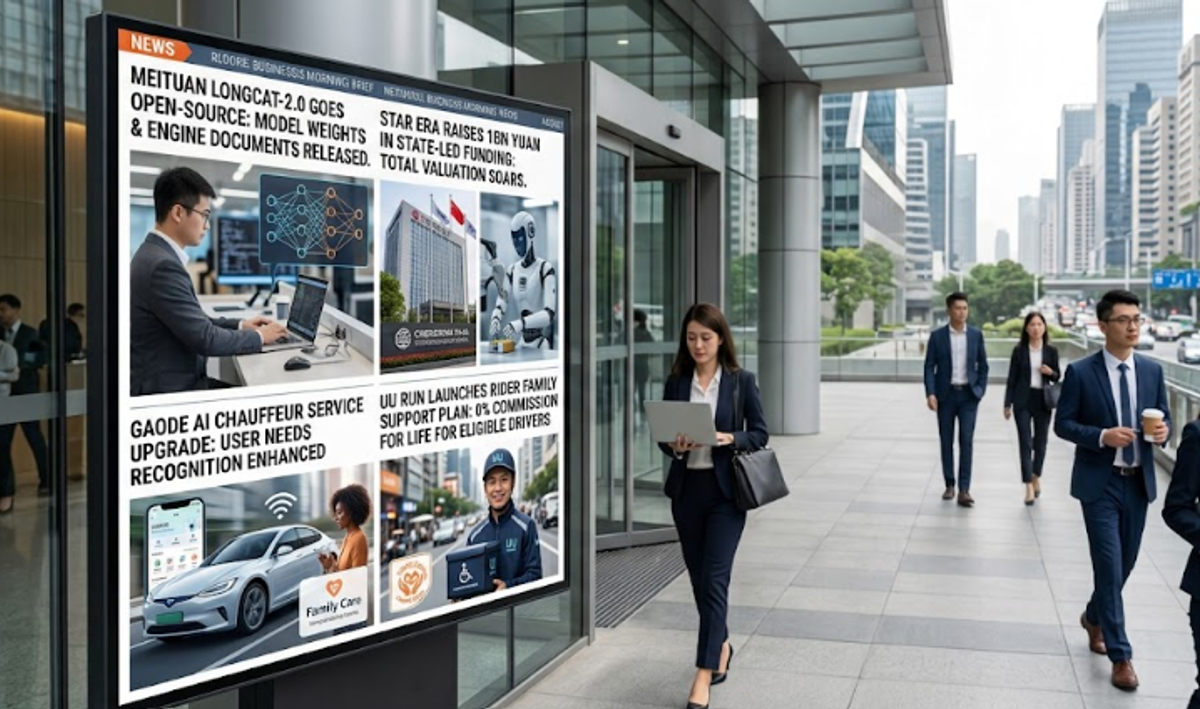
July 6, 2026, was a full news day. Meituan officially released the Meituan LongCat 2.0 open-source trillion-parameter model - full weights, inference engine, and technical documentation all dropped at once. Three domestic chip manufacturers confirmed same-day inference adaptation. Star Era announced a 1 billion yuan financing round backed by state capital. Gaode upgraded its AI ride-hailing service. And UU Run launched a lifetime zero-commission program for riders with disabilities and families in financial hardship.
China's open-source AI keeps accelerating. Here's what actually happened, and why it matters.
Inside the Meituan LongCat 2.0 Open Source Trillion Parameter Model Release
Most open-source model releases give you weights. Meituan gave you the inference engine too.
The full release includes model weights, the inference runtime, and detailed technical documentation - all public on the same day. That combination is rarer than it sounds. Most companies share the weights but protect the serving infrastructure. Releasing both signals a different kind of intent.
LongCat 2.0 is built on a sparse Mixture-of-Experts (MoE) architecture. Its LongCat Sparse Attention (LSA) mechanism is where it pulls ahead on long-context benchmarks, outperforming comparable models on multi-step reasoning without the usual compute overhead. The model also uses Zero Compute Experts - a design where certain expert modules are bypassed entirely when they're not contributing to the output. That's how it keeps inference costs manageable at trillion-parameter scale. Training used a variant of the MOPD (Multi-Teacher On-Policy Distillation) pipeline, pulling from multiple specialized teacher models.
Why open source at all? It turns Meituan's AI infrastructure investment into something different: ecosystem influence. If LongCat 2.0 becomes a reference standard for long-context MoE models in China, that's a form of ROI that no single product metric captures. Chinese AI companies reshaping competition globally have figured this out. It's the same playbook the Zhipu AI GLM-5-2 model launch used to build developer mindshare - different model family, same logic.
Why Domestic Chip Makers All Validated the LongCat 2.0 Open Source Model on Day One
Huawei Ascend completed inference adaptation for the model on July 6 - the same day as launch. Moore Threads followed with full validation across its MUSA software stack. Muxi Technology, one of the newer entrants in domestic AI compute, also confirmed support.
Three separate chip ecosystems. One launch day. That's not organic.
It signals months of parallel pre-launch coordination. For anyone tracking China's domestic supercomputing stack, this confirms the hardware ecosystem is now mature enough to run production-grade, simultaneous launches across multiple manufacturers. Chinese AI chips 3D stacking advances and commercial deals like the Tianshu GPU chips deal with ByteDance are part of the same underlying trend.
The semiconductor access strategy isn't working as designed.
Star Era's 1 Billion Yuan Round: When State Capital Repositions an Industry
Xingdong Jiyuan (Star Era) closed 1 billion yuan in new financing on July 6, led by China Chengtong Fund - a state-owned capital operation entity under the State Council's SASAC. Other participants included Jiangxi State-owned Assets Control, Guoyuan Equity, Chongqing Yufu Zhongxin Fund, and Hangzhou Capital. Total raised over two months: 2.5 billion yuan.
Star Era has direct lineage from Tsinghua University's robotics research teams - one of those cases where the academic pedigree is actually meaningful, not just a slide in the deck. Their XHAND product line features fully direct-drive dexterous hands with dense sensor arrays, which puts them in a small group of companies working at that level of manipulation precision. The company has also established real product-market fit in automated logistics center deployments, which gives the hardware operational context beyond lab demos.
But the composition of this round says more than the amount. When China Chengtong leads, it's a positioning signal: humanoid robotics is being reclassified from "VC-backed tech vision" to national strategic infrastructure. Physical AI solutions for business are now funded at infrastructure pace, not experiment pace. The Wuhan AI agent investment plan and similar regional government programs are reading from the same policy playbook. The 2.5 billion yuan in two months reflects both that priority and how quickly valuations compress when a sector gets designated as strategic.
Gaode's AI Ride-Hailing Upgrade: Better Interface, Unproven Matching
Gaode completed a capability upgrade to its AI Ride-Hailing Butler. Users can now describe travel needs in natural language - "I need a car big enough for two suitcases, and I'm traveling with a child" - and the system will parse the request, identify key requirements, and match a relevant service.
It's a better interface. Whether it's better matching is a separate question.
The direction matters, though. AI agent competition in China is pushing every major consumer platform toward natural language as the primary UI, and ride-hailing is a logical early test case. Standardized service is slowly becoming personalized service. Whether Gaode's matching quality actually delivers on the interface promise isn't something you can evaluate from a launch announcement - that's a product review question.
UU Run's Lifetime Zero Commission: Solidarity, Strategy, or Both?
UU Run announced the "Rider Family Support Program" targeting riders with disabilities, families dealing with serious illness, and riders with children who have autism or cerebral palsy. Once approved, they pay 0% commission permanently. All order revenue goes directly to the rider.
And riders from other delivery platforms can qualify after switching over. That's the part worth watching.
It's either genuine industry solidarity or one of the more creative rider acquisition plays anyone has run. Probably both. For context: Meituan has paid occupational injury insurance premiums for over ten million riders as part of its broader worker protection push. The China 618 shopping festival AI surge earlier this year showed how acute financial pressure gets during high-volume periods - UU Run's program addresses the chronic, structural version of that vulnerability instead.
Will other platforms follow? Genuinely uncertain. The lifetime nature of the commitment carries real financial weight. But the China AI sector’s explosive growth story is inseparable from the labor story, and how platforms treat workers shapes their international narrative - something that open source AI adoption in Africa and other emerging markets increasingly reinforces.
What These Four Stories Actually Point To
The Meituan LongCat 2.0 open source trillion parameter model is the headline - but the day-one domestic chip coordination is the detail worth holding onto. Huawei Ascend, Moore Threads, and Muxi Technology all validated simultaneously at launch. That's months of parallel pre-launch infrastructure work made visible in a single day. Ecosystem maturity doesn't announce itself; it just shows up.
Star Era's 2.5 billion yuan in two months isn't just momentum. It's a reclassification event - embodied intelligence as strategic national industry, not a venture experiment. Gaode's upgrade is incremental but directional. And UU Run's zero-commission commitment, whatever the motive, sets a visible floor for what rider protection can look like when a platform actually commits to it structurally.
The Meituan LongCat 2.0 open-source model release, the capital flows into robotics, and the labor policy moves are separate stories. But they're all pulling in the same direction.
The pace isn't slowing down.