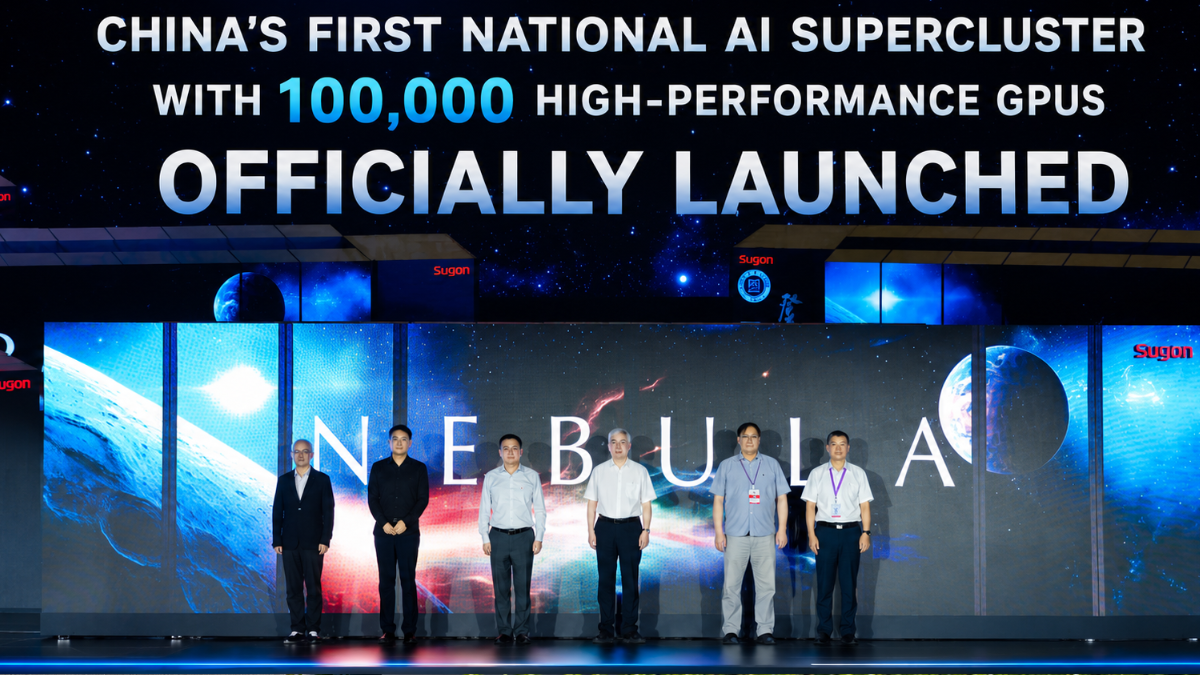
On July 10, 2026, during the Photosynthesis Organization 2026 Intelligent Computing Application Conference, Sugon announced the official completion of the Sugon 8000 Dengfeng 100000-card AI supercluster China launch - connected it live to China's National Supercomputing Internet - and the global AI infrastructure conversation shifted.
Every major component - compute, networking, storage - is domestic. That's the line that matters here.
Why China's 100,000-Card AI Supercluster Level Isn't Just a Bigger Number
Scaling from 10,000 cards to 100,000 sounds like multiplication. It isn't.
At the larger scale, network latency compounds across the fabric in ways smaller systems never stress-test. Memory access efficiency degrades under concurrent high-precision load. Cooling density hits hard physical limits. And if your software ecosystem can't hold under pressure (which, if you've watched domestic cluster deployments before, is exactly where things tend to break), performance collapses fast.
So the Sugon 8000 Dengfeng 100000 card AI supercluster China launch is meaningful precisely because it holds together at a scale that actually matters. Training trillion-parameter foundation models - MoE architectures especially - requires sustained high-precision compute that simply isn't achievable at smaller cluster sizes. The Chinese Premier AI clusters meeting earlier this year flagged this as a national priority. Dengfeng is the first hardware delivery on that commitment.
And as Chinese AI companies’ global competition with Western players sharpens, having replicable domestic infrastructure at this scale changes the strategic picture considerably.
The "Super Intelligent Fusion" Technology Route
Most large clusters still partition scientific computing and AI workloads into separate hardware domains. Dengfeng doesn't do that.
The system uses what Sugon calls the "super intelligent fusion" technology route - native integrated fusion of all compute types in one architecture. One fabric. One memory hierarchy. No partitioning. The result is full precision support from FP64 to INT8, which means the same cluster handles protein folding simulations at high precision and large model inference at high throughput without architectural compromise. You don't have to choose one or the other.
The Hygon processor provides the foundational computing power infrastructure. And - importantly for anyone tracking vendor strategy - Dengfeng uses an open AI computing architecture that supports multiple domestic accelerator brands, not just Hygon tokens. That's deliberate. Single-vendor ecosystem lock-in is exactly what this design avoids. The heterogeneous computing platform work happening across the domestic stack gives useful context on how multi-vendor architectures are being standardized here. For where domestic GPU supply is heading specifically, the Tianshu Zhixin GPU chip deal with ByteDance is a concrete example of how that ecosystem's evolving.
Network, Storage, and Cooling: Where Clusters Actually Win or Fail
Honestly, compute cards get all the press. But at 100,000-card scale, the network and storage underneath are where clusters live or fail.
Dengfeng runs scaleFabric, RDMA high-speed native networking hardware. RDMA (Remote Direct Memory Access) lets accelerators communicate directly without routing traffic through the CPU, removing what's typically the most persistent latency barrier in domestic clusters. The scaleFabric architectures are purpose-built for domestic hardware, not retroactively adapted from foreign networking stacks. That difference matters under high-concurrency load.
On storage, ParaStor parallel distributed storage handles the I/O layer. ParaStor metrics have landed the system on the global IO500 production list - the recognized benchmark for real-world parallel I/O performance in actual production environments, not a controlled lab result.
The memory supply layer matters too. The CXMT Tencent DRAM supply deal - a $2.94 billion agreement - shows how seriously the memory infrastructure side is being invested in alongside compute. Thermal density at this scale requires megawatt-level per-rack liquid cooling technology, and China's first green AI data center goes into how energy efficiency is being addressed as density climbs. Advances in domestic AI chip 3D stacking technology feed into the silicon layer beneath all of this - worth reading if you're trying to understand the full depth of the domestic supply chain.
What's Actually Running on the 100,000-Card Dengfeng Cluster
Over 300 super-intelligent fusion application optimizations are already complete on the system. More than 20 fields covered. More than 70 of those applications are running at 10,000-card scale under real sustained load.
The specific workloads demonstrated: protein folding simulation, trillion-atom-level water molecule dynamics simulation, and trillion-grid turbulence simulation. These aren't synthetic benchmarks. They're the exact workloads that used to require scheduling access to U.S. or European supercomputer time.
For broader context on China's supercomputing trajectory, China's Lingsheng supercomputer recently topped the Top500 global rankings, and the Lingcheng supercomputer architecture behind that result offers technical parallels worth understanding. Dengfeng sits in the same trajectory - built for AI-first, application-centered production use rather than pure benchmarking.
From Demonstration to Replication
During the same conference, Sugon signed a strategic cooperation agreement with the Beijing Institute of Intelligent Science (BAAI) to build a second 100,000-card super-intelligent fusion computing system.
That phrase is worth holding onto: "from demonstration to replication." It means the technology has crossed from proving a concept to deploying infrastructure at scale. Not a pilot. Standard infrastructure.
China’s AI sector’s explosive growth is putting sustained pressure on AI compute supply, and new distributed nodes like the Beijing space computing center are expanding the national infrastructure layer in parallel.
The Sugon 8000 Dengfeng 100000 card AI supercluster China launch is live. It's running real production workloads at scale. And a second system is already in development. If you're tracking China's AI infrastructure build-out from chips to systems to applications, this is where the decade-long investment starts compounding into something you can point to.