Summary
If you operate in the digital platform ecosystem, you must pay attention to a legal earthquake out of Santa Fe. A New Mexico state court has issued the historic Meta $567 million New Mexico teen mental health ruling, ordering the social media giant to fund a massive youth recovery program and fundamentally reconstruct how its platforms function for young users. First District Judge Bryan Biedscheid ruled that Meta’s platform design created a public nuisance by addicting minors and failing to prevent exploitation.
This decision caps off a multi-phase legal battle led by New Mexico Attorney General Raúl Torrez. When you combine this $567 million safety-fund decree with the prior $375 million consumer-protection damages verdict, Meta faces a staggering $942 million in total liability in New Mexico alone. While Meta plans to appeal the decision, arguing that it misrepresents their safety record, this ruling establishes a radical blueprint. For the next five years, Meta must restrict teen notifications, enforce monthly screen time caps, and limit adult-minor messaging vectors. Your understanding of platform liability, design ethics, and product engineering will never be the same. And fast.
Introduction & Core News Development
When you look closely at Judge Bryan Biedscheid’s decision in Santa Fe, you realize it represents a watershed moment in corporate accountability. The court didn't just slap Meta with a massive bill; it bypassed traditional product liability limits by applying the legal concept of "public nuisance" directly to software engineering. Under this five-year court order, Meta has to pay $567 million to establish a state-controlled youth mental health fund. Few saw this coming.
This massive financial penalty is only half of your concern if you're analyzing the company's future. The ruling forces Meta to implement an aggressive, highly specific set of operational modifications for minors in New Mexico. You're going to watch Meta struggle to enforce monthly limits on teen usage for Instagram and Facebook, silence push notifications during late-night hours, and implement highly restrictive controls on adult-to-minor interactions.
Meta’s legal team immediately announced its intention to appeal the ruling. They assert that the company has spent years building over fifty tools to keep families safe, claiming the court's decision relies on a distorted view of the facts. Yet, the immediate reality remains clear: a single state court has successfully asserted the power to dictate the engineering parameters of global social networks.
Background & Industry Context
To understand how we arrived at this point, you've to look back at the dual-phase structure of New Mexico’s litigation. In March, a state jury concluded the first phase by finding Meta liable for violating consumer protection laws. That jury found that Meta actively misled the public about the safety of its applications, resulting in a $375 million for consumer-protection damages verdict.
Instead of settling, Meta pushed into the second phase. That focused entirely on whether the company’s platform architecture constituted a public nuisance. Public nuisance laws historically targeted physical issues like toxic waste dumps, chemical spills, or illegal crack houses. Lately, creative prosecutors have expanded this doctrine to target opioid manufacturers, gun makers, and now, social media algorithms. Hardly.
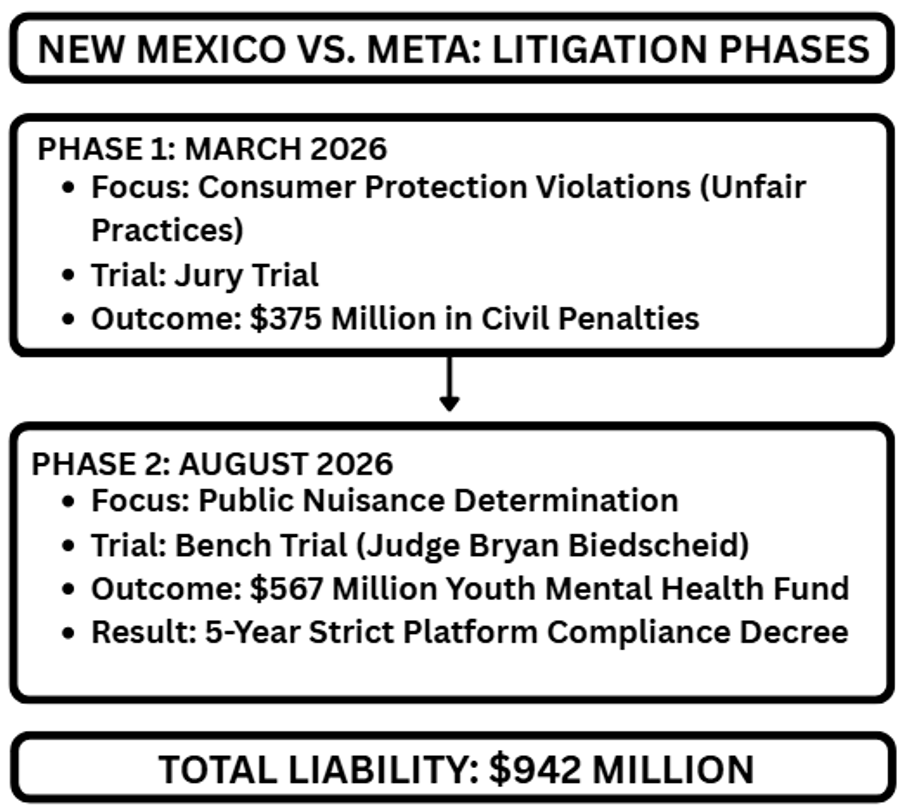
New Mexico's legal action against Meta concluded in two major phases, resulting in $942 million in total financial obligations, including civil penalties, funding for youth mental health initiatives, and a five-year compliance agreement.
You're seeing this strategy succeed just as a massive lawsuit wave crashes over Big Tech. Dozens of states, school districts, and municipal governments have filed parallel complaints. New Mexico Attorney General Raúl Torrez has set a dangerous precedent for Meta, demonstrating that state courts can bypass federal gridlock to extract massive payouts and force product redesigns.
Technical Breakdown & Architecture
If you're a software developer or product manager, you should study the specific technical mandates imposed by this five-year decree. The court's order targets the core engagement loops that drive modern social media. To comply, Meta has to re-engineer its notification engines, recommendation algorithms, and communication protocols for users under 18 in New Mexico.
First, look at the implementation of monthly usage limits. Tracking and capping active user sessions on a state-by-state level introduces immense geofencing and identity verification hurdles. If a teen uses a Virtual Private Network (VPN) or falsifies their age, Meta's systems must detect and stop them, or risk violating the court order. Here’s why.
Second, the decree requires strict safeguards for AI chatbots. When you integrate conversational AI into social platforms, you open up unpredictable interaction vectors. The court demands that Meta build guardrails to prevent these agents from delivering harmful, addictive, or suggestive prompts to minors.
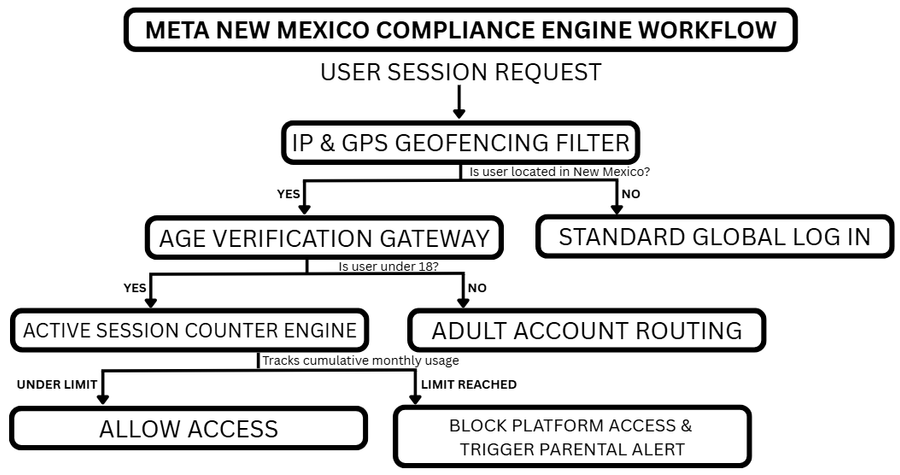
Illustration of Meta's proposed New Mexico compliance workflow, showing location checks, age verification, session tracking for minors, and automated parental notifications designed to enforce court-ordered youth safety measures.
Third, the platform must completely overhaul how it screens direct communication. Meta is required to implement tighter restrictions on adult-minor contact to protect children from sexual exploitation. That means upgrading automated detection pipelines to flag suspicious patterns, block unsolicited messages from unknown adults, and streamline how reports are sent to law enforcement. Case in point.
Business Impact & Strategic Implications
For Meta's executive team, this ruling represents an existential threat to its monetization model. If you analyze Meta's revenue streams, you know they rely on maximizing Daily Active Users (DAUs) and session duration. By forcing the platform to limit notifications and restrict usage hours, the court is directly depressing the ad inventory Meta can sell. No doubt about it.
The financial penalty of $567 million, when added to the prior $375 million consumer protection damages verdict, represents a $942 million hit. While Meta sits on a massive cash reserve, the real danger is the precedent. If other states replicate this public nuisance framework, Meta's legal liabilities could easily scale into tens of billions of dollars.
You also have to consider the internal engineering drag. When your developers are constantly forced to build regional safety overrides, state-specific geofences, and custom reporting pipelines, your core product development slows down. This friction mirrors the challenges detailed in past internal disputes, such as the Meta employees lawsuit, highlighting how legal compliance demands can strain engineering resources.
Industry Perspective & Ecosystem Dynamics
You should view this ruling as a massive escalation in the broader conflict between state regulators and social media companies. Historically, platforms shielded themselves under Section 230 of the Communications Decency Act. That protects online services from being held liable for third-party content. But Attorney General Raúl Torrez bypassed Section 230 by focusing on the platform’s features, its addictive design elements and algorithmic recommendations, rather than the content itself.
This design-centric legal approach is gaining traction. If you monitor other regional cases, like the ongoing Instagram youth mental health lawsuit led by Tennessee and dozens of other states, you see a coordinated effort to break Big Tech's legal shields. That’s just the start.
On an international level, this mirrors aggressive regulatory campaigns like China's minor online protection initiatives. That strictly limit gaming and app usage times for youth. The difference here's that a single local judge, rather than a centralized national government, is driving the enforcement. This decentralized regulation complicates the global governance of artificial intelligence and platform safety, creating a patchwork of compliance requirements.
GlobalByte Perspective
If you analyze this ruling objectively, you must confront an uncomfortable truth: the judicial system is stepping in to perform the job that legislative bodies have failed to do. You can see that Congress has remained gridlocked on national privacy and youth safety standards for over a decade. In this regulatory vacuum, state attorneys general and local judges are using the bluntest legal tools available to force change.
Using the "public nuisance" doctrine to regulate app design is a highly controversial strategy. You've got to wonder where the line will be drawn. If a judge can declare Instagram's notification system a public nuisance, what stops another court from declaring video games, streaming services, or even e-commerce apps public nuisances due to their persuasive design elements?
Your primary takeaway should be that the era of self-regulation for social media platforms is officially over. Whether Meta wins its appeal or not, the blueprints for dismantling their engagement loops have been drafted and tested in open court. If you're building consumer-facing software today, you must treat user retention and engagement metrics not just as business wins, but as potential legal liabilities. Mind you, it wasn’t always this simple.
Future Outlook & Strategic Roadmap
What happens next? You can expect a protracted legal battle as Meta takes this ruling to the New Mexico Court of Appeals and, if necessary, the state Supreme Court. Meta's legal strategy will likely focus on arguing that the public nuisance doctrine was improperly applied to software, and that the First Amendment protects its editorial rights to organize and display information. And fast.
During this appeal process, the actual implementation of the safety features will likely be stayed. But if the ruling stands, Meta must begin its five-year compliance period under the watchful eye of a court-appointed monitor.
Meanwhile, this ruling will inject new energy into federal debates over AI safety and platform design. As engineers and advocates voice their concerns over frontier AI risks, the New Mexico decision will serve as a practical example of how courts can enforce algorithmic guardrails. You should prepare for a future where platform design is heavily regulated, and age verification becomes a mandatory feature across the web.