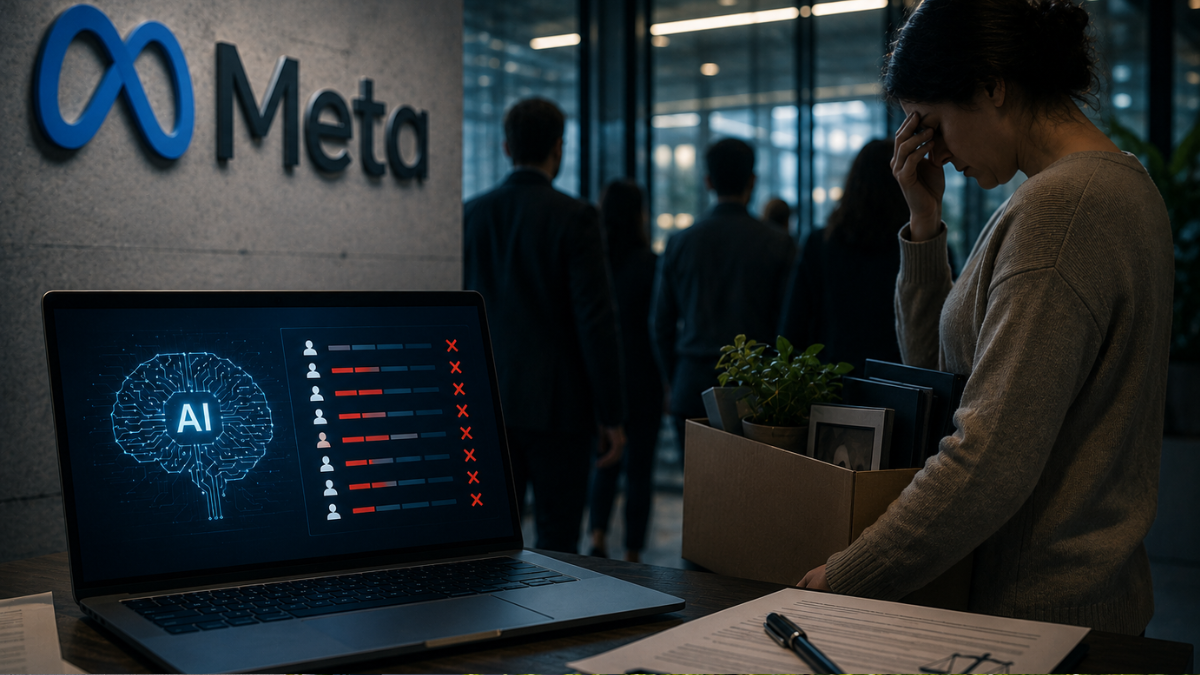
Twenty-six Meta employees have filed a federal lawsuit alleging the company used artificial intelligence to select layoff targets - and that the system disproportionately hit workers on medical, parental, or family leave. The Meta employees’ lawsuit AI algorithm driven layoffs discrimination case is now pending in Oakland federal court, and it's shaping up to be one of the most significant legal tests yet of how companies can - and can't - use automated tools when deciding who goes.
Every one of the 26 plaintiffs took protected leave. Every one requested or received a disability accommodation. And as of the filing date, all 26 still work at Meta - but their separations begin July 22.
You're watching AI-driven workforce changes reshape entire industries right now. This case puts a legal frame around what that actually means for individual workers.
What Meta's AI Selection System Actually Did
Meta announced in May it would cut roughly 8,000 employees - about 10% of its workforce. Standard restructuring language. But the lawsuit, filed in late June 2026, describes something more specific.
According to the complaint, Meta used a layered system of evaluation tools: keystroke monitoring and AI token usage dashboards, performance tracking, browser activity logs, algorithmically generated performance scores, and an internal platform called Meta Checkpoint. These inputs fed into rankings that the lawsuit describes as an "algorithmically assisted selection process" - one that wasn't designed to treat all employees equally.
Here's the built-in problem. Every one of those metrics requires you to be at your desk, actively working. If you're recovering from surgery, managing a disability, or on approved FMLA leave, your output scores are low - not because you underperformed, but because the system wasn't engineered to handle your absence. The lawsuit is blunt about this: those scores "by design, cannot be accumulated by an employee who is on protected medical or family leave, or whose output is reduced by a disability."
Meta apparently didn't pause the algorithm for protected-leave employees. No adjustment step. No leave-neutral review. The numbers went in as-is, the rankings reflected that, and people on leave came out worse.
Who Filed - and One Case That Stands Out
About half the 26 plaintiffs took pregnancy or caregiving leave. Eight are women who took maternity or pregnancy-related leave. Four are men who took parental leave. One woman took leave to care for a family member and then separate bereavement leave. Others took medical leave for conditions that Meta's own leave provider had formally approved.
One plaintiff's situation is particularly hard to explain away. He took leave for a serious, documented health condition. His manager, according to the lawsuit, explicitly warned him that taking that leave would likely result in selection for the upcoming layoffs. He took it anyway. He's now one of the 26 facing termination.
That isn't an algorithm doing something unintended. That's a manager with apparent awareness of how the system worked - and using it to discourage protected behavior. Meta offered no accommodation for his disability, the lawsuit says.
The Disparate Impact Argument - and Why It Still Has Teeth
The legal theory at the center of this case is "disparate impact" - a civil rights doctrine embedded in Title VII of the 1964 Civil Rights Act and reinforced by a landmark 1971 Supreme Court ruling. The principle: a facially neutral policy is still unlawful if it hits a protected class disproportionately, without being necessary for the business.
Here, the argument is specific. Women take pregnancy and caregiving leave at higher rates than men. A system that treats leave-related output gaps as performance deficiencies therefore hits women harder - not by intent, but by structural design. That's a textbook disparate impact claim.
The Trump administration has been trying to pull back on federal enforcement of this doctrine, directing the EEOC to deprioritize these cases. But private plaintiffs can bring disparate impact suits entirely on their own, without EEOC support. California law - where this case is filed - independently prohibits it. Against the backdrop of tightening tech regulations reshaping employer obligations globally, private litigation is simply moving faster than any regulatory framework can.
The lawsuit also cites the FMLA, the Americans with Disabilities Act, the Pregnancy Discrimination Act, and the Pregnant Workers Fairness Act.
A wide net. Deliberately cast.
Meta's Response
Short. The company said the claims "lack merit and are not based on facts," and that "workforce management and organizational decisions were and are made by people, not AI."
That last line will get pressure-tested in court. If Meta's human decision-makers were reviewing AI-generated candidate lists and approving them without running independent leave-neutral audits, the "people not AI" framing gets complicated fast. It's exactly the kind of deployment pattern driving the broader AI trust crisis - companies using automated scoring to do the heavy lifting, then attributing the outcome to human judgment.
Honest AI governance standards would require protected-class impact reviews before any AI-generated list reaches a decision-maker. Whether Meta ran those reviews is a question the court will probably want answered.
What the Plaintiffs Are Actually Asking For
Not a sweeping court victory. One thing: keep them employed while the case goes to arbitration.
The reasoning is clean. Once separations go final, several of the harms become irreversible - employer-subsidized health coverage lost during pregnancy, postpartum recovery, or active medical treatment; unvested equity forfeited; leave rights that expire on a schedule; and, for some employees, immigration consequences that can't be undone with a settlement check paid out months later. The plaintiffs' lawyers framed it plainly: they want to preserve the status quo, nothing more, while the underlying claims get a proper hearing.
Why This Meta Employees Lawsuit AI Algorithm-Driven Layoffs Discrimination Case Matters Beyond One Company
This isn't only about 26 people at one company. It's a stress test for practices that are now standard across tech - and spreading fast into other sectors too.
Companies are using AI in business decisions at every level of the employment lifecycle. Performance dashboards, token tracking, activity monitoring, and algorithmic ranking have become normal HR infrastructure. The pressure from AI competition among tech giants is pushing faster adoption, not slower. But speed doesn't reduce legal exposure - it often compounds it.
Advocates for human-centered AI design have been raising this flag for years. Output-based tracking systems will always penalize workers whose output is interrupted by protected medical or legal events, unless someone specifically engineers around that. That's not an edge case. It's a design choice - and companies making it passively are taking on real liability.
Building trustworthy AI systems in HR contexts means running protected-class audits before the list reaches a manager, not after the lawsuit lands. Compliance is a design requirement, not something you bolt on at the end.
The push for global AI accountability frameworks is gaining real momentum internationally, and AI integration across industries will keep deepening regardless of how this specific case resolves. Policy moves slowly. Lawsuits don't.
So if your organization uses algorithmic scoring, activity monitoring, or automated rankings for workforce decisions, the question the Meta employees lawsuit AI algorithm-driven layoffs discrimination filing forces is direct: does your system account for FMLA leave periods? Has anyone audited it for disparate impact across protected classes? And if a plaintiff's attorney asked for your leave-neutralization documentation tomorrow, what would you hand them?