Summary
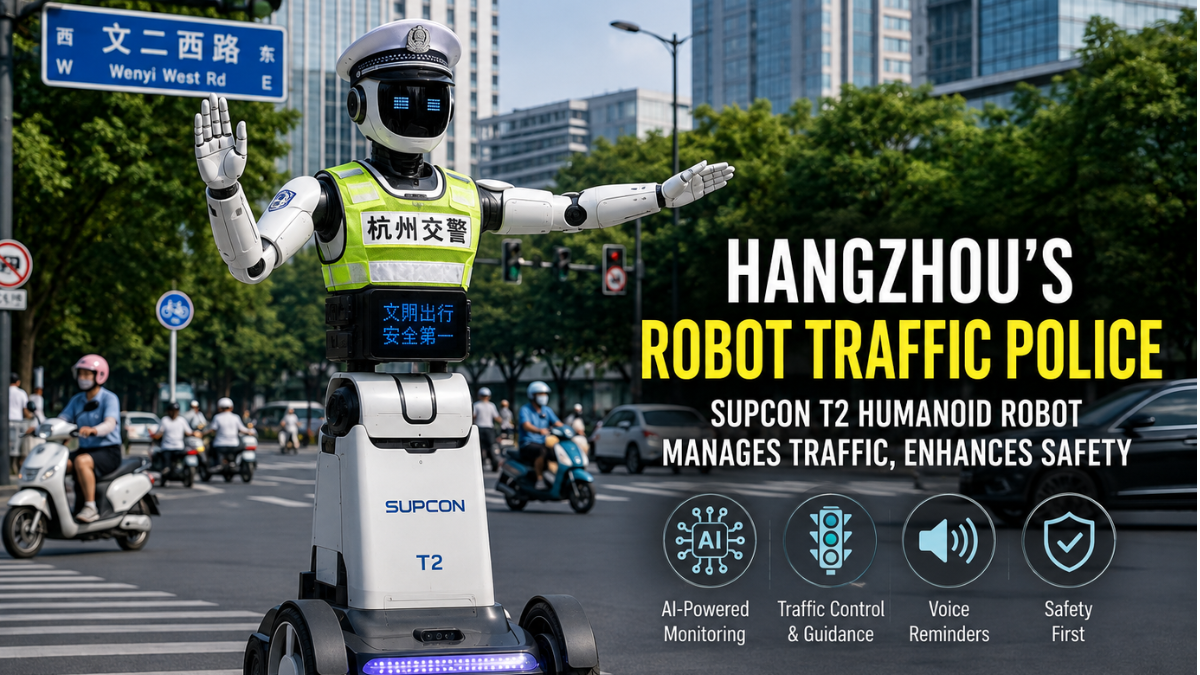
The China humanoid robot traffic police Hangzhou SUPCON T2 project puts a 1.88-metre, 98kg machine at busy intersections to direct vehicles and remind people about traffic rules. It looks futuristic, sure. But it isn't a movie-style RoboCop with arrest powers, weapons, or independent authority to issue fines.
Instead, the robot is designed for the repetitive parts of roadside traffic duty. It spots certain violations, gives polite verbal reminders, answers basic public questions, and copies standard police gestures in time with traffic signals.
That makes it more of a highly visible assistant than a replacement for a human officer.
Key Points
- T2 is an assistant, not a RoboCop: It cannot arrest people or issue fines.
- Real-world deployment matters: The robot is being tested in busy public intersections rather than controlled demonstrations.
- Repetitive work is the opportunity: Warnings, traffic gestures and basic public assistance are tasks robots can potentially handle consistently.
- Human officers remain essential: Judgment, enforcement and emergencies still require people.
- Weather is a serious test: Heat, rain, sunlight and crowded roads can challenge cameras, radar and autonomous systems.
- Scale will reveal the real value: SUPCON's expansion from 15 initial robots toward a much larger fleet will provide a better test of reliability.
- The bigger trend is physical AI: Robots are gradually moving from factories and exhibitions into public infrastructure.
- Privacy could become a major issue: Public-facing robots equipped with cameras and sensors raise questions about data collection and oversight.
- The real metric isn't how futuristic it looks: It's whether the robot can reduce repetitive workload, improve safety and operate reliably at a reasonable cost.
What is the China humanoid robot traffic police Hangzhou SUPCON T2?
Developed by SUPCON Information, the T2 is a wheeled humanoid robot built for outdoor traffic management. Its seven-jointed mechanical arms perform recognised traffic-police signals, synchronised with the junction's lights.
The China humanoid robot traffic police Hangzhou SUPCON T2 pilot began with 15 machines deployed across Hangzhou from May. SUPCON says nearly 50 units now operate in roughly eight cities across three Chinese provinces, with a target of close to 200 traffic-control robots by year-end.
That scale matters. China's robot ID rules could become increasingly relevant as more autonomous machines move from factory floors into public streets, where accountability is far less abstract.
The T2 doesn't just stand there and wave. Cameras, radar, and onboard computing let it monitor several common traffic problems:
- E-bike riders without helmets
- E-bikes carrying passengers
- Cars stopped beyond marked stop lines
- Pedestrians crossing against the signal
- General traffic-flow issues at high-volume junctions
Its public-facing role is deliberately softer than enforcement. A rider may hear a warning. A confused visitor can ask for directions, parking guidance, or information about traffic rules. And, if there is an emergency, the system can connect someone to local police.
How SUPCON's T2 handles real traffic duty
The SUPCON Information T2 robot traffic control specs are more practical than flashy. The robot weighs 98kg, stands 6 feet 2 inches tall, and operates autonomously from 7 a.m. to 6 p.m. It moves between pre-set positions without direct remote control, while a central platform allows police teams to monitor and dispatch units.
That schedule answers a common question: What hours do SUPCON traffic robots operate autonomously? In the current model, they work daytime shifts rather than patrolling around the clock.
SUPCON says the T2 has been tested for thousands of hours in school zones, tourist spots, business districts, rush-hour traffic, rain, and heat. Still, its sensors aren't magic. Strong sunlight, heavy rain, and temperature extremes can affect camera and radar performance.
The company reports recognition accuracy above 95%. That figure is useful context, not independent proof. Hangzhou traffic police did not comment on the deployment figures, so the performance claims should be treated as company-reported results.
China humanoid robot traffic police officers in Hangzhou focus on warnings
Can China's robotic traffic police arrest people or issue fines?
No. The robots do not have arrest powers, and their main function is to give verbal reminders rather than impose formal penalties.
That restraint is intentional. The China robocops direct traffic helmetless ebike warning approach aims to correct behaviour at the moment it happens. You forgot your helmet, the robot notices, and you get a reminder before rolling away. Simple. Effective. Less confrontational than a ticket.
SUPCON says its robots issued more than 170,000 warnings and helped cut monthly helmetless riding and stop-line violations by more than 40%. The Hangzhou robot traffic police pilot violation reduction claim has not been independently verified, but it points to the metric city officials will care about most: whether reminders change repeat behaviour.
The machines may also free officers from long hours spent repeating the same gestures at hot, wet, or congested junctions. Humanoid robocops handle extreme heat and rain while monitoring rush hour traffic in China, at least in theory, while human teams handle judgment-heavy incidents, disputes, and enforcement.
Why Hangzhou is a natural testing ground
Hangzhou has become a visible home for applied AI projects, not just polished demos. You can see that broader context in Hangzhou's AI innovation scene, where local companies are pushing AI into ordinary commercial and civic work.
The T2 also fits a wider China Smart City AI traffic enforcement Hangzhou strategy: collect data at the edge, respond quickly, and use central teams for supervision. That same logic sits behind smart-city edge AI.
China's robotics sector is moving quickly beyond showroom greeters. Unitree's public robot push, Zhiyuan's mass-produced robots, and MIIT humanoid data plans all reflect the same shift.
The challenge is turning a capable machine into something residents actually trust at a crossing.
Can China export police robots?
Chery-backed AiMOGA thinks so. The Chery AiMOGA police robot overseas export compliance question is especially relevant in the Middle East and Southeast Asia, where roadside officers can face punishing heat or persistent rain.
But exporting a police-adjacent robot is harder than exporting a vehicle. Humanoid police robots Middle East Southeast Asia export plans would need to account for local certifications, laws, police IT systems, language, public acceptance, and data-protection rules.
The biggest hurdles are privacy and integration. Cameras and sensors collect information in public spaces, so data privacy and law enforcement IT integration pose hurdles for Chinese robocop exports. A robot cannot simply arrive in another country and plug into a local enforcement network.
That said, interest in physical AI for business, embodied AI investment, and wider robotics manufacturing signals suggests the market won't stay limited to one use case. Even the broader robot and EV ecosystem is feeding that momentum.
A traffic assistant, not a law-enforcement replacement
China's humanoid traffic robots are useful because they target a narrow job: consistent, visible reminders and traffic gestures during long roadside shifts. The SUPCON T2 robot price autonomous traffic management equation will ultimately depend on maintenance costs, sensor reliability, staffing savings, and whether public behaviour actually improves over time.
For now, the T2 is not policing on its own. It is a machine that watches, gestures, speaks, and alerts people. Human officers remain responsible for judgment, enforcement, and the situations that don't fit neatly into a sensor's view.
GlobalByte Perspective
China’s use of the SUPCON T2 humanoid robot at traffic intersections is interesting not because it looks like a police officer, but because it shows where robotics is actually becoming useful: small, repetitive jobs that humans have to perform every day.
The T2 is not replacing traffic police, and that distinction is important. Its job is to watch, warn, guide and communicate while human officers remain responsible for enforcement and difficult situations. That makes the deployment more practical than the usual humanoid-robot demonstrations built around dancing, walking or lifting objects.
What stands out is the attempt to put these machines into real public environments, where weather, crowds, vehicles and unpredictable behaviour create conditions that are much harder than a controlled factory floor. If the reported reduction in traffic violations holds up over longer periods, the technology could have a genuine role in smart-city operations.
But the bigger test is still ahead. A robot can perform a traffic gesture reliably; proving that it can operate safely, cheaply and consistently across different cities is another matter. Privacy, sensor reliability, maintenance and public acceptance will become increasingly important as these machines move closer to everyday life.
For GlobalByte News, the T2 is best viewed as an early experiment in practical physical AI, not a robotic replacement for police officers.