Summary
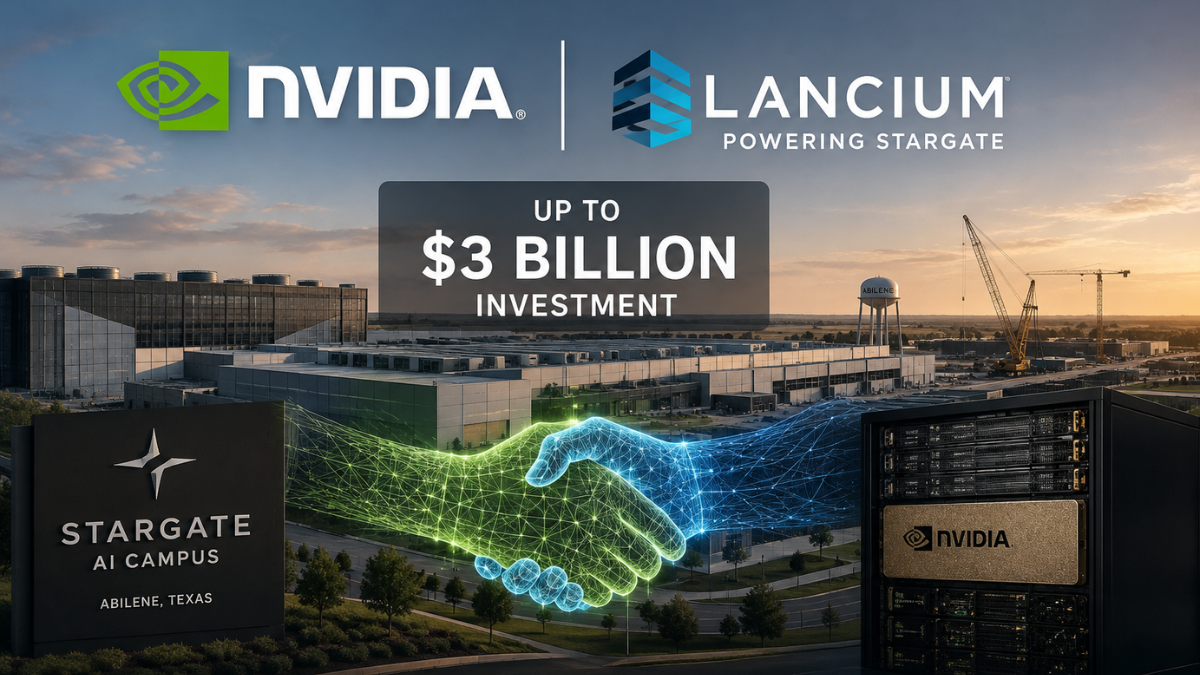
If you monitor the global race for artificial intelligence dominance, you'll see a massive shift from chip design to physical grid control. Nvidia is committing up to $3 billion in power developer Lancium, the engine behind the massive Stargate infrastructure initiative. You should watch this deal closely: Nvidia is securing an initial 20% stake for $2 billion, with an additional $1 billion tied to critical milestones like power grid hookups. This capital injection values the Blackstone-backed Lancium at a striking $10 billion enterprise valuation. Your strategic focus must shift toward Abilene, Texas, where Lancium's 1,000-acre Clean Campus serves as the foundational site for Stargate, a colossal $500 billion joint venture involving SoftBank, OpenAI, and Oracle. As you assess the next phase of cloud computing, this transaction signals that silicon leadership is no longer enough; you must secure the physical electricity to run it. This capital also positions Lancium for a planned initial public offering in 2027, rewriting your long-term calculations for AI scaling.
Introduction & Core News Development
When you analyze how hardware giants defend their market share, you usually look at software ecosystems like CUDA or architectural leaps in silicon design. But Nvidia's latest decision to directly fund its own supply chain energy requirements changes the game entirely. By committing up to $3 billion to Lancium, Nvidia is stepping directly into the business of energy generation and transmission.
You'll see the deal structure is highly tactical. Nvidia is laying down $2 billion upfront to claim a 20% equity stake in the Blackstone-backed power specialist. The remaining $1 billion isn't guaranteed; it's a performance-based incentive that depends on Lancium meeting strict operational benchmarks, particularly securing physical high-voltage grid connections. Under this deal, Lancium's portfolio of land, substation approvals, and grid access agreements carries an implied enterprise value of $10 billion.
For your enterprise, that means Nvidia isn't just selling GPUs anymore. They're actively building the physical environments where those chips will live. If you've struggled with chip delivery wait times or high hosting fees, you'll understand that the bottleneck has shifted from manufacturing silicon to plugging that silicon into an electrical socket. And fast.
Background & Industry Context
To understand why this is happening now, you've to look at the severe power crunch facing modern cloud computing. Over the past year, your engineering teams have likely run into power limitations when trying to lease space in traditional data hubs like Northern Virginia or Silicon Valley. So operators have been forced to look elsewhere, making a data center campus in Texas the new frontline for large-scale deployments.
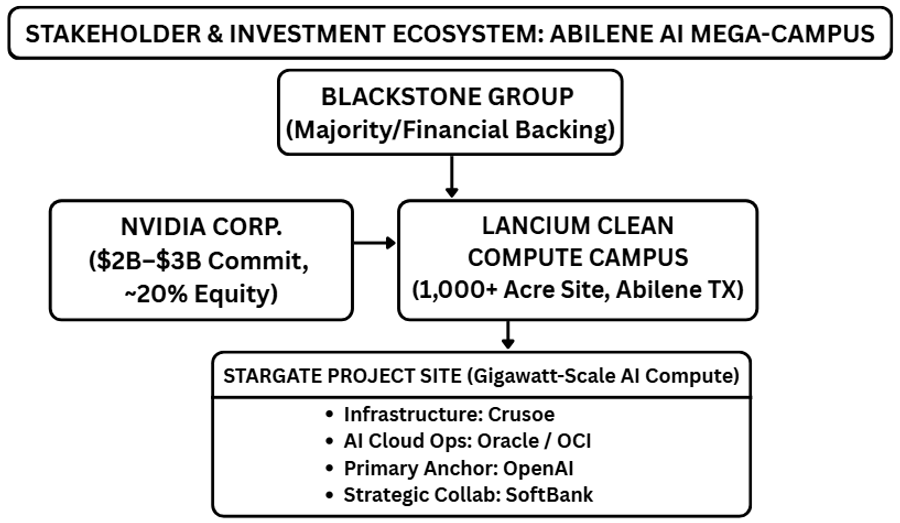
The Abilene AI mega-campus brings together Nvidia, Blackstone, Lancium, OpenAI, Oracle, SoftBank, and Crusoe to build one of the largest AI infrastructure projects in the U.S., supporting next-generation data centers and large-scale AI computing.
Lancium has quietly acquired vast tracts of land and secured vital grid interconnection rights in West Texas, a region known for abundant wind and solar energy. Their crown jewel is the 1,000-acre Lancium Clean Campus in Abilene. This facility isn't just another server warehouse; it's the official starting point for the Stargate project.
If the name Stargate sounds familiar, you'll recall its dramatic announcement earlier this year. Backed by a public-private push under the Trump administration's $500 billion infrastructure initiative, Stargate brings together SoftBank, OpenAI, and Oracle. It's an alliance designed to build rare computing clusters. By anchoring this project in Abilene, Lancium has positioned itself as the gatekeeper of the physical energy these tech giants desperately need.
Technical Breakdown & Architecture
When you look under the hood of a modern AI facility, you quickly realize that power distribution is a massive engineering challenge. You aren't just dealing with standard server racks; you're managing high-density hardware deployments that require up to 100 kilowatts per rack.
This reality explains why Nvidia is focusing so heavily on "grid hookups" as a condition for its final $1 billion investment. To make these systems work, you need high-voltage substations that can step down electricity from main transmission lines directly to the server floor with minimal energy loss. Lancium's technical edge lies in its proprietary power orchestration software and its proximity to the ERCOT (Electric Reliability Council of Texas) grid.
By choosing West Texas, you can tap into cheap, stranded renewable energy that would otherwise go to waste due to transmission bottlenecks. Lancium's system acts as a giant shock absorber for the grid. It scales power consumption up and down in real-time based on grid stress and electricity prices.
This setup is perfect for training runs. While training large language models requires steady, reliable power infrastructure, you can run non-urgent batch jobs during peak renewable generation hours to cut costs. By building these advanced control systems directly into the Abilene campus, Lancium is creating a model for how future green data centers must operate to avoid crashing local grids.
Business Impact & Strategic Implications
If your firm is trying to figure out where to invest next, you should pay close attention to Lancium's skyrocketing valuation. This $10 billion enterprise valuation shows that raw power capacity is now just as valuable as software IP. With Blackstone providing major financial backing and Nvidia taking a direct 20% stake, Lancium has the cash and the strategic support to scale rapidly.
This partnership also sets up a clear path for Lancium's planned initial public offering in 2027. For your investment timeline, that means we're entering an era where energy infrastructure companies will be priced like high-growth tech stocks.
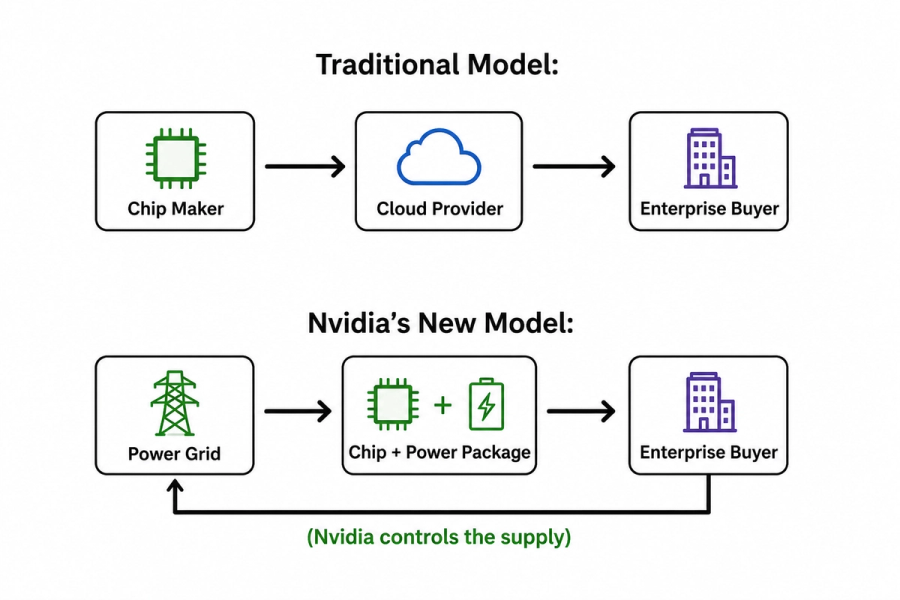
Nvidia is also gaining massive strategic use here. By owning a fifth of the company that controls the Stargate project's power supply, Nvidia can ensure its own next-generation chips are prioritized for installation. If you're a competitor trying to buy server space on the Stargate campus, you'll likely have to play by Nvidia's rules and use their hardware.
Industry Perspective & Ecosystem Dynamics
When you step back and look at the broader market, you'll see this deal alters the balance of power among hyperscalers. SoftBank, OpenAI, and Oracle joined forces on Stargate to build an alternative to Microsoft and Google's dominant clouds. By securing Lancium's land and power assets, they've locked down the physical foundation needed to build their massive infrastructure for artificial intelligence.
This move also signals a major shift in how the US government views technology and national security. The federal support for a $500 billion infrastructure initiative shows that keeping AI development on US soil is a top priority.
For your long-term planning, you must expect tighter regulations around data center energy use. You'll likely see state and federal officials push operators toward self-sustaining clean energy campuses like Abilene to protect residential power grids from blackouts. Few saw this coming.
GlobalByte Perspective
If you're looking at this deal as just another corporate investment, you're missing the bigger picture. You must realize that Nvidia is running a brilliant defensive playbook. They know their dominant market share in GPUs won't last forever, as rivals like AMD and custom silicon from cloud providers will eventually close the performance gap.
By locking up the power grid, Nvidia is making sure that even if a competitor builds a faster chip, they won't have the electricity to run it. Your enterprise needs to understand this shift: the ultimate limiting factor for AI is no longer the speed of the chip, but the availability of the megawatt. Hardly.
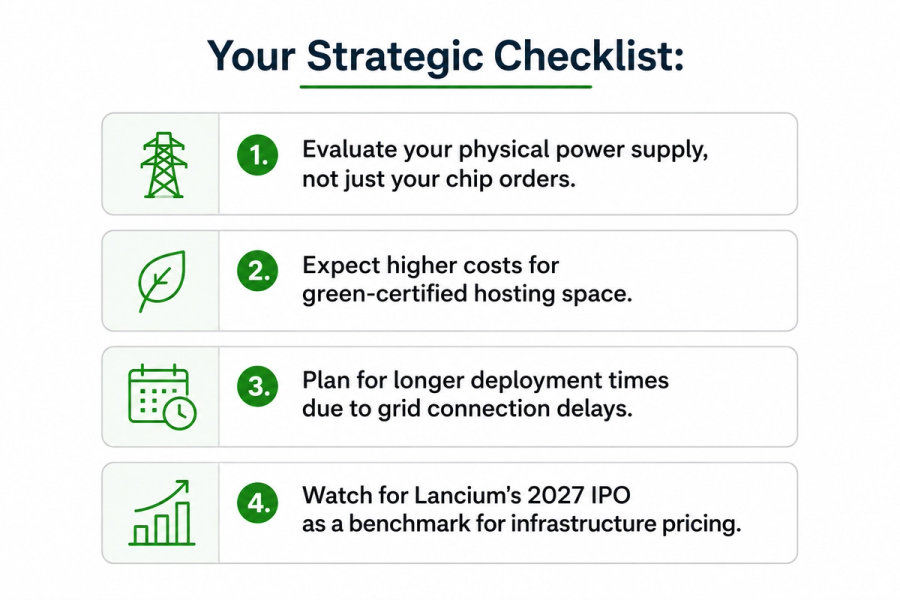
This strategy also comes with real risks. If you track Lancium's milestones, you'll see that getting high-voltage lines approved and built in Texas is notoriously slow and complicated. If grid operators fail to deliver these hookups on time, Nvidia's extra $1 billion won't pay out, and the Stargate project could face major delays. You should keep a close eye on these infrastructure bottlenecks, as they'll dictate the pace of AI development for years to come.
Future Outlook & Strategic Roadmap
Next, you should expect Lancium to move quickly to meet Nvidia's performance milestones. They'll need to secure their grid connections and break ground on new server facilities in Abilene to unlock that final $1 billion in capital.
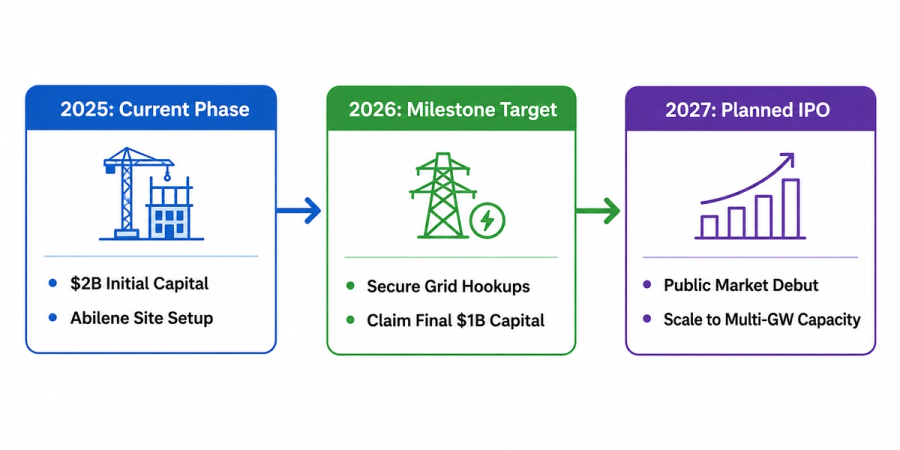
You should also watch for other tech giants to follow Nvidia's lead. It won't be surprising if Microsoft, Amazon, or Google start buying up stakes in energy developers to protect their own supply chains. Here’s why.
Between now and Lancium's planned IPO in 2027, the focus will be on execution. If you're building products or investing in this space, your success will depend on how quickly these physical facilities can scale. The companies that secure their power supply today are the ones that will lead the market tomorrow.