Summary
Alibaba sells Lingxi Games Trustar Capital 2 billion deal is more than a routine ownership change. It signals where one of China’s biggest tech groups wants to put its money next: artificial intelligence and cloud computing, not mobile games.
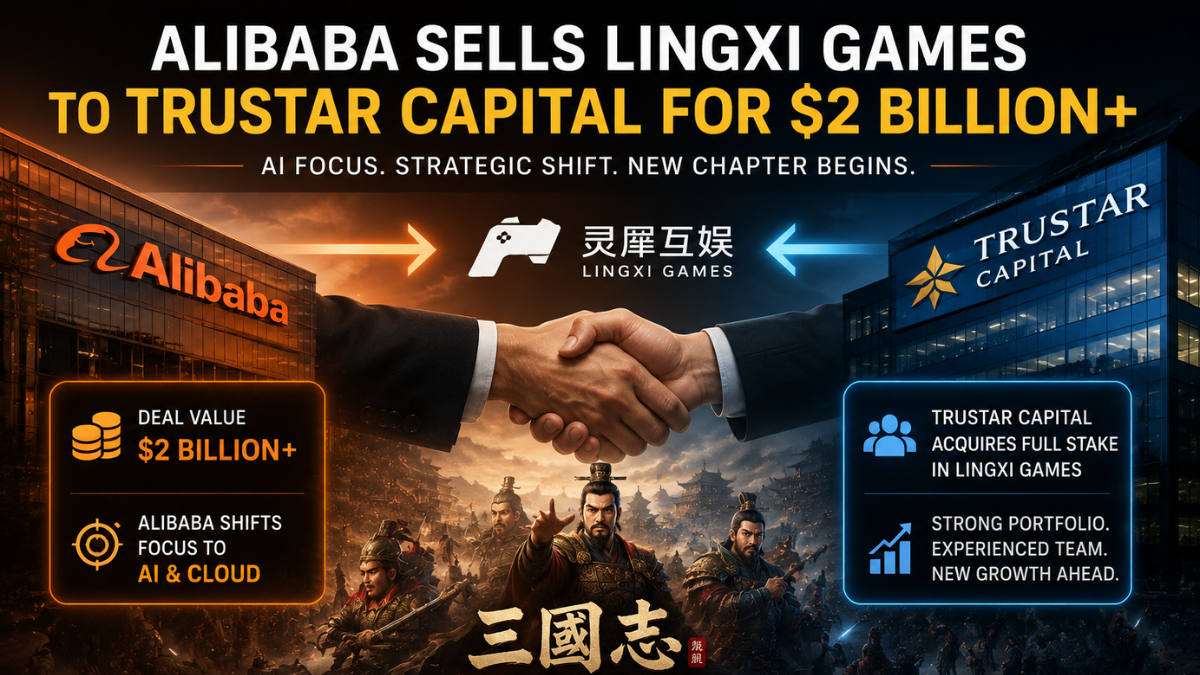
Under a formal agreement, Alibaba will transfer its entire Lingxi Games stake to private-equity firm Trustar Capital. Sources familiar with the matter say Alibaba could receive more than $2 billion, while earlier reporting put the value at no less than $1.5 billion.
That’s a sizable exit. And it leaves a few practical questions for players, investors, and anyone tracking China’s technology sector.
Key Points
- Alibaba is exiting Lingxi Games. The company plans to transfer its entire stake to Trustar Capital.
- The deal could be worth more than $2 billion. Earlier reports had placed the valuation at no less than $1.5 billion.
- Lingxi is not necessarily a weak asset. The reported price suggests Trustar sees considerable value in its games, people, and operating business.
- Alibaba is putting greater focus on AI and cloud. The sale fits the company's broader effort to direct resources toward computing, AI models, and enterprise infrastructure.
- Trustar Capital is taking over an established studio. The firm, formerly known as CITIC Capital, is an Asia-focused private-equity investor.
- Lingxi's existing leadership is expected to stay. CEO Zhou Bingshu and the current management team are expected to continue running the business.
- Three Kingdoms: Strategy Edition remains a major Lingxi asset. The mobile strategy game was developed in collaboration with Koei Tecmo.
- Regulation has already affected Lingxi's financing plans. Earlier fundraising efforts reportedly stalled after China proposed tighter online-gaming rules in late 2023.
- The final deal details are still limited. The material does not disclose a closing date, regulatory conditions, exact purchase price, or any future Alibaba technology or cloud arrangement with Lingxi.
- The bigger question is what Trustar does next. Whether it invests in new titles, expands the existing portfolio, or prioritizes financial returns will determine how significant this ownership change becomes.
Alibaba sells Lingxi Games Trustar Capital 2 billion deal marks an AI pivot
The Alibaba game studio sale 2 billion dollars story fits a wider corporate pattern. Alibaba has been reviewing non-core holdings while directing capital, management attention, and technical resources toward AI and cloud services.
You can see that strategic direction in Alibaba's AI strategy, its growing Alibaba's Qianwen push, and the intense scrutiny around Alibaba's chip access. These aren’t isolated initiatives. Together, they point to a company trying to compete where computing capacity, models, and enterprise infrastructure matter most.
Gaming can still produce big hits, of course. But it demands a different kind of investment cycle, and it may not fit Alibaba’s current capital priorities as neatly as cloud and AI do.
That said, the sale does not mean Lingxi was a weak asset. Quite the opposite. A multi-billion-dollar price suggests the buyer sees real value in its game portfolio, talent, and operating platform.
Who is buying Lingxi Games from Alibaba?
Trustar Capital acquires Lingxi Games Alibaba stake as an Asia-focused private-equity investor with experience supporting businesses through their next growth phase. The firm was formerly known as CITIC Capital, which is why some coverage refers to the Alibaba gaming unit sale CITIC Capital Trustar.
According to an internal memo sent to Lingxi employees by CEO Zhou Bingshu, Trustar has the industry resources and operating expertise to support the studio. That’s the optimistic version.
Private-equity ownership can bring sharper financial discipline too. Sometimes that means better focus and faster decisions. Sometimes it means more pressure to deliver. The final outcome will depend on how much room Lingxi gets to invest in new titles rather than simply protect existing revenue.
Alibaba sells Lingxi Games Trustar Capital 2 billion deal keeps management in place
For now, the leadership message is reassuring. Zhou Bingshu Lingxi Games CEO leadership stay is part of the agreement’s stated continuity plan, with Zhou and the existing management team expected to remain in charge after the ownership transition.
That matters because Lingxi has already been through change. Zhou became CEO in 2024 after founder Zhan Zhonghui left, following a management reshuffle. Keeping the current team in place could limit disruption at a studio where product knowledge and live-service experience are hard to replace.
The deal memo did not disclose a closing date, regulatory conditions, or the exact price. Nor did it explain whether Alibaba will retain cloud, publishing, or technology partnerships with Lingxi.
That last detail is worth watching. Alibaba Cloud security and infrastructure services could still make commercial sense for Lingxi after a change in ownership, but there’s no confirmed arrangement yet.
Why Three Kingdoms: Strategy Edition makes Lingxi valuable
Lingxi Games is best known for Three Kingdoms: Strategy Edition, a multiplayer mobile strategy title built around one of China’s most enduring historical settings. The game was developed in collaboration with Japan’s Koei Tecmo, answering a question fans often ask: yes, Koei Tecmo did collaborate with Lingxi on Three Kingdoms: Strategy Edition.
That connection adds credibility. Koei Tecmo’s own Three Kingdoms-related franchises have deep recognition among strategy-game audiences, while Lingxi has demonstrated it can adapt that appeal for mobile players.
The Three Kingdoms Strategy Edition Lingxi Games buyout therefore involves more than a single successful title. Trustar is acquiring a team with proven expertise in live operations, strategy gameplay, licensed collaboration, and China’s demanding mobile market.
Not bad assets to have.
A deal shaped by gaming regulation and capital markets
Lingxi had reportedly explored external fundraising before. That process stalled after China proposed tighter online-gaming rules in late 2023, a reminder that regulation can quickly alter valuations and investor confidence.
The Lingxi Games valuation 1.5 billion 2 billion range reflects that uncertainty as well as the company’s strengths. A formal sale gives Alibaba a cleaner exit and Trustar a defined path to ownership, while Lingxi avoids the prolonged ambiguity of a fundraising process.
For readers following China mobile gaming market M&A Lingxi Games, this transaction also sits within a larger investment environment. China's capital-market rules are evolving, and investors are increasingly weighing whether companies are positioned for consumer growth, AI infrastructure, or both.
What Alibaba’s capital shift means beyond gaming
Alibaba divests gaming unit Lingxi Games to focus resources on AI and cloud, but this is not simply about selling a distraction. It’s about funding a strategic race that is getting more expensive by the month.
The company is operating against a backdrop of China's AI growth outlook, China's AI investment surge, and fiercer China's AI competition. Cloud capacity, advanced chips, model development, and enterprise adoption all require patience and huge budgets.
And investors are watching closely. China's tech stock resilience and China's digital economy offer useful context for why AI-related asset allocation has become such a big corporate issue.
GlobalByte Perspective
Alibaba’s decision to sell its entire stake in Lingxi Games looks less like a rejection of gaming and more like a choice about where the company wants to deploy capital next.
A potential $2 billion-plus deal gives Alibaba a meaningful cash return from an established gaming business, while Trustar Capital gets control of a studio with a proven portfolio, experienced management, and a strong position in China’s mobile strategy market. The interesting part is that Lingxi is not being sold because the business appears worthless. The reported valuation suggests the opposite.
For Alibaba, the bigger story is the shift toward AI and cloud computing. Building competitive AI models, securing computing capacity, developing chips, and expanding cloud infrastructure require enormous and sustained investment. Selling a sizeable consumer-gaming asset gives Alibaba another way to concentrate resources on those priorities.
For Lingxi, the ownership change could go either way. Keeping CEO Zhou Bingshu and the existing management team should reduce disruption, but private-equity ownership also brings pressure to improve returns. The next few years will show whether Trustar invests aggressively in new games or focuses more heavily on extracting value from Lingxi’s existing portfolio.
GlobalByte takeaway: this is not simply a gaming deal. It is another example of how China's technology companies are reshaping their portfolios around the AI economy.