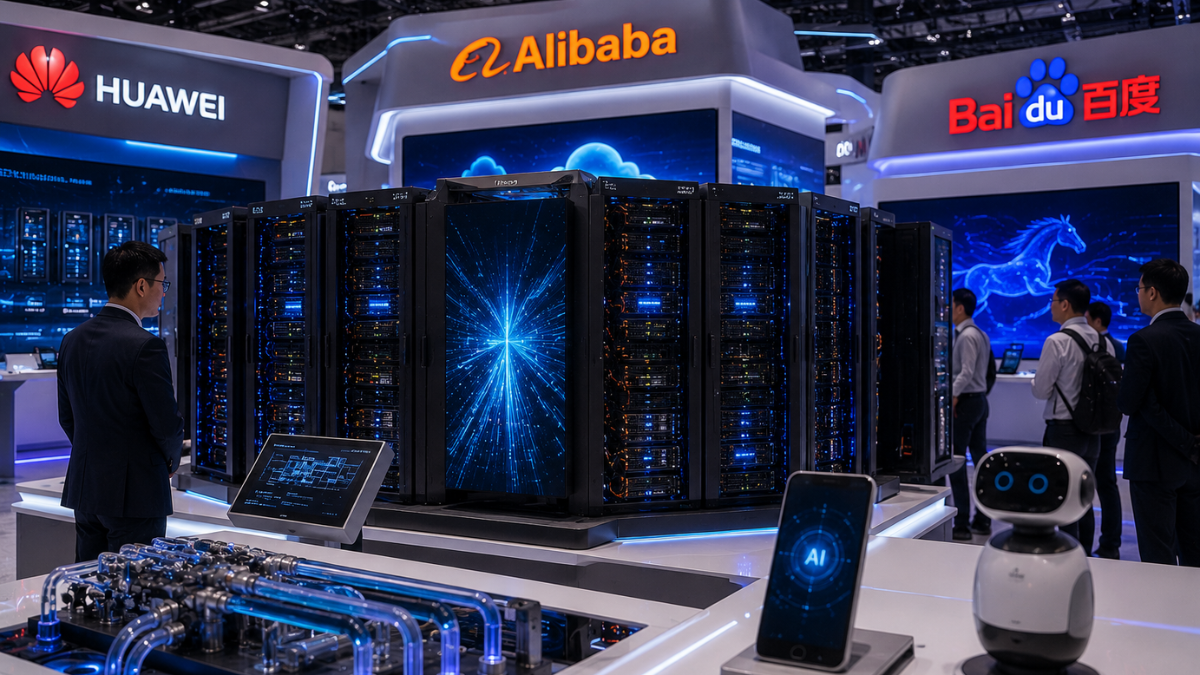
The World Artificial Intelligence Conference in Shanghai just delivered one of the most hardware-dense showcases in recent memory. The WAIC 2026 supernode computing unit achievements from Huawei, Alibaba, and Baidu weren't incremental chip refreshes - they marked a genuine shift in how China's top tech companies are building AI infrastructure. Last year, the conversation was about individual accelerators and benchmark scores. This year, the story moved to something harder: making dozens of chips talk to each other at extreme speeds without the whole system falling apart.
That's the supernode moment. And it arrived in Shanghai all at once.
What Actually Changed at WAIC 2026
Representatives from numerous countries and international organizations attended the Shanghai World Artificial Intelligence Conference, and the domestic hardware competition was impossible to miss. Several major manufacturers showed up with supernode products instead of the single-chip announcements that dominated previous years - Huawei, Alibaba Cloud, Baidu, and others all on the same stage within the same week.
Securities analysts covering the space flagged the underlying shift clearly: competition in domestic computing power is now extending into chip interconnect and system integration capabilities. Building a fast chip is one engineering challenge. Making that chip work at full speed inside a cluster of hundreds? A completely different problem.
The China AI industry growth trajectory has been pointing toward this infrastructure-level competition for a while. WAIC 2026 gave it a very public face.
Huawei's Ascend 950 Supernode Makes Its Debut
The Huawei Ascend 950 Supernode public appearance at WAIC was its first. This wasn't a product that had been quietly shipping to enterprise customers for months before getting an official announcement - it debuted at the conference itself.
Huawei's focus isn't just the chip in isolation. It's the Ascend 950 cluster architecture and system integration capabilities - the interconnect fabric, the cooling infrastructure, the software stack that ties it all together. The company has spent years building an end-to-end platform on the Ascend family, and this supernode is where that investment lands in 2026.
For context on the underlying engineering, Chinese AI chips 3D stacking technology is one of the architectural approaches domestic firms are using to push performance without access to the most advanced lithography nodes - and Huawei's roadmap sits squarely in that effort.
Alibaba Cloud's Lingjun Zhenwu M890: 800 Gbps and Public Cloud Access
Alibaba's announcement carried two distinct wins in one product launch.
First, the Alibaba Cloud Lingjun Zhenwu M890 Supernode Instance is now available through the public cloud for the first time. Dense supernode compute was previously only practical for large enterprises with hardware on-premises. Putting it on public cloud opens access to research labs, mid-sized AI companies, and regional enterprises that can't justify building their own clusters - and that's a genuinely meaningful expansion.
Second, the Alibaba Lingjun Zhenwu M890 card-to-card interconnect speed has been upgraded to 800 gigabits per second. That's not an arbitrary benchmark. Eight hundred gigabits per second is the threshold that makes trillion-parameter AI model inference on public cloud services practically viable. Models at that scale require constant high-speed data movement between chips. Slow interconnects become the bottleneck regardless of how capable the individual chips are - and 800 Gbps is where that bottleneck disappears.
The constraints around China Nvidia H200 chip purchase limits for major Chinese cloud providers aren't going away. Building domestic alternatives capable of handling frontier model workloads isn't purely a preference at this point. And Alibaba's Alibaba Cloud WAAP security leadership positioning shows the company is building a complete enterprise stack around this compute foundation, not just a faster cluster.
Baidu Kunlun: First Domestic Supernode to Hit Mass Production
Baidu's announcement was the quietest of the three. But commercially, it may be the most significant.
The Baidu Kunlun Chip supernode mass production delivery milestone puts Baidu in a position no other domestic manufacturer currently holds. Prototypes and reference designs are everywhere in this space. Actual mass delivery is rare - because getting manufacturing right involves yields, supply chains, and quality control problems that chip design alone doesn't solve. Baidu clearing that bar is meaningful for anyone tracking when domestic supernodes actually show up in enterprise deployments at scale.
The NDRC Action Plan Dropped at the Conference - Deliberately
Right alongside the hardware announcements, the National Development and Reform Commission released its action plan on July 19, and the timing wasn't accidental. The NDRC intelligent computing power accessibility action plan 2026 outlines eight major measures specifically designed to broaden access to AI compute across China - not just for hyperscalers, but for smaller research institutions, regional firms, and public sector organizations.
The measures include infrastructure expansion, capital allocation toward domestic compute deployment, and provisions for reducing cost barriers to entry. These aren't vague aspirations - they're framework signals that move procurement budgets.
This policy backdrop connects directly to how AI accelerates China industry empowerment across manufacturing, logistics, healthcare, and public services. The infrastructure investments being announced aren't just for the tech sector.
What the Market Is Actually Watching Now
The WAIC 2026 supernode computing unit achievements prompted a specific observation from securities analysts: the competitive moat is moving from chip performance to interconnect architecture and system integration depth.
Think about what that means practically. If multiple Chinese manufacturers can produce capable AI accelerators - which they now clearly can - the differentiator becomes how well those chips perform in a cluster. Sub-micron-level optical interconnect bandwidth thresholds. Software stacks that keep thousands of chips synchronized. High-throughput automated tracking of AI model training cluster metrics is becoming a default operational requirement, not an upgrade. Corporate governance guidelines for scaling high-performance compute clusters now increasingly treat liquid cooling as baseline infrastructure for domestically produced supernodes in large-scale deployment.
The competitive shift is accelerating. Chinese firms leave Nvidia for local suppliers faster than most analysts predicted even a year ago, and the WAIC announcements add infrastructure credibility to that trend. The Sugon 100,000-card AI supercluster launch showed domestic hyperscale deployments reaching real scale earlier this year, while Lenovo AI computing infrastructure revenue targets reflect the same momentum from a different angle. On the pure supercomputing side, both China's Lingcheng supercomputer architecture and the Lingsheng supercomputer Top500 ranking achievements have already put domestic hardware on the global leaderboard.
AI Robots and OS-Level Agents Were There Too
The conference showcased more than infrastructure. Several AI robot smartphones were demonstrated alongside early examples of intelligent agents operating at the operating system layer - not just the application layer.
That distinction matters. An app-layer agent does things within a single application. An OS-layer agent orchestrates across applications, interacts with hardware directly, and manages system resources. The AI robot smartphone operating system layer agents WAIC showcased were early stage, but the direction is consistent with where the broader industry is heading.
The MWC Shanghai AI economy and 6G developments earlier this year pointed toward the same convergence - compute, connectivity, and AI models collapsing into a single integrated layer. The heterogeneous computing full-stack platform work happening at Chinese research institutions is directly relevant to how those OS-level agents will actually run on domestic hardware at scale.
Key Takeaways: Why WAIC 2026 Supernode Announcements Matter
The WAIC 2026 supernode computing unit achievements from Huawei, Alibaba, and Baidu mark a real inflection point. The domestic hardware story has shifted from "can China build competitive chips" to "can China build competitive systems" - and the answer from Shanghai is yes, with Baidu already at mass production, Alibaba on public cloud at 800 Gbps, and Huawei presenting a full platform play.
The NDRC policy support and the competitive pressure from chip-access restrictions reinforce the same direction. The WAIC 2026 supernode computing unit achievements showed the technology is ready. What comes next is the scale-up - and the interconnect, liquid cooling, and system integration markets that follow it.
Watch the deployment numbers over the next two quarters. That's where the real story lands.