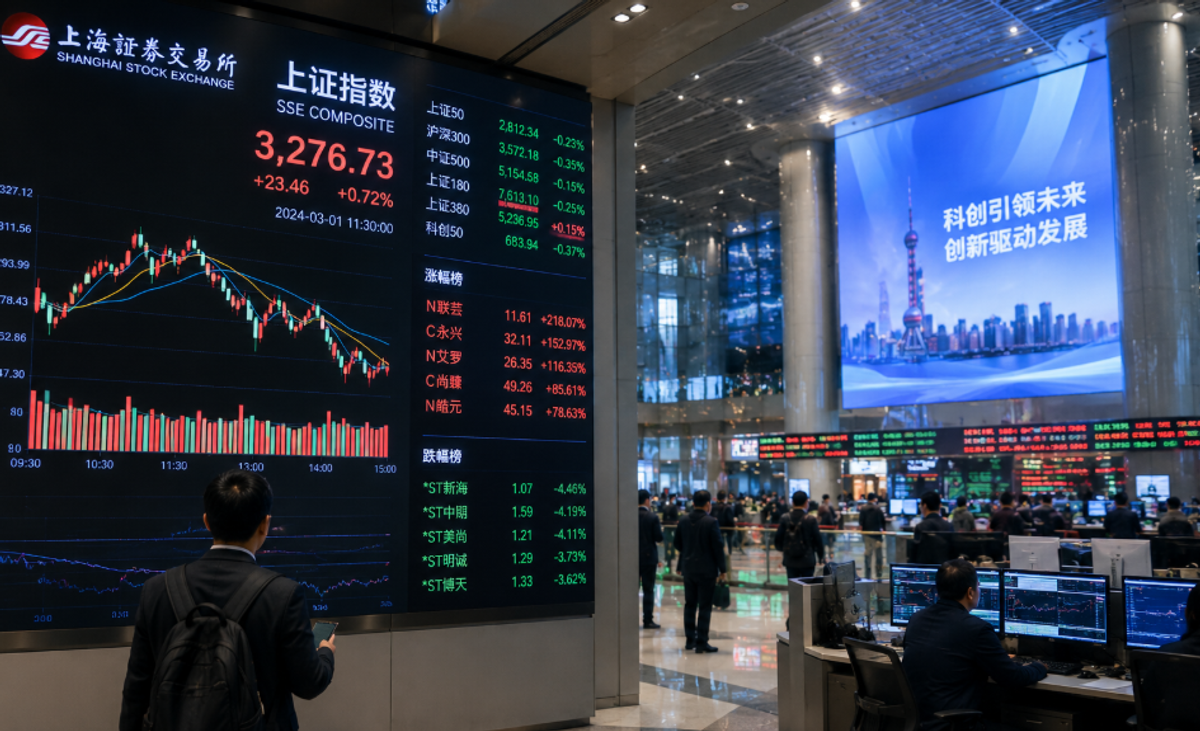
If you've been following China's tech sector this year, something has changed. Not just at the product level or in the labs - at the IPO pipeline level too. The rules around China’s capital market tech innovation enterprises listing have been substantially rewritten, and the effects are already showing up in specific company timelines.
Changxin Technology - a major domestic DRAM memory chip manufacturer - went from IPO acceptance to approval in just 140 days. Unitree Robotics passed its Science and Technology Innovation Board IPO review and filed for registration. Shenghe Jingwei, which specializes in advanced wafer-level packaging and testing, listed in April. These aren't coincidences. They're the direct output of a deliberate policy overhaul.
Opening the Gates: How China Capital Market Listing Access Changed for Tech Innovators
Here's the thing: the old rules were built around profitability. If your company wasn't making money yet, your listing options were limited. That model worked fine for mature industries. For quantum computing, biomanufacturing, embodied intelligence, and AI? Not really.
The Science and Technology Innovation Board has expanded its listing standards to accommodate unprofitable companies in what regulators call "frontier tracks." Artificial intelligence, quantum technology, biomanufacturing, and robotics all qualify now. The ChiNext board system has also been restructured to handle science tech financing across more stages of company growth, from early-scale startups through pre-IPO expansion.
A pre-review mechanism has been introduced too. Companies can now verify their "science and technology innovation attributes" before committing to the full listing process. Less wasted time. Fewer rejected applications. Practical, not flashy - but it matters.
The Policy Framework Behind the China Capital Market Tech Innovation Enterprises Listing Push
Several policy frameworks drive the current changes. The "Eight Measures for the Science and Technology Innovation Board," the "Six Measures for Mergers and Acquisitions," and the "1+6 Measures" together form a coherent architecture covering listing access, refinancing flexibility, and M&A support.
Two specific changes stand out. Listed tech companies now face fewer restrictions on how they deploy refinancing funds - which means capital raised through secondary offerings can flow more freely toward R&D or acquisitions. And there's a dedicated fast track for industrial chain mergers and acquisitions, letting established listed companies absorb smaller innovative firms without requiring those targets to run their own full listing process. That accelerates technology consolidation in ways the old system couldn't match.
Tian Xuan, Dean of the Guanghua School of Management at Peking University, has described the institutional logic clearly. By opening channels for unprofitable companies and those with non-standard equity structures, the market channels social capital toward the front edge of technological innovation. Mechanisms like equity incentives, ecosystem cultivation, and market makers do the work of improving pricing efficiency and directing resources toward new productive forces. It's deliberate architecture. Not accidental.
The Companies Actually in the Pipeline
Shenghe Jingwei's listing is significant for China AI chip innovation - it plays a direct role in domestic semiconductor packaging supply chains. Changxin Technology's 140-day approval signals that strategically important companies in semiconductors are receiving expedited treatment. Yangtze Memory Technologies (YMTC) has initiated IPO guidance and filing. That one's worth tracking carefully.
Unitree Robotics is the headline. If registration completes, it becomes the first publicly listed company in China focused purely on humanoid robots - directly advancing the embodied intelligence A share market listing category that regulators now explicitly support. Chinese tech enterprises across adjacent sectors are watching closely, since the Unitree process sets a precedent for how the board handles robotics going forward.
What the Numbers Actually Show
Over 2,000 companies are now listed across the Science and Technology Innovation Board and ChiNext combined. Total market cap exceeds 35 trillion yuan. Technology companies account for more than 30% of the entire A-share market - and among companies valued above 100 billion yuan, roughly 45% are in tech.
That's not a niche anymore.
The science and technology innovation index has consistently ranked among the top performers year-to-date. Chinese AI startups have attracted growing long-term institutional capital. Anyone tracking China AI industry news has seen these capital flows shift toward core tech sectors in a way that's more sustained than it's been in previous cycles.
Patient Capital and the Virtuous Cycle
There's a phrase Chinese policymakers use a lot right now: "virtuous cycle." Capital flows into technology, technology produces innovation, innovation generates industrial value, value attracts more capital. It sounds tidy. But - unusually for a policy phrase - it actually describes something real.
The central mechanism is patient capital: long-horizon investment that tolerates extended R&D timelines before expecting returns. Regional initiatives like the Wuhan tech investment plan show how local government funding feeds companies into this pipeline at scale. The China quantum computing sector is one of the clearest examples - quantum companies are years from profitability, but they now qualify for relaxed listing standards under the "future industries" designation. The capital can actually reach them now.
China supercomputing platforms and infrastructure companies are increasingly in scope. Companies pushing tech security innovation and dual-use technologies - where development timelines simply don't fit traditional profitability criteria - are also being explicitly accommodated. The system is expanding to cover more of these cases by design, not by exception.
What's Next for China Capital Market Tech Innovation Enterprises Listing in H2 2025
More is coming. The policy direction for the second half of 2025 points toward continued expansion of institutional inclusiveness - more company categories, more sectors, more flexibility on financial benchmarks. Investment products tied to the tech sector are expected to grow, giving both retail and institutional investors more access points. Emerging tech companies in hardware, materials, and next-gen computing stand to benefit as the framework extends further.
China global tech influence is increasingly tied to whether domestic capital market reforms actually produce globally competitive companies at scale. Based on the data so far, the pipeline is moving faster than it was twelve months ago. The institutional infrastructure supporting it is still being built - but the direction is set.
Key Takeaways
China capital market tech innovation enterprises listing isn't just a regulatory story anymore. It's a structural reshaping of how China intends to fund and scale its next generation of technology companies.
The numbers are real. 35 trillion yuan in combined board market cap. 45% of large-cap A-shares in tech. Unitree, Changxin, and YMTC all moving through the pipeline simultaneously. Patient capital growing. A policy architecture explicitly designed to keep pace with how fast the technology itself is evolving.
If you're tracking where the next wave of hard tech gets financed - AI, quantum, semiconductors, robotics, embodied intelligence - the China capital market tech innovation enterprises listing reforms deserve serious attention right now. The pipeline is deeper than most external observers realize. And it's just getting started.