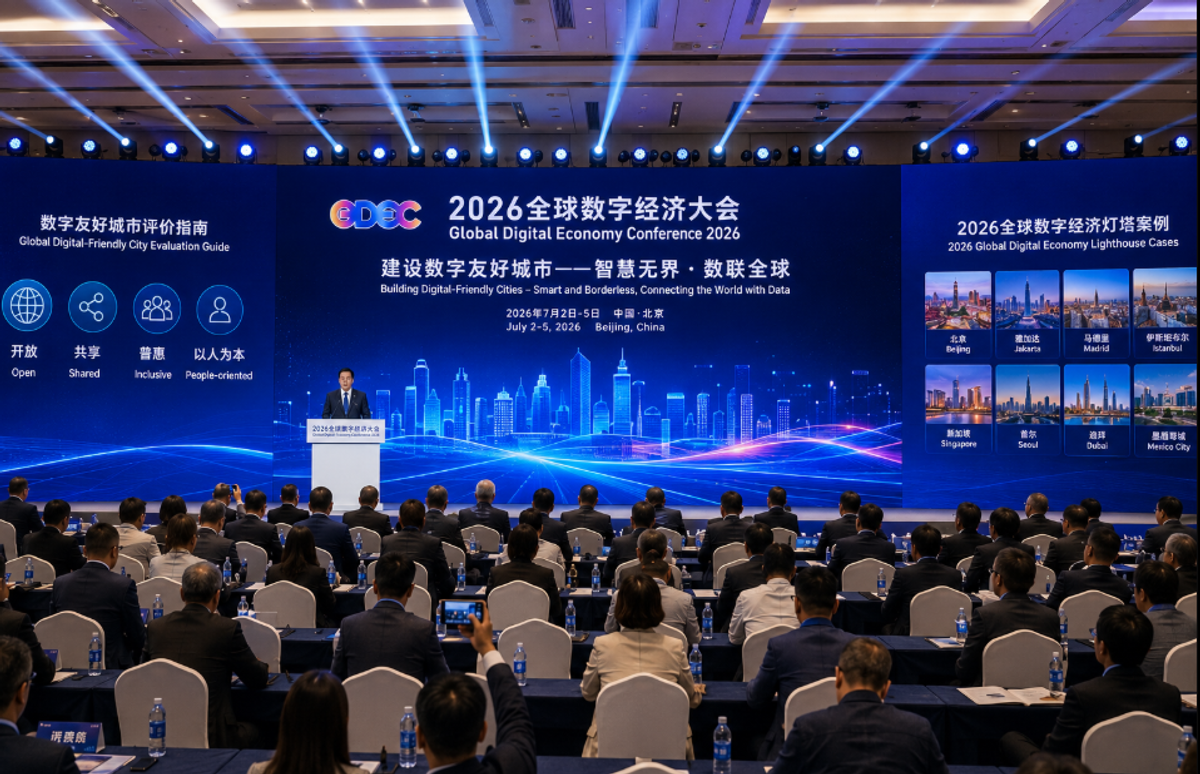
Beijing just made a very public case that it's the city other cities should be studying.
At the 2026 Global Digital Economy Conference, held July 2-5 in the Chinese capital, the numbers didn't just impress - they set a new bar. Nearly 40 high-level international delegations and more than 1,000 industry guests flew in to talk AI, digital governance, and data infrastructure. And by the time it wrapped up, the Beijing benchmark for global digital economy cities wasn't just a marketing claim anymore.
It's a measurable, internationally validated reality.
What Actually Happened at GDEC 2026
The conference theme was "Building Digital-Friendly Cities - Smart and Borderless, Connecting the World with Data." That sounds like conference branding. But the substance behind it was real.
Three new international organizations signed on as co-organizers this year: the United Nations Industrial Development Organization (UNIDO), the World Data Organization (WDC), and the Global Digital Economy Cities Alliance (GDCC). The UN Conference on Trade and Development (UNCTAD) and the International Trade Centre (ITC) joined as supporting bodies. That's not a small footnote. Six major international organizations showing up to validate one city's model is a different kind of signal.
The digital economy industry expo highlights from this conference stretched across AI applications, smart governance tools, and cross-border data infrastructure - and the appetite was clearly there on the international side.
Honestly, nearly 40 delegations flying in for a conference centered around a single city's digital model says something. People showed up because the results are worth studying.
Beijing's Digital Economy Now Accounts for 46% of GDP
Let's talk numbers, because the Beijing Digital Economy Development Report blue book for 2025-2026 didn't hold back.
In 2025, the added value of Beijing's digital economy exceeded 2.4 trillion yuan - up 8.7% year-on-year. That figure now accounts for 46.4% of the city's total GDP. Think about that for a second. Nearly half of everything Beijing produces economically has a digital foundation.
And in the Global Digital Economy Benchmark City Index evaluation, Beijing ranked second globally, maintaining its designation as a "global leading city." That ranking matters especially given the broader context of China's innovation-led economic resilience against an increasingly complex global economic backdrop.
What's driving this? Strong data infrastructure. Aggressive policy execution. And a city government that's actually delivering results, not just publishing roadmaps.
A Global Standard for "Digital Friendliness" - and Why It Changes Things
One of the most significant outputs from this conference wasn't a product launch or a funding announcement. It was a framework.
The release of the Global Digital Friendly Cities Evaluation Guidelines marks the first time a unified, universal international standard for digital friendliness has been established in this space. That's actually a big deal. Before this, every city was essentially grading its own homework. Now there's a shared rubric - one that's measurable, replicable, and scalable across different national contexts.
The Global Digital Economy Cities Development Report, released alongside it, frames "digital friendliness" as the core value direction for urban digital transformation going forward. Not just efficiency. Not just growth metrics. Friendliness - meaning technology that works for people, not just for spreadsheets.
A batch of nearly 20 industry rules and standards was also introduced at the conference to support the friendly development of the digital industry. This kind of standards work tends to be slow and unsexy, but it's what makes everything else stick.
13 Lighthouse Cases From 308 Applications
The 2026 Global Digital Economy Lighthouse Cases selection process was genuinely competitive. Applications came in from more than 60 countries across six continents. 308 valid submissions. 13 selected.
Beijing landed two of them.
The Jingban intelligent government collaborative office platform - also known as the "Beijing Office" platform - was recognized as a benchmark case for smart government. The Beijing Vehicle-Road-Cloud demonstration application made the list as a reference model for smart mobility at scale. If you want to understand how Beijing applies structured AI to real governance problems rather than just proofs of concept, look at events like the Jingkai intelligent manufacturing AI competition - the pattern is consistent.
The Vehicle-Road-Cloud system is its own category of interest. It's not just connected cars. It's a full-stack integration of vehicle data, road infrastructure, and cloud computing - and other cities can now reference it as a proven model. The Chinese AI companies reshaping global competition are increasingly building on exactly this kind of urban infrastructure.
Why UNDP Picked Beijing for Its New Innovation Lab
The UNDP Digital Friendly and Sustainable Innovation Lab was officially established in Beijing during the conference. That's the United Nations Development Programme putting a formal institutional home for digital economy research in one specific city.
UN Under-Secretary-General and UNDP Deputy Administrator Xu Haoliang was explicit about why: Beijing's leading position in global digital economy innovation makes it the right place to explore inclusive, efficient pathways for digital transformation. He wasn't being diplomatic - the metrics back it up.
This fits a broader pattern. The Beijing space computing innovation center launch earlier this year pointed in the same direction - Beijing positioning itself as a hub for infrastructure that can scale globally. And the AI sector’s explosive growth signals out of China more broadly show exactly why organizations like UNDP want to study and adapt these models for global application.
Beijing's "Digital Methodology" - What It Actually Means
Beijing's approach at GDEC 2026 wasn't just a showcase. It was a system on display.
Standard setting. Factor activation. Industrial upgrading. Global collaboration. Governance improvement. These five tracks are running simultaneously - and this conference delivered results across all of them.
The Beijing Overseas Expansion Base also launched its online comprehensive service platform during the event, giving enterprises end-to-end support for entering global markets. That's a real, tangible tool - not just a policy direction. For businesses thinking about international expansion, this sits alongside developments like Xiongan startup funding 2026 as evidence of the broader regional ecosystem being built.
The China's open-source AI global market share story connects here too. Beijing's benchmark status isn't just about what's happening domestically - it's partly a function of how Chinese AI tooling and infrastructure is being adopted and adapted internationally.
On governance frameworks, the conference aligned closely with work being tracked in China AI governance 2026, where Beijing is increasingly shaping international frameworks, not just responding to them. Even at the infrastructure level, projects like the green electricity AI data center show the city investing in sustainable foundations alongside raw capability.
Why This Matters Beyond Beijing
The numbers are impressive. The rankings are legitimate. But the deeper story from GDEC 2026 is that Beijing has moved from being a case study to being a reference model - one that international organizations are now formally building institutions around.
When UNDP establishes an innovation lab in your city, when six international organizations co-organize a conference around your model, when 2 of your projects make a global top-13 list from 308 applications, something has shifted. The Beijing benchmark for global digital economy cities now gives other cities something concrete to measure themselves against - not just an inspiring headline, but actual frameworks, standards, and cases they can study and adapt.
That's what GDEC 2026 built. Not just recognition. A standard that travels.