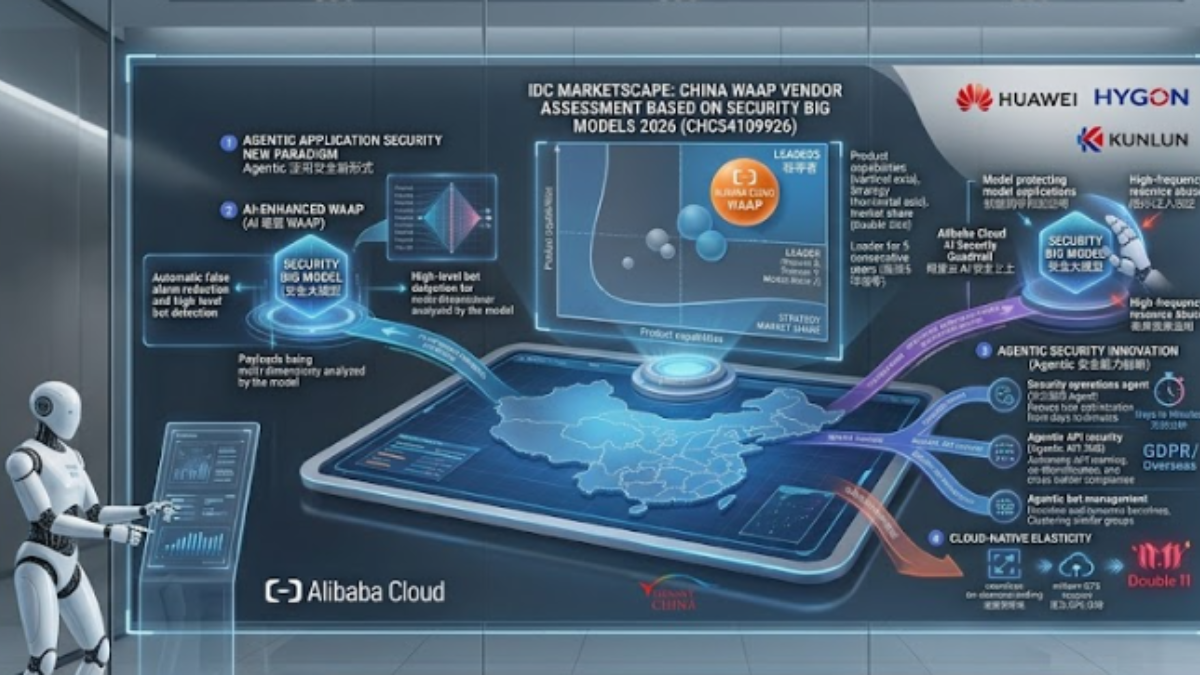
IDC's "IDC MarketScape: China WAAP Vendor Assessment Based on Security Big Models 2026" (Doc #CHC54109926) was just published, and Alibaba Cloud secured the top Leaders position across all three scoring dimensions at once: product capabilities, strategy, and market share. If you've been watching the broader application security landscape, this tracks with the direction things have been heading. But Alibaba Cloud WAAP Agentic Application Security China 2026 is worth examining closely - because the how behind that ranking tells you something specific about where enterprise WAF is actually going.
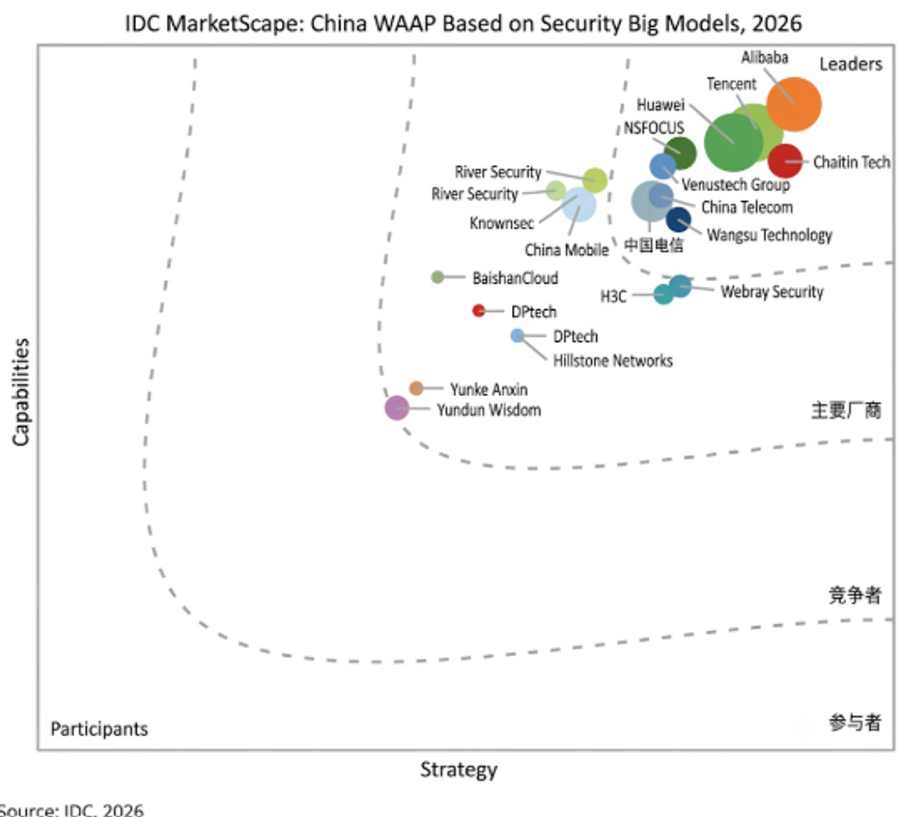
IDC MarketScape: China WAAP Based on Security Big Models, 2026
Five consecutive years leading the Chinese public cloud Web application firewall market, with share still expanding. That's the context sitting underneath the IDC finding.
What the IDC MarketScape China WAAP 2026 Report Actually Shows
IDC's methodology combines qualitative and quantitative scoring across product capabilities, vendor strategy, and real-world market traction. Topping all three simultaneously isn't a common outcome. It means the product is genuinely competitive, the strategy reads as credible to enterprise buyers, and customers are choosing it at scale - not just in benchmark environments.
IDC identifies two dominant paths in China's WAAP market right now. Public cloud vendors are taking the unified platform route, bundling API security, bot management, anti-DDoS, and core WAF into a single architecture. Dedicated security vendors take the point-solution route. As Chinese AI companies in 2026 push aggressively into cloud-native security from every angle, the platform route is pulling ahead - and Alibaba Cloud is the clearest example of why that's happening.
How Alibaba Cloud's Agentic Application Security Features Work in Practice
Start with the architecture, because it underpins everything else.
The platform supports cloud, on-premises, multi-cloud, and hybrid cloud environments from a single management plane. Beyond standard CNAME proxy, it natively integrates with ALB, MSE, FC, CLB, and ECS with no changes to your existing business architecture. For genuinely complex hybrid or multi-cloud deployments, a reverse proxy plus service SDK model handles unified policy configuration, log analysis, and security controls across assets living in entirely different environments. Native service integration for ALB, MSE, and FC frameworks is what makes this workable at enterprise scale without custom glue code. How hybrid cloud structures achieve unified policy configuration without architecture changes is a real operational challenge - and this is a direct answer to it.
On core protection, large language models run multi-dimensional payload analysis and auto-generate whitelist entries when traffic looks like a false positive. How to minimize false positive security alerts using large language model whitelists is one of the harder ongoing problems in WAF management - alert fatigue sets in fast, and analysts start ignoring signals they shouldn't. Automating whitelist generation based on model analysis is a meaningful fix. Reducing operational security workload by twenty-five percent is what customer data shows, not a spec sheet projection.
API security uses contextual correlation analysis to sharpen sensitive data identification accuracy. Automated asset discovery for shadow APIs and microservices keeps pace as your API surface grows - you can't protect endpoints you don't know exist. Bot management incorporates workflow learning and graph model analysis to catch abnormal traversal patterns (specifically, the "skip steps to high-value interfaces" behavior that marks sophisticated bots) and builds dynamic baselines from individual user history. That's a meaningful step beyond signature-based detection.
Alibaba Cloud's New Agentic Security Capabilities for 2026
Here's what's actually new this year, and why it matters.
The SecOps Agent covers core web protection, basic bot protection, scanning protection, and custom rules. Rule optimization time drops from days to minutes. It also proactively discovers attack surfaces not yet covered by existing rules and auto-distributes updated policies - meaning your security posture evolves with your deployment cadence, not weeks behind it. The deployment of SecOps Agent for multi-dimensional traffic analysis is the most operationally significant addition for enterprise teams that are tired of playing catch-up during release cycles.
Agentic API security uses an AI baseline engine to auto-learn API structure, applies contextual semantic analysis to identify similar sensitive fields accurately, and handles real-time API desensitization plus automated cross-border compliance. For teams navigating GDPR requirements on international traffic, the zero trust architecture application layer firewall deployment model here produces compliance outputs as a byproduct of normal operation - not a separate audit project. This matters a lot given how China tech security transfers face increasing regulatory scrutiny across borders.
AI application protection uses a zero-code intrusion gateway access model with dedicated rule templates for prompt injection, unauthorized API calls, and sensitive data leakage. As AI agent investments in China accelerate and more enterprise teams deploy LLM-based systems, how to secure external LLM APIs using reverse proxy and service SDK solutions is no longer a theoretical question. Prompt injection attacks and API abuse targeting inference endpoints are live, documented threats.
China AI governance rules are tightening at the same time that China AI policy directives are pushing AI adoption into more industries simultaneously. More AI infrastructure means more surface area to protect - and the pressure isn't easing.
Real Enterprise Deployments Worth Knowing About
The customer cases are worth reading for what they reveal about where agentic security is actually landing.
An emerging EV manufacturer used Agentic API security to complete GDPR audits for cross-border operations via real-time de-identification and automated compliance outputs. That's specific and verifiable - not a generic "improved security posture" summary. A leading sports brand reduced human intervention in security operations by roughly 70%, shifting its team from rule-based operations to policy-based governance. And a major foundation model company deployed AI application protection specifically to block keyword injection and computing power abuse on large-scale inference services.
That last case matters more than it might first appear. Protecting autonomous AI agent runtimes is the key direction the security industry is moving toward. China AI sector growth 2026 means the number of inference services that need this kind of protection is multiplying fast. The China AI economy signals coming from events like MWC Shanghai confirm that pace isn't slowing.
What Enterprise Security Teams Should Take From This
If you're working through a B2B compliance evaluation framework for cloud WAAP vendors, the IDC MarketScape gives you a structured comparison model. But the practical takeaways distill down quickly.
Unified architecture flexibility is not a commodity feature. If you're managing hybrid or multi-cloud infrastructure alongside public cloud - and most serious enterprise operations are - consistent security policy management across environments is a real operational gain. Not every platform delivers it without friction or architecture work.
The AI features here aren't vaporware. AI solutions for enterprise 2026 have passed the pilot phase for vendors at this scale. LLM whitelist automation, Agentic bot clustering, and SecOps Agent rule tuning each solve a documented operational problem in WAF management.
One honest limitation worth knowing: the deepest native integrations are with Alibaba Cloud's own ecosystem. Non-Alibaba infrastructure is supported via the reverse proxy and SDK model, but it's not quite as seamless as the native integration path. Worth factoring into your evaluation if you're running a genuinely mixed environment.
China's open-source AI momentum is accelerating agent deployment broadly; the China AI agent competition landscape shows how fast teams are building agentic systems, and the Chinese AI model trust crisis is a reminder that trust in AI infrastructure has to be earned through demonstrated security - not asserted through marketing positioning.
Where Agentic Application Security in China Goes From Here
Alibaba Cloud WAAP Agentic Application Security China 2026 is the clearest current example of where enterprise WAF is actually heading: away from manual rule management, toward AI systems that discover, adapt, and enforce security policy continuously and autonomously. The IDC Leader position is the formal acknowledgment of a trajectory that's been building for five years, measured in consistent market share data.
For enterprise teams evaluating the AI-driven cloud Web Application Firewall market, the practical signal here is direct. If your infrastructure involves LLM-based applications, AI agent deployments, or complex hybrid environments, your security layer needs to evolve as fast as the threats targeting it. The Alibaba Cloud WAF security big models approach - from integrated WAAP to Agentic application security driven by large models - is built for that requirement. Five consecutive years of customers choosing it over alternatives, at scale, suggests the approach is holding up in real environments. That's a harder thing to fake than any benchmark.