Summary
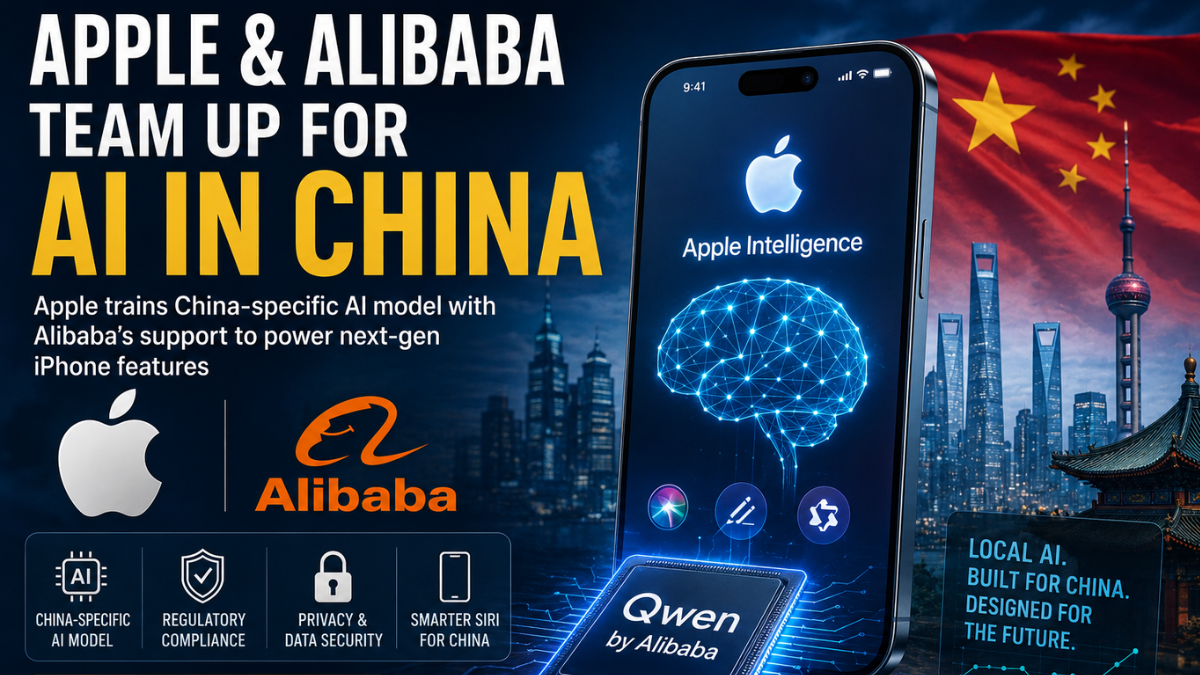
The Apple China AI model Alibaba partnership iPhone story signals a major shift in how Apple may bring generative AI to one of its most important markets. Rather than relying only on a local provider, Apple has reportedly trained a China-specific large language model with Alibaba’s support.
That matters because China isn't just another iPhone market. It's a fiercely competitive arena where buyers already expect useful on-device AI, local language support, and assistants that understand the apps they use every day.
Apple’s reported approach could give Chinese iPhone users more localized AI features in the coming months. But it also raises big questions about approvals, privacy, model control, and how Apple plans to compete with Huawei.
Key Points
- Alibaba gives Apple a local route into China's AI market: The reported partnership could help Apple deploy generative AI features while working within China's regulatory environment.
- Qwen could power selected Apple Intelligence features: Reports suggest Alibaba's model may support functions such as Siri and Writing Tools, while Apple continues managing the overall user experience.
- Apple is taking a different approach in China: Unlike markets where Apple can work with providers such as ChatGPT, its China strategy reportedly relies on a combination of Apple's technology and a domestic AI partner.
- Regulatory approval is a major part of the story: Apple needs to satisfy China's requirements for generative AI services before wider AI features can reach users.
- Huawei and other Chinese brands are already moving quickly: Apple isn't entering an empty market. Huawei, Xiaomi, Oppo, Vivo, and Honor are building AI directly into their smartphone experiences.
- The timing matters for iPhone sales: A localized Apple Intelligence rollout could make newer iPhones more attractive to Chinese consumers, but AI alone won't solve Apple's broader competitive challenges in the country.
- Apple still wants control: Working with Alibaba doesn't necessarily mean handing over the entire AI experience. The reported arrangement suggests Apple can retain control over its software layer while using local model capabilities where necessary.
- Privacy and data handling remain important questions: The exact architecture, processing arrangements, and division of responsibilities between Apple and Alibaba will matter as much as the model itself.
- China's AI market is moving quickly: Local models such as Qwen, DeepSeek, and Kimi are raising expectations for what consumers should be able to do with AI on their devices.
- The real test will be everyday usefulness: Mandarin accuracy, Siri performance, app integration, response speed, and the ability to complete useful tasks will determine whether Chinese users actually notice a meaningful improvement.
Apple China AI model Alibaba partnership iPhone strategy explained
Apple reportedly trains China specific large language model capabilities with Alibaba’s technical support, creating a different setup from its AI deployment in other regions. Outside China, Apple Intelligence can use Apple-built models and optional integrations with services such as ChatGPT. That route isn't available in mainland China.
Why can't Apple use ChatGPT or Claude in China? Those services are not broadly available there under local rules, and foreign generative AI products face strict compliance requirements. Apple needs a locally compliant path if it wants AI features to ship on Chinese devices.
This is where the Apple Alibaba Qwen LLM integration iPhone China plan becomes important. Alibaba’s Qwen model could handle localized tasks while Apple retains more influence over the overall product experience, interface, and device-level features.
It’s a practical compromise. Not a perfect one.
Why Apple is building its own China-focused model
Why is Apple training its own AI model for China? Control is likely the biggest reason. If Apple relies entirely on a third-party model, its AI experience can vary based on another company’s capabilities, updates, and priorities.
A proprietary model may help Apple tune responses, safety behavior, and integrations around iOS, iPadOS, macOS, and Vision Pro. The reported Apple dual track AI deployment strategy China would let the company use its own foundation while also working with a domestic partner where local infrastructure and regulatory knowledge matter most.
Apple has already faced pressure from local competitors. Apple’s China AI challenge is closely tied to the fact that Chinese brands have moved quickly to package AI assistants into new phones.
And, frankly, Chinese buyers have plenty of alternatives.
Huawei, Xiaomi, Oppo, Vivo, and Honor are all participating in the China smartphone market AI assistant competition. The AI-ready smartphone race is no longer about adding a chatbot for marketing. It’s about whether your phone can search, write, summarize, translate, create, and take action in useful ways.
Apple Intelligence launch China CAC approval: what we know
Reports say the Apple Intelligence launch China CAC approval process has moved forward after the Cyberspace Administration of China registered Apple’s generative AI service. Has China’s Cyberspace Administration approved Apple’s AI features? Registration reportedly clears an important regulatory step, though a registration does not guarantee every feature will arrive at once.
The Generative AI regulation Cyberspace Administration China framework requires services to meet local rules around security, content management, and data handling. That’s why foreign tech companies need local partners to deploy AI in China. You can build a capable model, but you still need approvals, local operating arrangements, and a service architecture regulators will accept.
Apple becomes first foreign firm approved for proprietary AI model in China only if the reported arrangement proceeds as described. Apple and Alibaba have not publicly detailed every technical or commercial term, so you should treat the exact model split as still developing.
How Alibaba and Qwen may fit into Siri
How is Alibaba supporting Apple’s AI model development in China? Alibaba reportedly helped train the China-specific model and is expected to provide Qwen-based capabilities for Apple Intelligence in the country.
The Alibaba’s Qianwen AI ecosystem gives Apple access to a widely recognized local model family. Still, Qwen is not simply replacing Siri.
Apple Siri and Writing Tools integrate Alibaba Qwen model for Chinese users through a localized arrangement. How will Alibaba's Qwen model integrate with Siri on Apple devices? Reports suggest compatible devices could use Qwen for selected generative requests, while Apple continues to manage the software layer and user experience.
A Chinese-language guide reportedly mentioned Qwen connections for Siri and Writing Tools on Macs, then disappeared from Apple’s site. That deletion is a real wrinkle. It may reflect changing rollout plans, incomplete documentation, or a feature that wasn't ready for public explanation.
Apple vs. Huawei: the sales stakes are real
Apple Huawei AI competition China market share is about more than flashy demos. Domestic brands can promote native AI features as part of the phone's everyday value, while Apple has had to wait for its localized version of Apple Intelligence.
Custom AI features expected to boost iPhone sales in key Chinese market, especially if they work naturally in Mandarin and across common local workflows. Apple China revenue AI features rollout could help reduce one obvious product gap, though it won't fix everything overnight.
Price pressure remains. Huawei’s recovery remains a challenge. And China’s open-source ecosystem is moving quickly, as China’s open-source AI surge shows.
Apple also has to operate amid hardware constraints. China’s AI chip limits can affect the broader compute environment supporting local AI development.
What makes Apple’s China approach different
How does Apple's China AI strategy differ from its global strategy? Globally, Apple can combine its own models with optional third-party assistance from U.S. providers. In China, it reportedly adopts dual track AI strategy combining proprietary models and Alibaba Qwen, shaped by local regulations and service availability.
That means Apple proprietary AI model China smartphone market plans may look familiar on the surface but behave differently behind the scenes. The model provider, cloud processing, feature availability, and rollout timing could all vary by region.
This is also a reminder that AI partnerships aren't just about model quality. Alibaba’s cloud security push highlights why security, infrastructure, and local operating capacity matter when generative services reach millions of devices.
Meanwhile, Chinese AI model competition keeps raising the bar for every player. Apple can't arrive with a limited feature set and assume its logo will carry the day.
When will Apple Intelligence launch on iPhones in China?
When will Apple Intelligence launch on iPhones in China? Reports point to a rollout in the coming months through an iOS update, but Apple has not confirmed a final public release date for every feature.
Feature availability may arrive in stages. That’s common with regulated services, especially when device compatibility, language tuning, and model integrations are involved.
China’s AI industry outlook also suggests why Apple can’t afford to treat this as a minor regional update. China is becoming a critical proving ground for consumer AI.
GlobalByte Perspective
Apple’s China AI strategy is less about simply adding another chatbot to the iPhone and more about finding a way to make Apple Intelligence work inside a market with very different regulatory and competitive conditions.
The reported partnership with Alibaba gives Apple a practical route into China. Alibaba brings local AI expertise and the Qwen model ecosystem, while Apple can continue controlling much of the iPhone software experience. That arrangement could help Apple close a noticeable AI gap with Chinese smartphone brands without completely giving up control of its platform.
But getting the model onto iPhones is only the first step.
The bigger test will be whether Apple can turn this partnership into AI features that Chinese users actually find useful. Huawei, Xiaomi, Oppo, Vivo, and Honor are already competing aggressively on AI-powered smartphone experiences, so simply launching Apple Intelligence later may not be enough to regain momentum.
There is also a regulatory balancing act. Apple has to satisfy China's requirements around generative AI while maintaining its own approach to privacy, security, and software control. That makes the China version of Apple Intelligence fundamentally different from Apple's global AI strategy.
In our view, the Alibaba partnership is less a sign that Apple has abandoned its own AI ambitions and more a sign that the company understands it cannot approach every market in exactly the same way. China may become the clearest example of Apple's increasingly regional AI strategy.