Summary
The Black hole star discovery JWST little red dots MoM-BH-1 story sounds like science fiction. It isn't. Using data from the James Webb Space Telescope, astronomers found an early-universe object that looks star-like, spans roughly the size of our solar system, and shines with an output no ordinary star could sustain.
That object, MoM-BH-1, may be powered by a black hole hidden inside a dense hydrogen envelope.
If that interpretation holds, it could finally explain many of the tiny, unusually red sources scattered through JWST deep-space images. Astronomers call them little red dots, and they've been one of the telescope's most stubborn mysteries.
Key Points
- MoM-BH-1 may not be a normal star. Its extreme brightness suggests that something far more powerful than ordinary stellar fusion is driving it.
- A massive black hole could be powering the object. The leading explanation involves a black hole feeding on gas inside a dense hydrogen envelope.
- The object may be around the size of our solar system. Despite its relatively compact scale, it could produce an extraordinary amount of energy.
- JWST's spectral data is important here. The unusual hydrogen signature and deep Balmer break helped researchers move away from a simple dusty-galaxy explanation.
- It could shed light on early supermassive black holes. A rapidly growing, gas-covered black hole could offer clues about how massive black holes appeared so early after the Big Bang.
- The discovery may help explain some little red dots. MoM-BH-1 provides one possible physical model for at least a portion of these mysterious JWST sources.
- Not every little red dot has been solved. Other objects may have completely different origins, so astronomers will need more observations before drawing a broader conclusion.
- The most interesting part is what happens next. If future JWST observations confirm the black-hole-star interpretation, MoM-BH-1 could become an important piece of the puzzle surrounding the first generations of massive black holes.
Why the Black hole star discovery JWST little red dots MoM-BH-1 matters
MIT astronomers discover black hole star MoM-BH-1 while searching for some of the universe's first galaxies. Their survey, called Mirage or Miracle, was designed to separate genuinely early galaxies from objects that only appear to be them.
Instead, the team found something far stranger.
MoM-BH-1 appears as a bright red point from a time only a few hundred million years after the Big Bang. It is so luminous that normal stellar nuclear fusion can't plausibly explain it. The source emits about 100 billion times more energy than a typical star.
A black hole can produce that kind of power as gas falls inward and heats up. But the outer layer is what makes this case unusual: a vast, dense hydrogen cocoon enshrouded black hole early universe researchers believe resembles an enormous stellar atmosphere.
Simple. Weird. Potentially very important.
The finding also adds context to other astronomy stories, from investigations into cosmic ray origins to experiments behind a particle accelerator breakthrough. Different scales, same larger question: how does matter behave under conditions we can't reproduce easily on Earth?
A star powered by accretion, not fusion
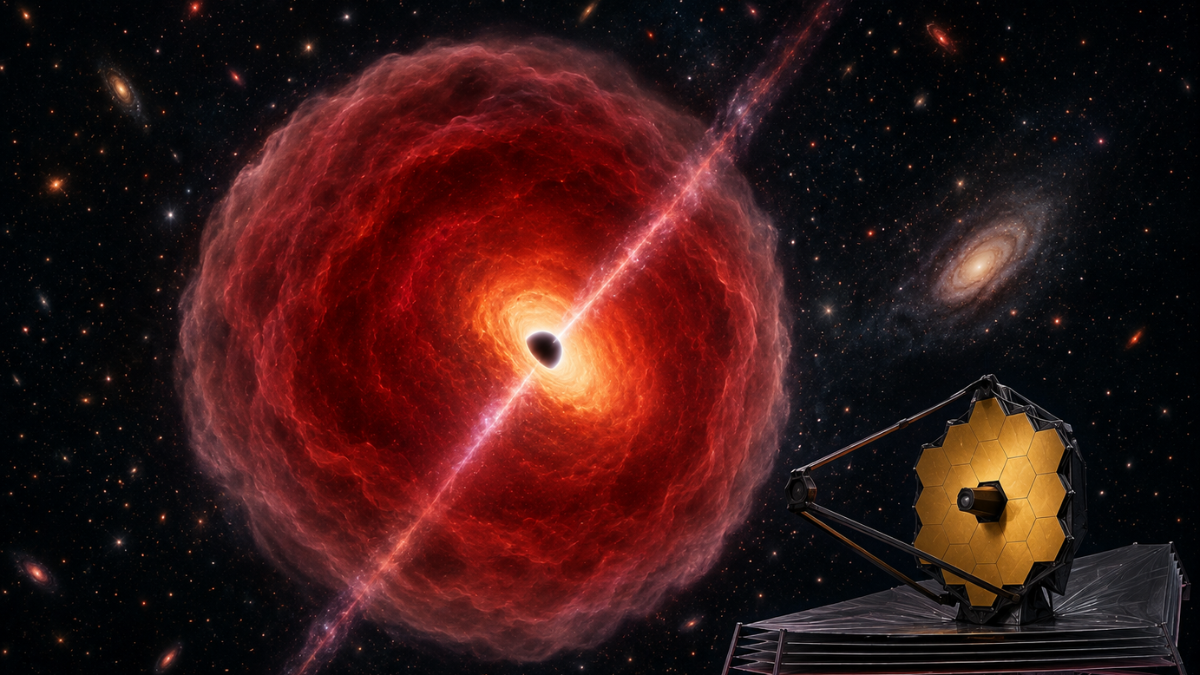
What is a black hole star discovered by MIT astronomers? It is not a conventional star with a black hole nearby. The leading model describes a central, actively feeding black hole surrounded by an extended envelope of hydrogen gas.
That distinction matters.
In a normal star, fusion in the core produces outward pressure that balances gravity. In MoM-BH-1, the likely engine is accretion. Gas falling toward the black hole releases enormous energy, heating the surrounding cocoon from within.
So, how does a black hole star differ from a normal star? Its power source is the central answer. This is a Black hole star vs nuclear fusion star energy problem, and accretion wins by a ridiculous margin in this case.
Rohan Naidu MIT black hole star study co-author and colleagues estimate that the central object could weigh around 100,000 Suns. That makes this a possible 100 thousand solar mass black hole star discovery, wrapped in gas rather than exposed as a familiar active galactic nucleus.
The spectral clue that changed the picture
A James Webb Space Telescope black hole star discovery needs more than a surprising image. It needs spectral evidence.
Researchers initially considered dust. Dust can make a distant object look red, much like smoke changes the color of sunlight. But MoM-BH-1 did not show the expected chemical fingerprints of a dusty galaxy. Its light was dominated by hydrogen and helium, with almost no heavier elements.
Then came the crucial clue: a very deep drop in light at certain wavelengths.
This Balmer break signature deep space red dot JWST observation pointed to dense hydrogen absorbing photons. A dense hydrogen cocoon create a deep Balmer break signature because the gas is packed tightly enough to behave less like a thin cloud and more like the outer surface of a giant star.
The JWST little red dots explained black hole star Nature paper argues that ordinary stellar populations cannot create a break this extreme without other evidence that simply isn't there.
That doesn't mean every red dot has been solved. Science almost never works that neatly. But MoM-BH-1 gives astronomers a physically credible model to test.
Could black hole stars explain early giant black holes?
Maybe.
Supermassive black hole seeds early universe JWST observations have long posed a timing problem. How did some black holes grow so massive so soon after the Big Bang? Starting with small stellar-mass black holes can be painfully slow under standard growth limits.
A hydrogen-wrapped, rapidly feeding black hole could offer a route around part of that problem. The MIT Kavli Institute team identifies MoM-BH-1 as a possible missing link in supermassive black hole growth because its central black hole may already be unusually massive while still buried in an early, gas-rich environment.
The object was found through the Mirage or Miracle survey MoM BH 1 black hole search, whose original aim was early galaxy identification. That accidental angle is part of what makes the result fun. You look for galaxies, and the universe hands you a new category instead.
For perspective, space science often moves through that same unexpected chain of evidence, whether it comes from lunar soil analysis, Tianwen-2 navigation data, or a new type of deep-space spectrum.
Why little red dots vanished later
What are the little red dots in JWST deep space images? They are compact, red, highly distant sources, mostly seen in the young universe. Some may be black hole stars embedded in young galaxies. Others could turn out to be different objects entirely.
Why do little red dots disappear in the present-day universe? The likely answer is environmental. Early galaxies had abundant pristine gas and very different conditions for black hole growth. As galaxies matured, metals, stars, feedback, and changing gas supplies altered the setup needed to maintain these dense envelopes.
MoM-BH-1 black hole star spans size of solar system while emitting 100 billion times more energy than a normal star. That extreme state may have been brief, rare, and tied to a universe that no longer exists in the same form.
A new way to view the early universe
The Black hole star discovery JWST little red dots MoM-BH-1 may be the first clear glimpse of an object that sits between familiar labels. It isn't a normal star. It isn't just a naked black hole, either.
Instead, it may be a black hole growing inside a solar-system-sized hydrogen cocoon, bright enough to outshine its host galaxy.
That possibility makes the James Webb Space Telescope black hole star discovery more than a curiosity. It could help explain how early black holes gained mass so quickly, why little red dots appear in ancient images, and why they faded from the modern cosmos. Meanwhile, advances across the field, from China's space industry to a reusable rocket engine, will keep expanding the tools available to ask those questions.
GlobalByte Perspective
The discovery of MoM-BH-1 could be one of the more interesting clues yet to emerge from JWST's study of the early universe. What makes it stand out isn't simply the idea of a black hole surrounded by gas, but the possibility that astronomers are seeing a stage of black hole growth that doesn't have an obvious modern equivalent.
The object appears far too bright to be powered by ordinary stars, while its unusual hydrogen signature points toward a dense envelope surrounding a massive central black hole. If that interpretation survives further observations, MoM-BH-1 could help explain how some enormous black holes managed to grow so quickly when the universe was still very young.
It may also give astronomers a better explanation for the mysterious little red dots that JWST keeps finding in the distant universe. That doesn't mean every little red dot is a black hole star, but MoM-BH-1 shows that these strange objects may have a much more complicated story than initially expected.
For GlobalByte News, the bigger takeaway is simple: JWST isn't just finding older galaxies. It's uncovering objects that are forcing astronomers to rethink how the early universe worked.