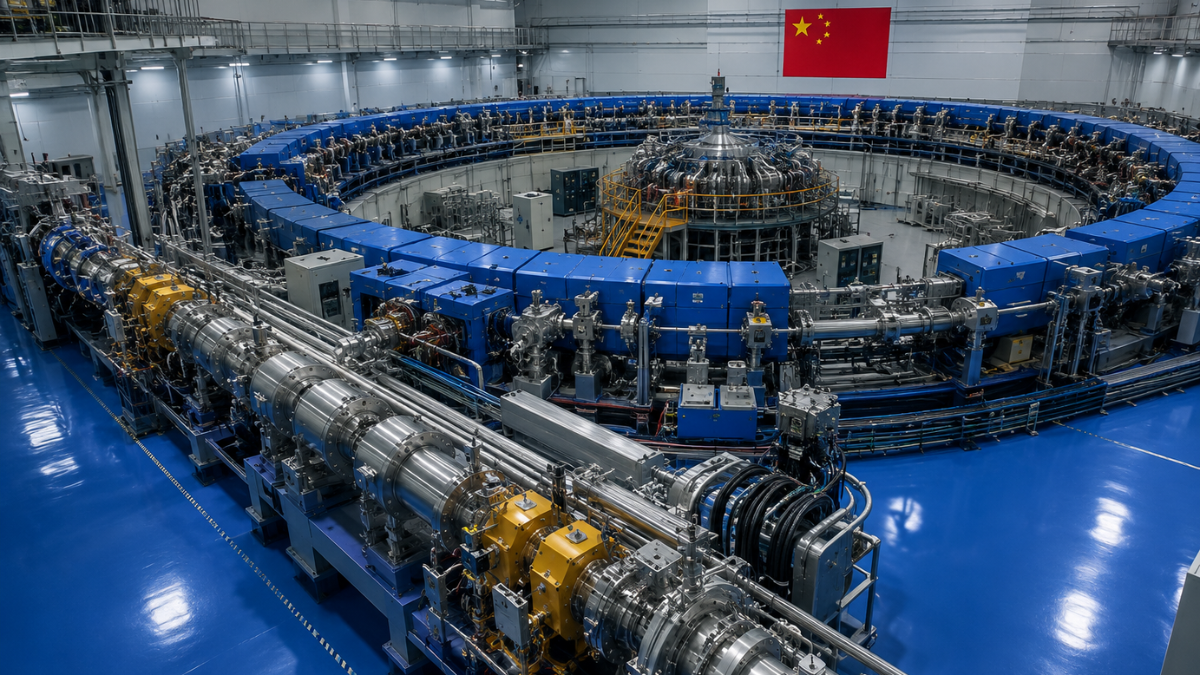
Scientists in southern China just switched on something they spent 16 years building. The China HIAF particle accelerator, short for High Intensity Heavy-ion Accelerator Facility, is now producing the most intense beams of charged atoms ever generated anywhere on Earth. Not "one of the most intense." The most intense, full stop.
That's a big claim. But the numbers back it up, and so does the physics community that's been waiting for this machine to come online.
Built in Huizhou, Guangdong province, at a cost of roughly 2.6 billion yuan (about US$384.1 million), the facility finished construction this week and has already begun scientific operations, according to state news agency Xinhua. It's the kind of infrastructure project that doesn't make headlines the way a new bridge or airport does. But for nuclear physicists, this one's a big deal.
What Exactly Is HIAF?
HIAF stands for High Intensity Heavy-ion Accelerator Facility, and it was developed by researchers at the Institute of Modern Physics in Lanzhou, Gansu, working alongside collaborators across the country. Sixteen years is a long development timeline for anything. For a piece of scientific infrastructure this complex, it's almost normal.
Here's the basic idea. Atoms lose electrons and become positively charged ions. Electric fields accelerate those ions, magnetic fields steer them, and the result is a beam of particles moving at extraordinary speed. Yang Jiancheng, HIAF's chief engineer at the Institute of Modern Physics, described it to Xinhua in blunt terms: "These fast-moving ions act like microscopic bullets." Fire them into target nuclei, or smash them into each other, and you recreate conditions that otherwise only exist inside stars or during a supernova explosion.
That's not a metaphor for the sake of a good quote. It's literally what the machine does.
Just How Powerful Is This Accelerator?
This is where the record-breaking part comes in. HIAF can pack up to eight times as many atoms into a single pulse compared to the previous world record holder, a German particle accelerator based in Darmstadt. Eight times. That's not an incremental upgrade; it's a different category of machine.
The Darmstadt facility (run by GSI Helmholtzzentrum für Schwerionenforschung) has long been the benchmark for heavy-ion research in Europe. HIAF doesn't just match it. It leapfrogs it on beam intensity, which is the metric that determines how much data scientists can actually collect per experiment. More ions per pulse means more collisions, more rare isotopes produced, and faster results across the board.
So how does China's HIAF stack up against other major facilities, like the Facility for Rare Isotope Beams in the United States? Structurally, HIAF is unusual. Most comparable facilities run a single accelerator type. HIAF combines a 100-metre-long linear accelerator with a 570-metre-circumference circular accelerator and storage rings, all in one connected complex. That combination lets researchers push atomic nuclei to higher energies and then keep them circulating for repeated experiments, rather than firing once and starting over.
Where Is HIAF Located, and Why Huizhou?
The facility sits in Huizhou, a city in Guangdong province in southern China. It's part of a broader push to build out major scientific infrastructure across the Greater Bay Area, and it joins a growing list of large-scale physics installations the country has stood up in recent years, including the PandaX dark matter laboratory buried deep underground at Jinping.
HIAF was first proposed back in 2010 and got the official nod from the National Development and Reform Commission as a major national scientific research facility the year after. Construction itself didn't start until December 2018, which means there was nearly a decade of planning, design work, and technical groundwork before a single support beam went up. The facility produced its first particle beam in October 2025, and it's been quietly racking up early results ever since.
The Engineering Problem Nobody Talks About: Keeping a Vacuum That Clean
Building an accelerator that intense isn't just about bigger magnets and longer tunnels. Yang pointed out that his team had to solve some genuinely hard engineering problems along the way, including finding ways to accelerate ions much faster than before. They also had to construct one of the world's largest ultra-high-vacuum systems, because even trace amounts of stray gas molecules in the beam path would cause collisions that ruin the experiment.
Think about that for a second. You're trying to keep a nearly perfect vacuum across a complex that stretches hundreds of meters. Any imperfection and the whole point of the machine, precise, repeatable collisions, falls apart.
Superconducting components play a role here too, and China has been on something of a tear lately when it comes to superconducting hardware. Earlier this year, the country logged a world's largest fusion reactor magnet test, and separate teams reported superconducting magnet breakthroughs that pushed the technology further still. None of that work is directly part of HIAF. But it's the same broader ecosystem of expertise that made a project like this feasible in the first place.
What Will the HIAF Particle Accelerator Actually Be Used For?
Fundamental physics is the headline use case, but it's not the only one. Yang laid out several directions researchers plan to pursue:
- Testing whether there's an actual end to the periodic table, or if heavier and heavier elements can keep being synthesized
- Figuring out how elements like gold and uranium formed in the first place
- Mapping the structure of the most exotic, short-lived atomic nuclei
- Determining how large and unstable a nucleus can get before it simply falls apart
And then there's the applied side, which honestly might matter more to the average person than the pure physics does. HIAF will be used to test spacecraft materials against radiation exposure, something that matters enormously as China ramps up satellite launches and deep-space missions. If you've followed China's deep space research program, you already know radiation hardening is a constant headache for mission planners, and a facility like this gives engineers a controlled way to stress-test materials before they ever leave the ground.
Can HIAF help with cancer treatment too? Yes, actually. Heavy-ion beams are already used in some cancer therapies because they can target tumors with more precision than conventional radiation, and HIAF is expected to support research into new medical isotopes as well. Better materials science is on the list too, which tends to be one of those quietly important side benefits that basic physics research throws off almost by accident.
Why This Fits a Bigger Pattern
HIAF didn't appear in a vacuum (pun somewhat intended). It's one piece of a much larger set of investments China has been making in scientific infrastructure, part of what amounts to China's major science and technology bets over the past several years.
Consider the computing side of things. Modern particle physics generates staggering volumes of data, and processing it requires serious horsepower. China's top-ranked Chinese supercomputer and the broader world's fastest supercomputer architecture behind it give researchers somewhere to actually crunch the numbers HIAF will produce. There's also a CAS domestic supercomputing platform designed specifically to bridge that kind of research infrastructure together.
The aerospace angle keeps popping up too. A new space computing innovation center is pushing AI processing into orbit, while a first comprehensive research aircraft recently completed its maiden flight to study atmospheric conditions. Rocket propulsion is getting attention as well, with a CAS Space engine test program logging a 620-second burn earlier this year. And since the Institute of Modern Physics that designed HIAF is based in Lanzhou, it's worth mentioning that Lanzhou's new aerospace research school opened recently too, in the same city, feeding into the exact same talent pipeline.
None of these projects are HIAF. But taken together, they paint a picture of a country building basic-science capacity across the board, not just in one flashy facility.
Open to Researchers Worldwide
Here's something that might surprise you. Xinhua's report noted the facility will be open to scientists from around the world, not just domestic researchers. That's fairly standard practice for large-scale physics infrastructure (CERN operates the same way), but it's still worth flagging given how much attention gets paid to scientific competition between countries these days.
Early results are already trickling in. Since that first particle beam back in October 2025, HIAF has reported findings in high-precision nuclear mass measurements, radioactive nuclei production, radiation testing of materials, and precision studies of highly charged ions. That's a fast start for a machine this complex.
The Takeaway
Sixteen years, 2.6 billion yuan, and a design that fuses three different accelerator technologies into one complex. That's what it took to build the China HIAF particle accelerator, and now that it's running, the payoff starts. Not just for abstract questions about how heavy elements form or where the periodic table ends, but also for spacecraft engineers, cancer researchers, and materials scientists, who'll all get something useful out of it, too.
It's early days. The first beam was only in October 2025. But the initial results, on nuclear mass measurements, radioactive nuclei, and radiation testing, are already coming in, and the facility's doors are open to researchers from anywhere in the world. Give it a few years, and HIAF might end up being the machine that answers questions nuclear physicists have been asking for decades.