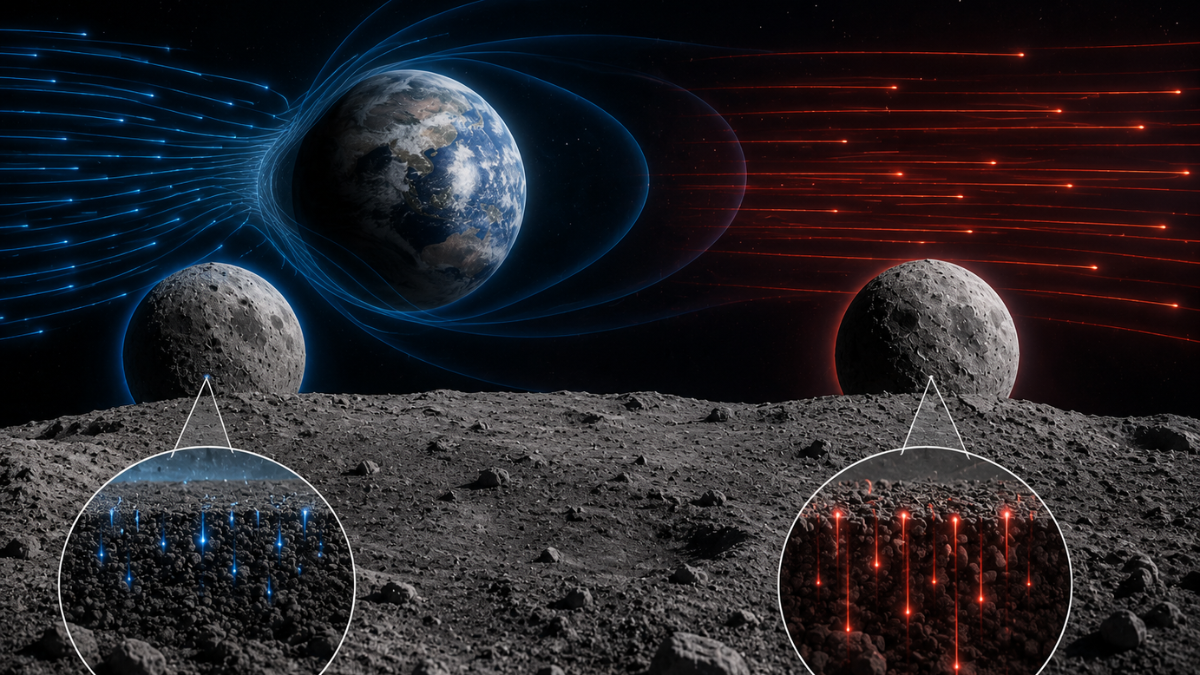
Scientists suspected for decades that the moon's two sides weren't getting the same solar wind. The near side always faces Earth, dipping in and out of our planet's magnetic influence during each orbit. The far side faces open space - no shield, no buffer. But without far-side samples, you couldn't actually prove it.
Now you can. The first systematic Chang'e 6 lunar soil noble gas solar wind analysis, published in Nature Geoscience and led by postdoctoral researcher Zhang Xuhang at the Institute of Geology and Geophysics of the Chinese Academy of Sciences under researcher Huaiyu He, has delivered direct physical evidence. Earth's magnetosphere genuinely slows the solar wind before it reaches the moon's near side. The far side gets the full, unfiltered blast.
The Hypothesis That Needed Far-Side Proof
The moon is tidally locked. Same face to Earth, always. During part of each orbit, that near side passes through Earth's magnetosheath - a turbulent transition zone where solar wind decelerates sharply after interacting with Earth's magnetic field. The far side? Always turned away from Earth, always outside that buffer.
So the logic was straightforward. Slower wind on the near side, faster wind on the far side. Different implantation depths. Different isotope ratios locked in the soil. But logic doesn't count as evidence. You need samples.
Chang'e 6 retrieved approximately 1,935 grams of regolith from the South Pole-Aitken Basin in 2024 - the first-ever soil collected from the far side of the Moon. That sample changed what's knowable.
What the Chinese Academy of Sciences Found in the Rare Gas Isotopes
The research team measured concentrations and 23 isotope compositions across five noble gases: helium, neon, argon, krypton, and xenon. Noble gases are chemically inert. They don't bond with anything in the regolith; they just sit exactly where the solar wind put them. That stability makes them near-perfect tracers for this kind of work. The Chinese Academy of Sciences lunar soil rare gas isotope measurements painted a clear picture relatively quickly.
The neon isotope ratio in the far-side Chang'e 6 samples was unlike anything previously seen in near-side lunar soil. Not a statistical edge case. A genuinely distinct signature - consistent with higher-energy, higher-velocity solar wind implantation - pointing directly at unmoderated solar wind exposure.
And then the krypton and xenon results came in.
The Stepwise Heating Experiment: Where Krypton and Xenon Settled It
Heavy noble gases don't diffuse inside lunar regolith. Once krypton and xenon are implanted, they stay. And because their release temperature during stepwise heating directly reflects implantation depth, you can read them like a forensic record of the original solar wind velocity. Faster particles implant deeper. Deeper means higher release temperature.
Far-side Chang'e 6 samples: xenon released at high temperature. Single peak. Deep implantation throughout.
Near-side Chang'e 5 samples: a double-peak pattern, with gas coming out at both low and high temperatures. That's shallow implants mixed with deeper ones - exactly what you'd expect from solar wind that had already been partially slowed before impact.
The krypton and xenon single-peak high-temperature release pattern from the far-side soil is about as clean a confirmation as this field produces. The two samples are telling completely different stories about the solar wind that shaped them, and those stories match the magnetosheath model exactly.
How Earth's Magnetosheath Acts as a Speed Governor
Normal solar wind velocity is roughly 400 km/s. When it interacts with Earth's magnetosphere, the magnetosheath region forces it down to around 200 km/s. That decelerated plasma sweeps across the lunar near side for part of each orbit. The far side never enters this zone - it absorbs full-speed particles the entire time.
The research team estimated that the Chang'e 5 near-side landing site was exposed to this slowed magnetosheath wind about 25% of the time. The Chang'e 6 far-side site? Zero percent. Computer simulations confirmed that 200 km/s particles produce exactly the shallow implantation profiles seen in near-side regolith.
This is the first empirical measurement of how Earth's magnetosphere slows solar wind on the moon - not a model, not an inference, but a reading taken directly from the soil itself.
Why This Opens a New Window on Earth's Own Magnetic History
Here's what makes this more than a confirmation of existing theory.
The researchers propose that heavy noble gases preserved in lunar regolith could function as a fossil record - a permanent signature of where Earth's magnetospheric boundary sat at different points across geological time. Krypton and xenon are stable. They don't migrate after implantation. If their depth profiles and isotope fingerprints in old regolith layers reflect the solar wind conditions when those particles hit, then ancient lunar samples may let you trace how Earth's magnetic field has evolved over billions of years.
Reading Earth's deep magnetic past through moon dirt. The moon has been taking notes on Earth this whole time - we're only just starting to read them.
Part of a Broader Scientific Push
This discovery sits inside a much larger story about China's space industry momentum - one that spans government programs, commercial investment, and serious laboratory science capable of doing something with the samples missions bring back. The same ecosystem funding far-reaching programs like the Tianwen-2 deep space mission is funding the labs that analyzed these 1,935 grams of far-side regolith.
Launch capability makes it all possible. China's Long March 10B rocket development, a CAS Space reusable rocket engine tested for 620 seconds, and milestones like the Long March 4B satellite launch show the infrastructure pipeline that supports missions at this level.
Academic investment is building the next generation of researchers. Lanzhou University aerospace school expansion is training scientists who'll work with whatever future sample-return missions bring back. Cross-disciplinary expertise matters here too - China's atmospheric research aircraft program is developing atmospheric and space weather science that connects directly to magnetosphere research.
The technological ambition runs even further than sample science. Beijing space computing innovation centers are bringing AI into orbital applications. Orbital data center infrastructure is being developed for in-space processing. Records like the world's largest fusion magnet test show the scientific breadth behind what's happening across the full research system.
The Chang'e 6 noble gas findings don't come from nowhere. They come from a system that's been building seriously for years.
What the Moon Has Been Recording All Along
The Chang'e 6 lunar soil noble gas solar wind analysis confirms what was long suspected but never proven: Earth's magnetic field acts as a speed regulator for solar wind reaching the lunar near side. The far side - permanently exposed, never shielded - absorbs faster, deeper-penetrating particles. And that difference is now measurable, isotope by isotope, in the soil itself.
The larger implication is harder to overstate. Heavy noble gases preserved in lunar regolith may hold a billion-year record of Earth's magnetic boundary - a fossil archive that no Earth-based rock record can replicate. The moon has been taking notes on our planet's magnetic history this whole time. The Chang'e 6 sample is one of the first real chances to read what it wrote.