Summary
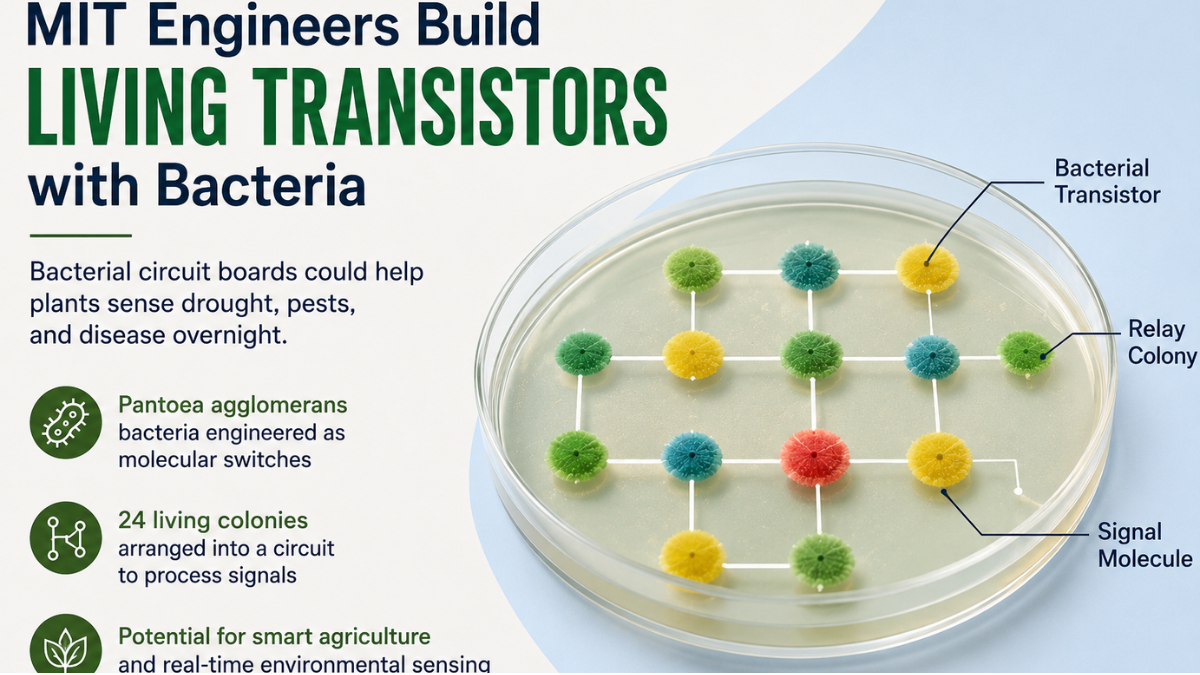
The MIT living transistors bacterial circuit board Pantoea agglomerans project sounds like science fiction at first. It isn't. MIT engineers have designed bacterial colonies that work like molecular switches, then arranged those colonies into living circuits capable of processing signals and performing calculations.
Not fast calculations, of course. A phone can complete billions of operations while you blink. These bacterial circuits can take roughly eight hours to finish one calculation.
But that's not really the point.
If a plant root could sense drought overnight, identify a pest-related signal, and trigger a protective response before the next day, speed at computer-chip scale wouldn't matter much. The value is putting computation directly where biological decisions need to happen.
Key Points
- MIT researchers built living circuits using engineered bacterial colonies.
- The system uses Pantoea agglomerans, a bacterium commonly found on plant surfaces.
- Two bacterial strains act as molecular transistors, while three others work as relays.
- The colonies communicate through signaling molecules rather than electrical current.
- Researchers demonstrated OR, imply, multi-input logic and demultiplexer operations.
- The largest demonstrated circuit contained 24 bacterial colonies and performed multi-input addition.
- A calculation currently takes around eight hours, making it unsuitable for conventional computing.
- Potential applications include drought, pathogen and pest detection in agriculture.
- The research was led by Hamid Doosthosseini, with Christopher Voigt as senior author, and was published in Nature Chemical Biology.
- The technology is still early-stage, and real-world agricultural use would require major testing for stability and reliability.
MIT Living Transistors Bacterial Circuit Board Pantoea Agglomerans: What MIT Built
In a standard electronic circuit, a transistor controls electrical current. It acts as a switch, allowing current to pass or stopping it based on an input signal.
MIT synthetic biology living computer circuits use a comparable idea, but replace electricity with signaling molecules. Engineered bacteria detect molecules in their surroundings, interpret those signals, and release new molecules that communicate instructions to nearby bacterial colonies.
The result is a Pantoea agglomerans biological circuit board built from living cells.
Rather than squeezing every calculation into one overworked bacterial cell, the researchers gave separate colonies separate jobs. One colony functions as a transistor. Another receives and relays its output. A third continues the calculation. Printed together on agar, they form a distributed biological computing system.
That layout matters. Synthetic biology often runs into a frustrating limitation: too many engineered genetic instructions inside one cell can cause crosstalk, resource strain, or both. Cells only have so much protein-making capacity. Ask them to do everything, and performance gets messy.
Christopher Voigt MIT biological engineering living transistors research takes the opposite route. Spread the labor around.
Why Pantoea agglomerans Was Chosen for a Living Circuit Board
The bacterium at the center of the work is Pantoea agglomerans, a species commonly found on plant surfaces. That makes it a particularly interesting candidate for future agricultural use, since it already has a natural relationship with the environments where crops grow.
So, what bacterium is used to build living circuit boards at MIT? Pantoea agglomerans.
Researchers engineered two bacterial transistor types. Both respond to a control molecule called OC-6 and can detect a target molecule known as OC-12. One transistor turns on when it receives the OC-6 input. The other turns off.
Depending on the combination of signals it receives, each cell releases an output molecule called OHC-14.
That chemical output becomes the circuit's message. Three additional engineered bacterial strains act as relays, translating the OHC-14 signal into a new molecular input that another transistor can understand. In other words, bacterial transistors communicate using signaling molecules to perform logic operations.
It's clever because the cells aren't merely sensing their environment. They're passing information onward in a controlled sequence.
How MIT Engineers Create Living Transistors From Bacteria
How do MIT engineers create living transistors from bacteria? By engineering cells so their genetic programs behave like conditional switches.
A biological transistor receives molecular inputs, evaluates whether certain conditions are met, then produces a molecular output only when the logic says it should. The two transistor designs in this study respond differently to the same switching signal, giving the team a useful on-off pair.
That small distinction opens the door to much more complicated behavior.
The MIT engineers living transistors bacteria research team combined five engineered strains in total:
- Two strains worked as molecular transistors.
- Three strains worked as relays between transistor colonies.
- Each strain interpreted or passed on chemical signals in a controlled way.
Those five strains function as universal building blocks for living circuits. Change the physical layout, alter the routes between colonies, and you can produce a different computation.
This is how biological transistors prevent cellular crosstalk in synthetic biology. Instead of relying on a huge number of unique transcription factors inside one cell, the system separates tasks across multiple colonies and uses distance-based molecular communication to direct the signal.
A Circuit Board Printed on Agar, Not Silicon
The biological circuit board agar plate printing process is surprisingly physical. Researchers print bacterial colonies onto an agar growth medium, positioning each colony about five millimeters from its nearest neighbor.
That spacing isn't arbitrary.
It helps ensure that a molecular signal reaches the intended next colony rather than drifting across the whole plate and creating unwanted interference. Information moves from one bacterial group to the next, like a relay race conducted through chemistry.
MIT researchers print living circuit boards onto agar plates capable of complex calculations, but the method also hints at where this could eventually go. The same basic system could potentially be printed onto plant leaves or roots.
That possibility shifts the conversation away from traditional computing. These circuits aren't competing with AI computing infrastructure, near-memory computing, or a 3D AI chip. They solve a different problem entirely: how to make a living surface sense, calculate, and respond locally.
What Calculations Can Bacterial Logic Gates Perform?
Bacterial switches logic gates demultiplexer MIT experiments showed that these living transistors can support several familiar logic operations.
The researchers demonstrated multi-input, OR, and imply gates. They also connected transistors into larger circuits that added two or three inputs and built a demultiplexer. A demultiplexer receives one incoming signal and routes it to one of several possible destinations according to a control signal.
The largest system in the study contained 24 bacterial colonies and performed multi-input addition.
That is not a tiny proof of concept. The MITVoigt Lab creates 24 colony bacterial circuit capable of multi input addition by coordinating many separate bacterial populations, each with a narrow role in the larger design.
And yes, cellular transistors vs silicon transistors computing is an uneven comparison if you judge only by speed. Silicon wins so completely that it isn't even close. Yet biological circuits can operate where ordinary electronics are a poor fit: on roots, leaves, soil, or other living surfaces.
Eight Hours Is Slow. For Agriculture, It May Be Fine.
How fast do living bacterial transistors perform calculations? Current circuits take around eight hours per calculation.
That sounds painfully slow until you think about the intended use. A crop doesn't need to process stock-market trades in microseconds. It may need to recognize that soil moisture is falling, that a pathogen-associated signal is present, or that pest pressure is rising.
A response over several hours could still be useful across a growing season.
Biological circuit boards could coat plant roots to detect drought and fight agricultural pests. Once the system recognizes a specific molecular pattern, it could potentially trigger a response such as producing a protective compound or signaling a change in plant treatment.
There are real hurdles, though. Lab agar plates are controlled environments. Fields are not. Rain, competing microbes, temperature swings, soil chemistry, regulation, and long-term reliability would all need serious work before bacterial circuits become an agricultural product.
Still, the logic is compelling. Put sensing and decision-making near the problem instead of waiting for distant analysis.
Living Computers and Silicon Computers Can Coexist
It helps to see this research as part of a wider computing picture. Traditional hardware keeps becoming more specialized through heterogeneous computing, new supercomputing architecture, advanced chip manufacturing, and silicon photonics.
Living circuits follow another path. They use cells as the hardware.
That doesn't make them replacements for conventional processors. It makes them potential biological controllers. A future smart crop might use bacterial logic to make local decisions, while data systems and AI chip technology handle larger-scale analysis elsewhere.
The field also connects naturally with cell-free protein synthesis and AI-assisted biology platforms, where researchers are finding faster ways to design, test, and manufacture biological systems.
Different substrates. Different strengths. Same broad ambition: make computation useful in places where it wasn't practical before.
Who Led the MIT Living Circuit Board Study?
Hamid Doosthosseini, an MIT postdoctoral researcher and the study's lead author, helped develop the system. The Hamid Doosthosseini MIT bacteria transistor paper was co-authored by former MIT postdoc Haorong Chen.
Christopher Voigt, head of MIT's Department of Biological Engineering, served as senior author.
The paper appeared in Nature Chemical Biology. That makes the Living circuit boards Nature Chemical Biology research especially relevant to anyone following practical synthetic biology, not just speculative bio-computing headlines.
What Comes Next for Bacteria Transistors?
The MIT living transistors bacterial circuit board Pantoea agglomerans system is still early-stage research. It has not yet turned crops into self-managing biological computers, and it shouldn't be presented that way.
But the core advance is meaningful.
MIT engineers wire together bacterial colonies to build living transistors and circuit boards with reusable components. Those components can be rearranged into logic gates, signal-routing systems, and multi-input calculations. That modularity is what could make future designs more ambitious.
If researchers can make these systems stable outside the lab, bacteria transistors agricultural environmental sensing could become useful for detecting drought, pathogens, nutrient shortages, or pest activity directly on plants and roots.
Slow? Definitely.
Potentially useful anyway? Also definitely.
A New Kind of Circuit, Built for Living Environments
The MIT living transistors bacterial circuit board Pantoea agglomerans research doesn't challenge silicon on speed, storage, or general-purpose computing. It offers something stranger and, for certain applications, more useful: programmable logic made from bacteria that can live where conventional electronics cannot.
How Pantoea agglomerans bacteria are engineered to act as molecular switches in biological computing is only the beginning. If the technology matures, a plant's own surface could become a sensing layer, a signal-processing network, and a response system all at once.
That idea is still years away from ordinary farms. But it is no longer just an idea.
GlobalByte Perspective
MIT's bacterial circuit research sounds futuristic, but the interesting part is actually quite practical. The team has shown that engineered bacteria can work together like tiny biological switches, passing chemical signals between colonies to perform calculations.
This isn't about replacing laptops or AI chips. The circuits are extremely slow — one calculation can take around eight hours. But speed isn't the main goal. The real opportunity is putting simple decision-making directly into places like plant roots, leaves, or soil, where traditional electronics aren't always practical.
The 24-colony system is what makes the research especially interesting. Instead of forcing one cell to handle everything, the researchers spread different jobs across bacterial colonies and connected them through chemical signals. That approach could make more complex biological circuits possible in the future.
GlobalByte Perspective: This is not a faster computer. It's a different kind of computer, built for environments where silicon doesn't make much sense. The bigger test will be whether these bacterial circuits can eventually work reliably outside controlled lab conditions.