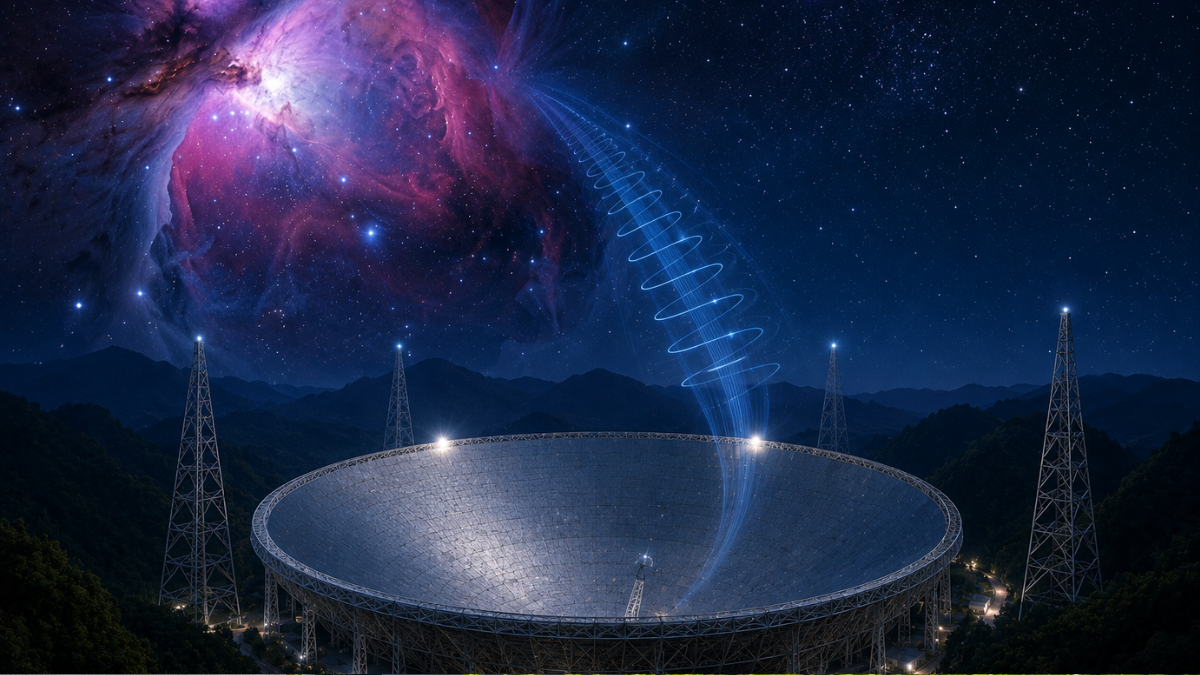
For over a hundred years, the origin of low-energy cosmic rays was one of astrophysics' most stubborn open questions. In 2026, a Chinese research team finally cracked it.
Scientists from Tsinghua University's Department of Astronomy, working with colleagues at Anhui Normal University and the University of Science and Technology of China, published findings in The Astrophysical Journal Letters proving that low-energy cosmic rays are generated inside star-forming regions. The low-energy cosmic rays origin FAST telescope discovery - led by Professor Li Di of the New Cornerstone Research Institute - used observations of the Orion Nebula to deliver the first hard observational evidence for this connection.
If you track the latest science discoveries, this one stands out. Not just for what it found, but for how it found it.
Why Was the Origin of Low Energy Cosmic Rays a Mystery for So Long?
Cosmic rays come in a wide range of energies. The high-energy variety gets most of the attention - they travel in near-straight lines and can be traced back to sources like supernova remnants. Low-energy cosmic rays are far trickier.
They scatter constantly. Interstellar magnetic fields deflect them, destroying any directional information that might reveal their birthplace. Researchers could measure what these particles do - ionize molecular gas, alter interstellar chemistry, slow or accelerate star formation rates - but pinpointing where they came from was essentially impossible with existing tools.
The Orion Nebula low-energy cosmic rays ionization rate has real physical consequences for how quickly stars form in that cloud. Whether those particles are born locally, inside the star-forming region itself, or arrive from across the galaxy changes the entire model. That's the distinction this study finally resolved.
The Method That Made This FAST Telescope Discovery Possible
The team didn't just look harder at the problem. They built a new tool to look with.
HINSA - Neutral Hydrogen Narrow Line Self-Absorption - is the technique they developed from scratch. The neutral hydrogen narrow line self-absorption method detects how cosmic ray ionization changes the physical state of atomic hydrogen gas inside a molecular cloud. When cosmic rays ionize that gas, they leave faint absorption signatures in narrow radio spectral lines. Subtle ones. Isolating those signatures requires extraordinary measurement precision - and that's exactly where FAST proved irreplaceable.
The Five-hundred-meter Aperture Spherical radio Telescope's collecting area is simply in a different class from competing instruments. For signals buried this deep in astrophysical noise, that size advantage isn't a nice feature. It's the whole reason the measurement is possible.
China's large-scale physics research infrastructure has been building toward results like this for years. The team also cross-referenced FAST data with gamma-ray observations from NASA's Fermi Gamma-ray Space Telescope. The Fermi Gamma-ray Space Telescope joint FAST data analysis confirmed elevated cosmic ray density inside the Orion molecular cloud - too high to be explained by particles drifting in from the broader Milky Way. They had to be generated locally by the star formation process.
CAS supercomputing platforms supported the heavy data processing work behind this analysis. Scientific breakthroughs at this scale are as much a computing achievement as an observational one.
Stars Illuminate the Milky Way in Two Ways, Not One
Here's the headline finding, and it reframes how we think about stars.
The violent processes involved in star formation - shocks, outflows, magnetic field compression - accelerate particles to cosmic-ray energies. Those particles then ionize surrounding gas and drive the chemical evolution of the interstellar medium. Stars, it turns out, inject energy into their environment through two completely separate channels: light and cosmic rays.
That's a real revision to existing models. The in situ acceleration of low-energy cosmic rays in the Milky Way means the feedback loop between stars and their environment is more active - and far more local - than the standard galactic diffusion model assumed. Star-forming regions’ cosmic ray acceleration is now an observationally confirmed phenomenon, not a theoretical prediction.
Chinese Academy of Sciences space programs and partner institutions provided the collaborative infrastructure behind this research. And the aerospace science talent pipeline inside Chinese universities is clearly producing researchers capable of building new observational methods from scratch - which, here, is precisely what made the difference.
What This Opens Up for Future Cosmic Ray Research
The Orion Nebula was a proof of concept. Now the method scales.
HINSA can be applied to map cosmic ray distributions across other star-forming regions throughout the Milky Way. Atomic hydrogen is abundant everywhere you look. That means this technique - once validated, which it now is - becomes a general-purpose tool for galaxy-wide cosmic ray mapping. That's a much larger deal than a single result from a single nebula.
China's satellite observation network is expanding in parallel with ground-based capabilities. China's space program milestones increasingly extend into fundamental science rather than pure engineering, and space-based AI computing could eventually help automate pattern recognition in the kind of faint spectral signals HINSA depends on. As orbital data processing advances continue, multi-messenger astronomy combining radio and gamma-ray data will only get faster.
This result fits a broader pattern of unexpected scientific discoveries from Chinese research institutions - findings that don't just confirm existing theory but force revisions to it. China's atmospheric research programs and China's expanding space science ambitions are both on strong upward trajectories. The FAST cosmic ray result is a clear output of that investment.
Why the Low Energy Cosmic Rays Origin FAST Telescope Discovery Matters
This wasn't incremental progress. A century-long question now has its clearest observational answer yet - and it came from a method that didn't exist before this team built it.
Star-forming regions produce low-energy cosmic rays in situ. Those particles ionize the surrounding gas. The ionized gas evolves chemically. And that evolved gas feeds into the next generation of star formation. The low-energy cosmic rays origin FAST telescope discovery just gave researchers a way to directly observe one link in that chain - which changes what's possible for every interstellar medium study that follows.
The Astrophysical Journal Letters publication is a beginning, not an endpoint. Expect the HINSA method in many more papers in the years ahead. And expect the Orion Nebula to be remembered as the place where the measurement that made this all possible was first validated.