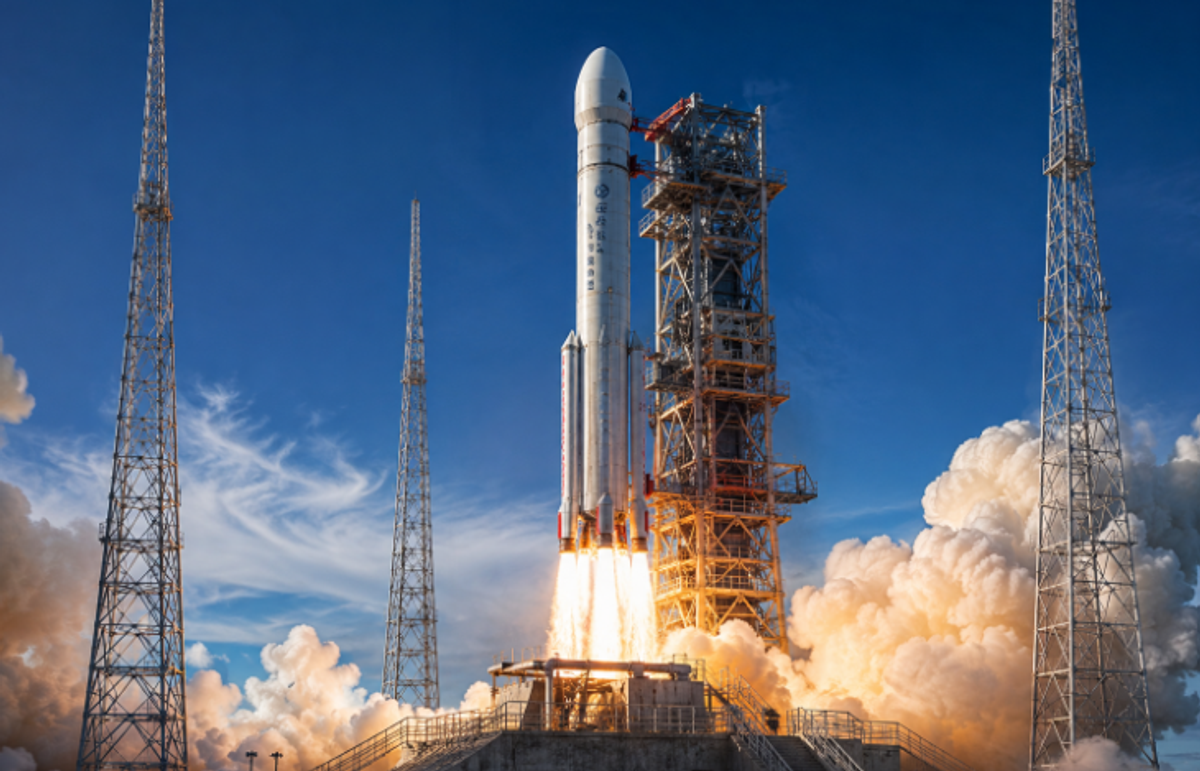
Something significant just happened in Chinese commercial space. CAS Space - the Guangzhou-based rocket developer tied to the Innovation Academy for Microsatellites of the Chinese Academy of Sciences - completed what might be the most demanding China reusable launch vehicle rocket engine test run by a private firm to date. The engine, the Kinecore 2, is rated at 110 tonnes of thrust on liquid oxygen and kerosene. It burned for 620 continuous seconds during the qualification trial. That's roughly 3.5 times what an actual flight demands. And a single ignition held stable for 400 seconds, setting a new stability record for the engine model.
That's not a routine checkout. That's a statement.
What the 620-Second Run Actually Proved
The duration grabs attention. The conditions are what matter.
This wasn't a controlled burn at comfortable parameters. The long duration engine firing test simulated sustained high temperatures, extreme rotational speeds, intense heat flux, and continuous vibrations - all at once, not sequentially.
Ming Aizhen, deputy general manager of the power design department at CAS Space, described it plainly: "The extended test is a critical qualification that verifies the engine's stable performance, fully covering flight conditions and demonstrating a sufficient life margin."
You don't run an engine for 3.5 times its required flight duration just to confirm it functions. You do it to measure how much space exists between "works" and "fails." That margin is what makes reusability economically viable - and without it, you're just flying once and discarding the hardware.
Cumulative reliability test time for the Kinecore 2 has now surpassed 2,000 seconds across the full test campaign. That's not one long run. It's accumulated evidence across multiple firings, the kind of data set that gives engineers enough confidence to authorize mass production. CAS Space said that once this comprehensive reliability phase is finalized, the engine is expected to support high-frequency, routine launches.
Fly it again. And again. That's the goal.
The Kinetica 2 and Its Common Booster Core Design
The Kinetica 2 engine test only makes complete sense once you understand what it's powering. The Kinetica 2 - called Lijian 2 in Chinese, with a planned reusable variant - is China's first launch vehicle built around a Common Booster Core (CBC) configuration. Understanding common booster core modular rocket design architecture comes down to one concept: the first stage and the side boosters are structurally and functionally identical. One design, built multiple times, clustered together (which, if you're familiar with how SpaceX approached Falcon 9, will sound like a deliberate production and cost-simplification strategy - because it is).
The reusable Kinetica 2 variant will run on a three-engine clustered power system based on the Kinecore 2. It carries up to 8 tonnes to a 500-km sun-synchronous orbit, or 12 tonnes to a 200-km low Earth orbit. That puts it firmly in medium-lift liquid-fueled orbital vehicle territory - which is where most commercial demand actually lives, from low-Earth-orbit satellite internet constellations to space-based computing centers to cargo resupply missions.
The rocket has already flown. On March 30, 2026, Yang Haoliang, CAS Space chief commander for the Kinetica 2 program, oversaw a maiden flight that accurately deployed the Qingzhou prototype cargo spacecraft and two satellites into their target orbits. First try.
Why China's Private Space Firms Are All Chasing Reusability Right Now
CAS Space isn't alone in this race. Commercial space launch vehicles’ reusability in China has become a genuine investment category, not just a research aspiration. The CAS Space Kinecore 2 rocket engine test is one data point in a broader competitive push across multiple firms.
Does that mean everyone's directly competing? Not quite - the market is large enough at this stage. LandSpace is pursuing a different path via its Zhuque 3 liquid oxygen methane static fire program - different fuel, different recovery approach, same destination: affordable, repeatable orbital access.
Policy frameworks like the Dongfeng commercial space innovation pilot zone have accelerated timelines across several companies. And the underlying economics aren't complicated: fly the same hardware multiple times without a complete rebuild between missions, and per-launch cost drops in ways that reshape what's commercially viable.
You can follow the wider pattern through China science breakthroughs coverage, which shows how these gains span sectors simultaneously. The same confidence driving China’s advanced technology push in semiconductor development is producing real engineering results in orbital hardware. China’s manufacturing expansion provides the industrial scale that makes long test campaigns and mass production planning realistic. And China's billion-yuan tech bets signal that capital commitments here are serious, not exploratory.
Honestly, the pace across all of this is hard to overstate. China quantum tech rollout and China tech-led economic growth are moving on similar timelines. The pattern is consistent: pick a critical technology, fund the qualification process rigorously, and push toward sovereign launch infrastructure engineering-level standards. The Kinecore 2 program is exactly that, applied to propulsion.
What Comes Next
A 100-kilometer recovery test for reusable rocket hardware is reportedly on CAS Space's roadmap. That would prove the full reuse case - not just that the engine handles repeated ground burns, but that the airframe can return, land intact, and be reflown without a major rebuild.
But engines are often the harder constraint. Airframe recovery is a defined engineering challenge. Engine reliability under repeated thermal cycling, vibration loads, and high-cycle fatigue - that's where reusable programs have historically hit trouble.
Passing a China reusable launch vehicle rocket engine test at 620 seconds, with 2,000+ cumulative seconds of validated data behind it, is how you start the flight reuse conversation with actual credibility. Not announcements. Data.
China AI model innovation companies and orbital computing infrastructure developers are already planning around what lower launch costs would unlock. All of it depends on engines like the Kinecore 2 delivering on the reusability promise. This test moves that story forward.
For ongoing coverage of where this is heading, the latest China tech news has you covered.