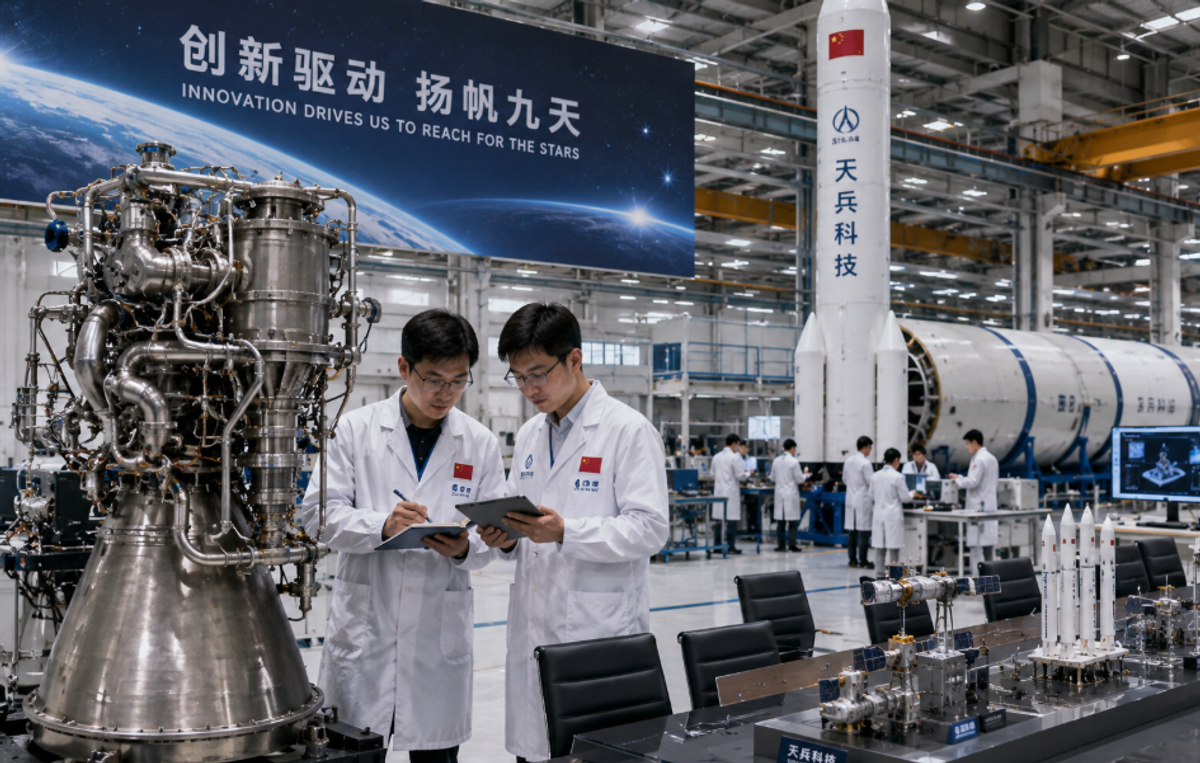
The Tianbing Technology strategic investment from Hengdian Capital is the headline - 200 million yuan into one of China's earliest next-generation liquid rocket developers. But honestly, that's just the start. This was a genuinely busy week across commercial launch, low-altitude infrastructure, and spatiotemporal intelligence. Here's what happened and why it matters.
The Tianbing-Hengdian Deal Explained
Jiangsu Tianbing Aerospace Technology was founded in 2019. It came out of the gate building next-generation liquid rocket engines and medium-to-large liquid-fueled launch vehicles - a harder technical path than solid rockets, but one with better long-term economics for reusability. The Tianbing Technology strategic investment by Hengdian Capital at 200 million yuan isn't seed-stage money. It's a conviction bet on how Tianbing Technology uses this capital to scale its next-generation liquid rocket program at a moment when commercial launch competition is heating up fast.
Hengdian isn't a passive financial backer. Strategic rounds at this size typically come with real coordination - supply chain, market access, or downstream deployment. The Tianbing Technology strategic investment from Hengdian Capital fits a pattern you're seeing more broadly across China's commercial aerospace sector, where industrial capital is moving in with intent.
If you want context on how China capital market tech rules have shifted to support exactly these kinds of rounds, that's worth reading separately. And for a sense of where high-tech startup funding flows more broadly across China's innovation zones right now, the picture is similarly active.
Qianfan Hits 238 Satellites - and Changes the Launch Math
On July 5, Yuanxin Satellite used a Long March 8A rocket from the Hainan International Commercial Launch Site to do something new. For the first time, they pushed the flat panel satellite stacking configuration to 20 satellites per launch. All of them hit their target orbits. Clean separation. The Qianfan constellation now has 238 satellites in orbit.
Why does the stacking number matter? Because why Yuanxin Satellite increased the flat panel stacking configuration to 20 satellites per launch is really a question about cost per satellite deployed. Pack more into each fairing, and your deployment curve accelerates without proportional cost increase. It's the kind of quiet operational improvement that reshapes competitive positioning over time.
The Infrastructure Deals Nobody's Writing Big Headlines About
A lot is happening in the background this week.
Qianyi Aerospace and Suzhou Shangrou New Energy signed a cooperation to co-develop China's first 400-square-meter rollable flexible perovskite solar panel for Qianyi's "ALAYA" computing satellite constellation. Shangrou brings more than ten years of ultra-lightweight flexible photovoltaics work to this. And how rollable flexible perovskite solar panels power the ALAYA computing satellite constellation is a genuinely interesting engineering question - these panels need to fold tight for launch and deploy reliably in orbit under thermal cycling. The 400-square-meter scale they're targeting is large.
Zhongke Xingtu and Shanghai Jiao Tong University's School of Automation and Sensing signed an agreement in Xi'an to establish a Space Situation Intelligent Sensing Joint Laboratory. The work covers space situational awareness, intelligent information processing, and space security management. That's institutional capacity-building, not a product announcement - but the Shanghai Jiao Tong University space security management laboratory will matter years from now.
Lanzhou University launched its new School of Aerospace Science and Engineering, set up jointly with the Lanzhou Institute of Space Technology Physics - the Aerospace 510 Institute. The explicit goal: bridge the gap from basic research to engineering application and produce mission-ready talent. It's the kind of academic infrastructure that signals long-horizon commitment to the field.
Low-Altitude Gets Real Budget and Real Agreements
Fujian's provincial government released its 15th Five-Year Plan for "Maritime Fujian" construction. It explicitly calls for a low-altitude plus marine three-dimensional network connecting UAV logistics to islands, eVTOL deployments, marine ecological monitoring, and maritime emergency response. Five domains - air, space, land, sea, underwater - unified under a single digital awareness layer. That's not a concept paper. That's a funded construction roadmap.
In Yunnan, the provincial transportation investment group and Lincang city signed a low-altitude cooperation agreement with a specific regional angle. They're tying low-altitude logistics to the China-Myanmar Indian Ocean New Corridor - meaning the Yunnan Transportation Investment Group China-Myanmar Indian Ocean low-altitude logistics initiative isn't just domestic infrastructure; it's part of a connectivity play reaching into South and Southeast Asia. Tourism, border patrol, and logistics applications are all scoped in.
Tibet University opened its Plateau UAV Research and Development Center - China's first dedicated platform for UAV R&D in plateau scenarios. Plateau unmanned aerial vehicle emergency management applications in Tibet face genuinely different challenges than standard deployments: pressure, temperature extremes, rugged terrain. Having a dedicated center for this isn't symbolic. It's operationally necessary.
Then there's Fenghua District in Ningbo. A tender worth just over 13 million yuan went out for the Fenghua District low-altitude government and police integration system. Specific, funded, procurement-stage. The low-altitude economy is in execution mode.
Spatiotemporal Intelligence: BeiDou Independence, AI Scale, and 3D Mapping
Guangdong achieved something technically significant this week. The project on a fully independent province-wide BeiDou positioning reference service - led by the Guangdong Institute of Land Resources Surveying and Mapping, with Wuhan University and South China Agricultural University as partners - passed its scientific achievement evaluation. Understanding the fully independent province-wide BeiDou positioning system in Guangdong means understanding that the entire service chain now runs on domestic infrastructure with no external dependencies. That's a meaningful self-sufficiency milestone.
Beijing's digital economy numbers came out big. Lu Ya of the Beijing Academy of Social Sciences released the 2026 Development Report, reporting that Beijing's 2025 digital economy added value exceeded 2.4 trillion yuan - up 8.7% year-on-year - with core AI industry scale reaching approximately 450 billion yuan. Over 2,500 related enterprises, with 225 large models registered by April 2026. These figures explain why Beijing consistently tops China AI unicorn rankings discussions. If you're tracking Chinese AI companies rising at the global level, Beijing's numbers give you a sense of the base. And the active China AI startup ecosystem context underneath those figures makes the investment flow make more sense.
Kuwa Technology and Huixi Intelligent signed a strategic cooperation targeting edge deployment of advanced world models in complex urban scenarios. The goal: enable embodied intelligence deployment at tens of thousands of units scale. This is exactly the kind of strategic deal reshaping China's AI infrastructure layer. Billion-yuan AI sector bets are flowing into embodied AI from multiple directions, and the Kuwa-Huixi edge deployment deal fits cleanly into that wave.
Aerospace Hongtu filed a patent for a method of constructing space environment entity data files - integrated storage and information sharing for digital twin space environments. Patent number CN117251410B, authorized July 3, 2026.
And Vantor, formerly Maxar, launched WorldView 3D on July 1. The commercial remote sensing space-based 3D mapping product delivers 3-meter accuracy coverage across over 100 million square kilometers of the globe, accessible through a single-click interface. Why Maxar Vantor WorldView 3D space-based mapping delivers three-meter accuracy at that scale is partly a satellite fleet question and partly a processing pipeline one - but from the customer side, it's a significant usability step up.
Why This Week Reads as a Shift, Not Just News
The Tianbing Technology strategic investment by Hengdian Capital is the most visible item, but the week as a whole tells a consistent story. Commercial launch capability is scaling. Low-altitude is moving from policy to procurement. Spatial data infrastructure is reaching independence milestones. AI is getting deployed at the edge.
China tech investment regulations are evolving alongside this activity, and China's tech IPO milestones suggest the capital markets are ready to receive these companies when they mature. The Hengdian Capital investment in Tianbing Technology is one data point. But China's innovation investment landscape shows the same pattern repeating across sectors.