Summary
The Cerebras CS-4 AI server chip system launch chatbot inference announcement puts a very specific problem in focus: waiting for an AI assistant to produce its next word. Cerebras Systems has introduced a new rack-scale system built to make chatbot responses faster, particularly for large language models such as Claude.
That matters because inference is where an AI model actually answers your question. Training gets most of the headlines, but inference is the recurring workload that users feel every time they open a chatbot.
Cerebras is aiming directly at that bottleneck.
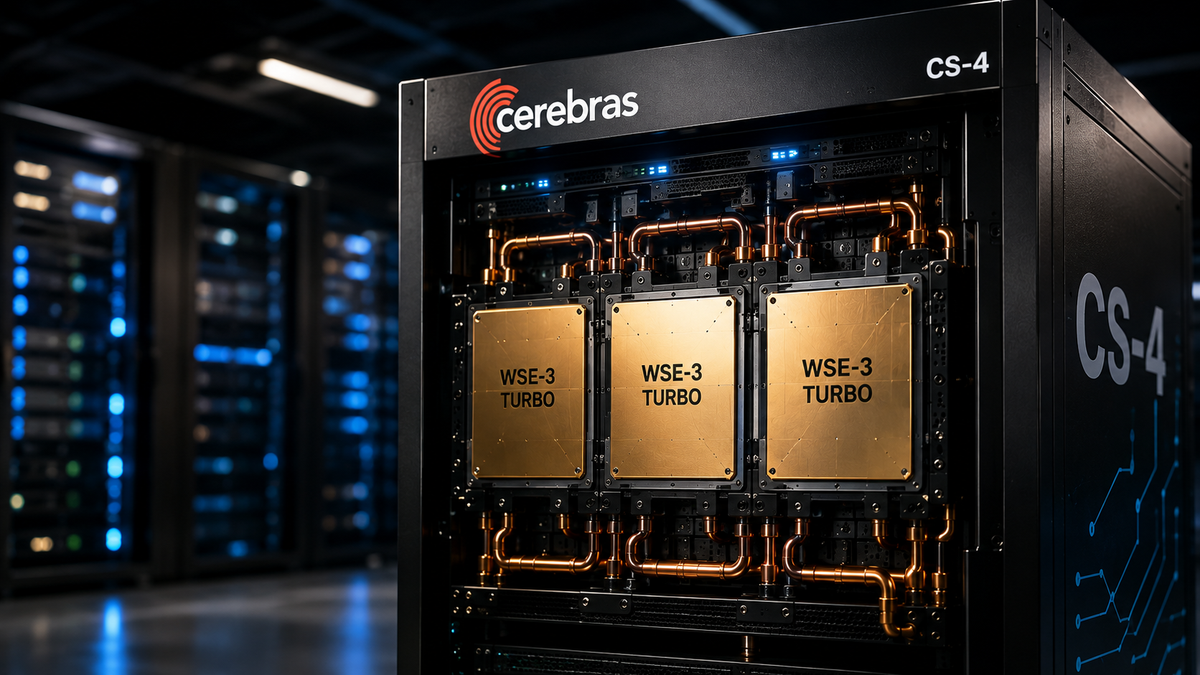
Its CS-4 rack uses three unusually large WSE-3 Turbo chips, a modular Nexus design, and updated networking hardware. The company says this combination can reduce the data movement that often slows conventional multi-chip AI systems. It is a bold technical claim, and one that puts the company squarely in the middle of growing chatbot market competition.
Key Points
- Cerebras CS-4 is designed mainly for AI inference, especially large language models and chatbot workloads.
- Each rack uses three WSE-3 Turbo wafer-scale processors.
- The chips are built using TSMC's 5nm process.
- Cerebras' approach aims to reduce chip-to-chip data movement, which can affect inference latency.
- The Nexus architecture is designed to make data-center deployment simpler.
- Cerebras says Nexus uses 50% fewer components than its previous setup.
- The company expects CS-4 availability in the third quarter.
- Cerebras plans another chip and server generation in 2027.
- CEO Andrew Feldman says Cerebras is targeting 600MW of computing power by the end of 2027 and 20x higher throughput. These are company targets, not independently verified results.
- The CS-4 is not a straightforward Nvidia replacement; Cerebras is targeting a more specific inference-focused market.
- The bigger question is whether Cerebras can turn its architectural advantage into real customer deployments, reliable performance and large-scale capacity.
What Is the Cerebras CS-4 AI Server System?
What is the Cerebras CS-4 AI server system? It is a server rack designed for high-speed AI inference, powered by three wafer-scale WSE-3 Turbo processors. Rather than treating the chip as a small component among many accelerators, Cerebras builds around a processor large enough to occupy an entire wafer.
The Cerebras CS-4 AI server chip system launch chatbot inference strategy is less about adding more conventional GPUs to a cluster and more about reducing the friction between the model, memory, and compute hardware.
Each rack is based on the Cerebras Nexus server architecture modular AI rack approach. Nexus uses pluggable modules that package the compute chips and related infrastructure into a system intended to be faster to deploy in a data center.
Simple. Big chips, fewer handoffs.
That design lands at an interesting moment for the wider market. Massive projects such as this AI supercluster launch show that the industry is still building ever-larger clusters. Cerebras, meanwhile, is arguing that chip size and system architecture can matter just as much as raw card counts.
The WSE-3 Turbo Chip Is the Center of the Rack
The Cerebras CS-4 server rack WSE-3 Turbo chip launch centers on three WSE-3 Turbo chips per rack. These processors are manufactured using the TSMC 5nm Cerebras wafer scale engine CS-4 system process, according to the company.
What chip powers the new Cerebras CS-4 server rack? The answer is the WSE-3 Turbo, a wafer-scale engine designed specifically for AI workloads. It is far larger than a typical GPU die, which is why Cerebras often describes its hardware as dinner-plate-sized.
That size is not marketing decoration. It is the core engineering bet.
Why do dinner-plate-sized chips reduce data transfer slowdowns?
Traditional AI deployments often split a model across many chips. Data has to travel between processors, across interconnects, and through memory systems before the model can generate the next token. Those transfers consume time and power.
With wafer-scale AI hardware, more of that work can stay on one processor. The result, in theory, is less waiting on communication and more time spent computing.
This is the logic behind why Cerebras dinner-plate-sized chips eliminate data movement bottlenecks in AI inference. “Eliminate” is a strong word, of course. No system removes every bottleneck. But keeping more of a workload local can materially improve response times, especially when a chatbot is generating output token by token.
It also explains the push toward near-memory computing, where hardware designers try to narrow the physical and performance gap between compute and data.
How Cerebras CS-4 Speeds Up AI Chatbot Inference
How does Cerebras CS-4 speed up AI chatbot inference? Cerebras says the rack combines large chips with new networking components that speed data movement among the three processors. The goal is lower latency and higher throughput for LLM inference.
In plain English, latency is the pause before a chatbot begins answering. Throughput is how much work the system can serve over time. You need both if you run a popular AI service. A fast first token feels good to an individual user, while high throughput keeps the service from slowing down when thousands or millions of people show up at once.
The Cerebras Systems CS-4 AI chatbot inference speed claim rests on the system’s ability to avoid some of the communication overhead that comes with large GPU clusters. This is also a case of wafer scale AI chip chatbot query speed acceleration: fewer chip-to-chip exchanges can mean fewer delays before and during a response.
There is a catch. Real-world performance depends on the model, batch size, software stack, prompt length, and the way the service is configured. Hardware vendors often publish attractive peak numbers, while production workloads can be messier. Still, inference latency is a genuine pain point, so there is plenty of reason for AI operators to test alternatives.
The same pressure is driving investment across the sector. Demand for AI computing infrastructure is no longer just about building the largest training cluster. Serving models efficiently is becoming its own infrastructure race.
Cerebras CS-4 vs Nvidia AI Inference Hardware
The Cerebras CS-4 vs Nvidia AI inference hardware comparison is not a simple winner-versus-loser story. Nvidia has the enormous advantage of a mature software ecosystem, widespread cloud availability, established networking products, and a vast installed base of developers.
Cerebras takes a different route. Instead of assembling a large pool of smaller accelerators, it uses wafer-scale processors and designs the rack around them. If your workload benefits from keeping model execution on a huge single chip, the architecture may have an edge in speed and simplicity.
But hardware is only half the purchase decision. You also have to consider model compatibility, developer tooling, availability, power requirements, support, pricing, and how easily the system fits into an existing data center.
That is why how Cerebras competes with Nvidia in AI inference is really an architectural question. Nvidia sells a highly flexible platform for a broad range of workloads. Cerebras is making a narrower, sharper pitch for customers who need very fast LLM inference.
The market has room for more than one design. Supernode computing systems and custom rack designs are appearing across the industry because conventional scaling is expensive, power-hungry, and increasingly constrained by communication overhead.
Nexus Architecture Promises a Faster Data Center Setup
The Cerebras Nexus server architecture reduces data center setup components by 50 percent, according to Cerebras Chief Technology Officer Sean Lie. He said the new design uses 50% fewer components than the prior setup, which should make deployment less complicated.
How does the Nexus architecture improve Cerebras CS-4 data center setup? The modular design uses pluggable units that package the system more cleanly for installation. Less hardware to connect and configure can shorten construction timelines and reduce opportunities for errors.
That sounds mundane next to a giant AI chip. It is not.
Data center buildouts often hit practical limits involving racks, cables, networking, cooling, power delivery, memory availability, and staffing. A system that cuts installation complexity may be valuable even before benchmark results enter the conversation. The Sean Lie Cerebras CS-4 50 percent fewer components claim speaks directly to that operational headache.
It also connects to broader AI data center demand, where getting usable capacity online quickly can matter as much as having ambitious long-term plans.
Availability, Manufacturing, and the 2027 Roadmap
When will the Cerebras CS-4 AI server system be available? Cerebras said the CS-4 is expected to be available in the third quarter. The company also confirmed that its WSE-3 Turbo chips use TSMC’s 5nm manufacturing process.
So, for buyers researching Cerebras CS-4 availability date specs and TSMC 5nm manufacturing details, the headline points are straightforward: third-quarter availability, three WSE-3 Turbo chips in a rack, Nexus modular architecture, and TSMC 5nm fabrication.
Cerebras plans another chip and server generation in 2027. That timing is central to the company’s longer-term pitch, not a side note.
What manufacturing process is used for Cerebras WSE-3 Turbo chips? TSMC’s 5nm process. Manufacturing at that scale is a major undertaking, and the industry’s dependence on advanced foundry capacity keeps AI chip supply chains under close scrutiny.
Memory will matter, too. As inference capacity expands, the pressure on server DRAM supply and other crucial components is unlikely to disappear.
Cerebras Wants 600MW of Compute by 2027
Cerebras CEO Andrew Feldman said the company expects to deliver 600 megawatts of computing power by the end of 2027. He also described a target of four times faster performance by the end of that period and 20 times more throughput.
That is the Cerebras 600 megawatt AI compute target 2027, and it is enormous. It suggests Cerebras is planning for customers that need sustained, production-scale inference capacity rather than occasional model experiments.
What are Cerebras's compute targets for 2027 according to CEO Andrew Feldman? Feldman said the company aims to deliver 600MW of compute by the end of 2027, while targeting a 20x increase in throughput. Those are company projections, not guaranteed outcomes, so you should treat them as roadmap goals until independently demonstrated at scale.
The Andrew Feldman Cerebras AI hardware roadmap 2027 is also a reminder that AI infrastructure requires a full ecosystem. Chips need power, cooling, physical data center space, memory, networking, and reliable suppliers. Rising AI server memory pressures could affect the economics of every large deployment, regardless of processor choice.
And there is the power question. As companies race to serve more AI traffic, efficient system design could become just as decisive as peak benchmark speed.
Cerebras Reports Revenue Growth Alongside the CS-4 Launch
Cerebras recently reported an adjusted loss of $6.9 million on sales of $180.1 million. The numbers give the Cerebras Systems CBRS ticker quarterly earnings revenue discussion some context: the company is investing heavily in a difficult hardware market while also reporting meaningful sales.
The Cerebras Systems CBRS reports sales growth alongside CS-4 next gen AI rack announcement narrative will depend on execution. Shipping hardware is one hurdle. Securing customers, building capacity, supporting deployments, and proving performance over time are separate tests.
Still, the CS-4 announcement shows where Cerebras sees demand heading: production LLM inference, deployed at large scale, with users who care about response time.
What the CS-4 Launch Means for AI Inference
The Cerebras CS-4 AI server chip system launch chatbot inference effort is a direct wager on faster LLM serving. Its three WSE-3 Turbo chips, TSMC 5nm manufacturing, Nexus modular design, and claimed reduction in components give it a distinct identity in a market still dominated by GPU-based infrastructure.
Cerebras is not trying to be everything to every AI buyer. It is betting that speed-sensitive chatbot inference rewards a different kind of machine, one designed around wafer-scale compute and less data movement.
Whether that bet pays off will come down to customer deployments, independently measured performance, software support, and the company’s ability to meet its 2027 capacity goals. But if you care about why some chatbots answer faster than others, the Cerebras CS-4 AI server chip system launch chatbot inference story is one worth watching.
GlobalByte Perspective
Cerebras is taking a different approach to the AI inference problem. Instead of simply adding more GPUs, the CS-4 is built around three large WSE-3 Turbo chips and a system architecture designed to reduce the amount of data moving between processors. The goal is simple: make AI responses faster.
That matters because inference is the part of AI that users actually experience. A model can be trained on massive infrastructure, but if it takes too long to respond, the hardware behind it doesn't mean much to the person using the chatbot. Cerebras is betting that reducing communication overhead can help with that problem.
The more interesting part is that Cerebras isn't really trying to replace Nvidia across the entire AI hardware market. Nvidia has a much larger software ecosystem and installed base. Cerebras is making a more focused pitch around high-speed LLM inference, where latency and throughput matter heavily.
The CS-4 also shows that AI infrastructure is becoming an operations problem, not just a chip problem. Cerebras says its Nexus architecture uses 50% fewer components than the previous setup, which could make large deployments easier to install and manage.
GlobalByte Perspective: The CS-4 is interesting because Cerebras is challenging the assumption that faster AI always means more accelerators. Its wafer-scale approach could become valuable as AI companies look for faster inference without endlessly increasing the complexity of their GPU clusters. But the real test will be customer deployments and independently measured performance, not just the numbers announced at launch.