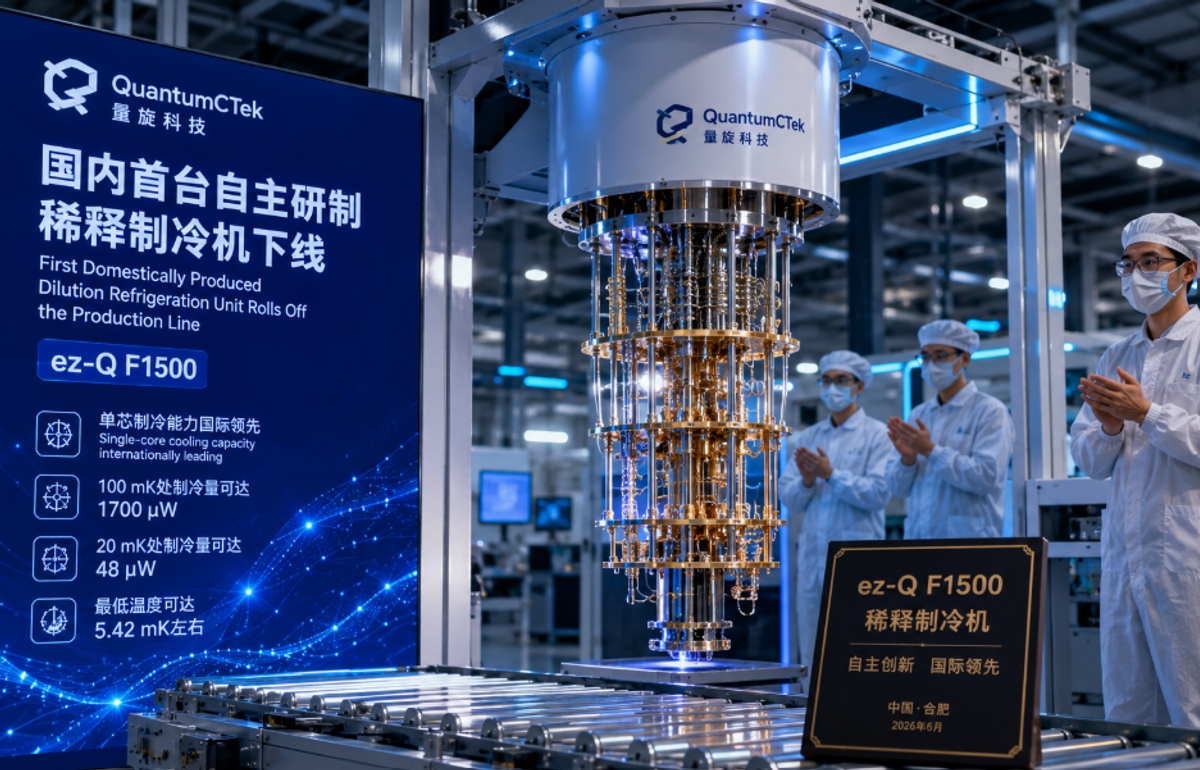
Something significant just happened in China's quantum computing world. QuantumCTek Co., Ltd., working under the guidance of the Innovation Academy for Quantum Information at the Chinese Academy of Sciences, has officially rolled the first domestically produced QuantumCTek ez Q F1500 dilution refrigerator off the production line. And if you follow where superconducting quantum computing is headed, this is a milestone worth understanding.
The cooling numbers are striking on their own. But the bigger story is what this hardware does, why the industry needed it, and what it signals for quantum science breakthroughs coming out of China.
What a Dilution Refrigerator Does - And Why Quantum Computers Can't Work Without One
Think of a quantum computing chip as an extremely sensitive brain. Capable. Precise. But delicate in ways that are hard to overstate.
For it to function at all, it needs temperatures close to absolute zero - we're talking millikelvin range, a tiny fraction of a degree above the coldest temperature physically possible. That's where the dilution refrigerator comes in. It's not optional equipment. It's the life support system for the quantum chip.
But cooling is only part of the job. The refrigerator also works alongside a shielding system to suppress electromagnetic interference and vibration, giving the chip an absolutely quiet thinking space. Any stray noise, and the quantum state collapses. So the fridge needs to get cold enough, stay stable, and do both reliably over time - and it's that combination that makes it the superconducting quantum computer's core component. It's also the infrastructure that makes advances in AI and quantum computing possible at serious scale.
The Problem the Industry Has Been Working Around
Here's the uncomfortable reality with current commercial options. Most single-core dilution refrigerators deliver somewhere between 400 and 800 microwatts of cooling capacity at 100 millikelvin. Workable for today's smaller chips. But not nearly enough for kilobitant error-correctable superconducting quantum computers, which need considerably more cooling power.
The standard workaround? Connect at least two core units in parallel. It functions. But it's messy - more components means more failure points, system complexity shoots up, and long-term stable operation of the cryostat becomes much harder to guarantee. Engineers have known this was a band-aid, not a solution.
The Innovation Academy for Quantum Information at the Chinese Academy of Sciences set out to fix the root problem instead.
What the QuantumCTek ez Q F1500 Dilution Refrigerator Actually Delivers
In 2025, the Chinese Academy of Sciences completed prototype development of a high-power dilution refrigerator with a single dilution cooling unit, achieving 40 microwatts at 20 millikelvin. A solid first step.
The QuantumCTek ez Q F1500 dilution refrigerator builds on that foundation and pushes considerably further. Using only a single core, it delivers:
- 1700 microwatts of cooling capacity at 100 millikelvin
- 48 microwatts at 20 millikelvin
- A cryogenic temperature floor of approximately 5.42 millikelvin
That 1700 microwatt figure is more than double what most commercial single-core dilution refrigerators currently offer. And getting there without linking multiple cores together is the whole point. Simpler cryostat structure, fewer failure modes, better long-term reliability. The single-core cooling capacity here genuinely sits at an internationally leading level - measured directly against what's commercially available elsewhere, not as a marketing claim.
That said, these specs come from the first production batch. Real-world deployment will be the true test. It's worth revisiting once units are actually in the field.
Stable deep-cooling environments matter beyond quantum chips too. Research in quantum cryptography security and other cryogenic quantum systems benefits from exactly this kind of millikelvin-level engineering.
Why This Matters Beyond the Hardware Specs
China has been investing in quantum computing infrastructure for years. But high-power dilution refrigeration has been a genuine gap in the domestic hardware stack. Chinese quantum startups have made real progress on algorithms and software. The physical infrastructure is now catching up in a meaningful way.
Closing this gap means China's path to kilobitant superconducting quantum computers no longer depends on imported cooling systems - with all the supply chain exposure that implies. You can see the same pattern playing out in China's semiconductor supply chain and in China's AI cluster strategy - deliberate, systematic moves toward self-sufficiency at every layer of the technology stack.
Laying the foundation for error-correctable superconducting computing requires exactly this kind of hardware. It's not glamorous work. It rarely makes headlines. But it's load-bearing infrastructure for everything that comes next in quantum computing.
When Does the QuantumCTek ez Q F1500 Ship?
Deliveries are set to begin in the second half of 2026. This isn't a research announcement or a prototype demo - it's a product entering the market.
For labs and institutions tracking the future of Chinese tech, the ez Q F1500 represents a real shift in what's available domestically. If performance holds up under deployment conditions, it changes the calculus for system architects who've been forced to rely on multi-core parallel connections as a default workaround.
China's AI market growth gets a lot of attention, but the hardware enabling that growth rarely gets the same coverage. Breakthroughs like this are exactly why it should.
Key Takeaways
The QuantumCTek ez Q F1500 dilution refrigerator is China's first domestically produced unit of its kind, and its single-core cooling performance competes at the top of the global market. For superconducting quantum computing, that's a meaningful shift - not just technically, but strategically.
A lot is happening across China's innovation ecosystem right now, and this announcement fits a clear pattern. Whether you're following cutting-edge tech hardware or quantum computing policy, the ez Q F1500 is a development worth tracking as deliveries begin.