Picture this. A humanoid robot walks up to a penalty spot inside a Shanghai exhibition hall, reads the goal, adjusts its angle, and scores - while a crowd cheers loud enough to drown out the air conditioning. No remote control. No scripted playback. Just a machine making real-time decisions, from ball recognition and positioning to force-controlled shooting, all within milliseconds.
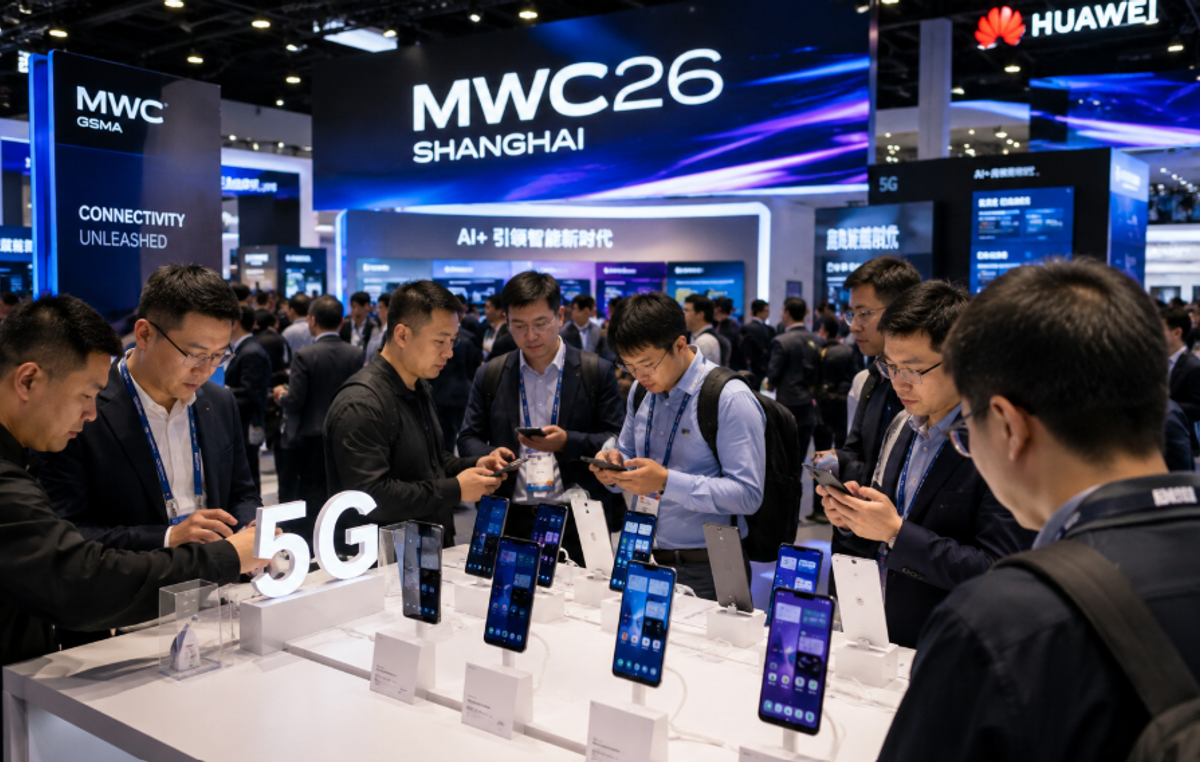
That was the opening scene at MWC Shanghai 2026. If you want to understand where MWC Shanghai future mobile AI tech is genuinely heading, this three-day event delivered more concrete signals than any single industry report could cover. Here's what actually matters.
Robots on the Pitch - and What That Proves About MWC Shanghai Future Mobile AI Tech
The humanoid robot football penalties challenge wasn't a sideshow. Eight teams, including Unitree Robotics, Linkerbot and China Mobile (Hangzhou), competed at the Mobile World Congress Shanghai's newly launched mobile AI innovation zone. Each robot completed the full penalty process without any external input: recognizing the ball, calculating angle and positioning, determining force output, then shooting. Autonomous from start to finish.
This is embodied intelligence: perception, decision, and motion control outside a controlled lab environment. The robots weren't moving through preset coordinates - they were reasoning about a dynamic physical situation in real time. That distinction is significant, and if you follow tech startups to watch in the embodied AI space, what's being validated here is the entire decision loop, not just hardware capability.
Vivek Badrinath, Director-General of GSMA, named humanoid robotics alongside the low-altitude economy and autonomous driving as the three most exciting GSMA humanoid robotics autonomous driving frontier tracks in Asia's mobile ecosystem. His framing was blunt: the "pipe" model for telecom operators is over. These companies are now strategic digital partners working across robotics, drones, connected vehicles, and AI deployment - and the shift is already well underway.
From Data Flows to Intelligence Flows
China Mobile Chairman Chen Zhongyue opened his keynote with a story that's easy to underread. Zhang Xujia, who is hearing-impaired, received China Mobile's "one person, one model" hearing-impaired AI accessibility technology device and, for the first time, heard his own voice while making a phone call. Simple moment. Quiet revolution.
Chen's broader argument was sharper than the headline coverage suggests. He reframed the entire history of "mobile" across three phases: Mobile Communication handled voice and messages, Mobile Computing scaled to bytes, and Mobile AI now handles tokens - knowledge-bearing, problem-solving streams he called "intelligence flows." The latest gadget innovations coming out of this space aren't about better specs. They're about processing a fundamentally different kind of information.
For carriers, this means breaking out of the data pipeline role entirely and rebuilding as AI service platforms - capable of millisecond-level semantic parsing, cloud inference, and intelligent generation. China Mobile is pursuing this through twin growth flywheels: an open intelligent service ecosystem and integrated intelligent infrastructure.
Network-side, the company is advancing 5G-A and terabit optical networks, with 6G research and development targeting industrial manufacturing and telemedicine scenarios. Self-evolving autonomous networks - self-configuring, self-optimizing, and self-healing - are already in development. For anyone tracking AI industry trends, this shift from passive infrastructure to active intelligence is the defining pattern right now, and it's moving faster than most timelines predicted.
China Unicom, Huawei, and the Race to Define What 6G Actually Means
China Unicom came to MWC26 Shanghai with a clear strategic message. Deputy General Manager Miao Shouye outlined the company's pivot from basic pipeline to comprehensive digital service provider, built around four collaborative actions: co-building intelligent networks via shared submarine and cross-border terrestrial fiber routes plus edge nodes; co-developing a cross-border cloud-computing ecosystem with token-based products; co-delivering AI-embedded services across industries; and co-establishing a joint security framework for cross-border data flows.
The security piece is getting less attention than it deserves. Cross-border anti-fraud cooperation and safe data flows aren't glamorous - but they're foundational to everything else on that list.
Huawei Deputy Chairman Wang Tao declared 2026 a critical inflection point for mobile communications and brought specific technical proposals with him. His core argument: networks need to expand from connecting people and things to connecting intelligence itself. In dense areas, the density of intelligent agents per square kilometer is expected to exceed 10 million - a number that fundamentally reframes what "network capacity" even means.
Huawei's three-layer intelligent network architecture comes with a two-phase rollout strategy. For spectrum, Wang called for 200 to 400 megahertz of continuous wideband spectrum as the capacity foundation - the layer that makes 6G's promised gains on downlink and uplink speed actually deliverable. On space-terrestrial integration, he presented two models: satellites as telecom supplements, or ground-led collaborative construction. The industry hasn't settled that question yet.
These infrastructure choices tie directly to what you'd find reading about AI clusters and trade at the policy level - they're connected decisions, not parallel ones. And China's supercomputing milestone with the Lingsheng system is directly relevant here: raw compute and network architecture are being built in tandem.
China's Position, and the Global Stakes
Zhong Zhihong, Chief Engineer at China's Ministry of Industry and Information Technology, laid out the national strategic direction: next-generation infrastructure, deeper digital-industry integration, and open global cooperation. She specifically called for accelerating 6G core research and development and standardization while building application ecosystems across AI, quantum technology, and embodied intelligence - and pushed for global consensus on artificial intelligence governance and unified 6G standards. That last part was both a diplomatic statement and a deliberate positioning move.
The GSMA's own data makes the stakes concrete: China now accounts for over 40% of global 5G connections. That's not just market share - it's a deployment baseline that determines where 6G will scale fastest. For AI growth outlook projections, this infrastructure lead matters more than most coverage acknowledges.
Meanwhile, AI startup launches in the embodied AI and 6G-adjacent space are accelerating in parallel with the hardware buildout, and the two are feeding each other in ways that don't show up cleanly in aggregate numbers.
The Bigger Picture: IoT Was Just the Warmup
Step back, and the pattern becomes obvious. The transition from internet of things to internet of intelligence isn't a metaphor anymore - it's showing up simultaneously in product demos, keynote architectures, and infrastructure investment cycles.
Drone fleets operating under unified regulatory platforms. Connected vehicles evolving into software-defined intelligent systems. AI accessibility devices changing daily life for people who've never had reliable access before. These weren't concepts at MWC26 Shanghai. They were live.
The global AI unicorn rankings tell a related story: the companies commanding the highest valuations right now build at the intersection of physical AI and network infrastructure - exactly where MWC26 Shanghai pointed its spotlight. At the chip and edge computing level, events like the NVIDIA and Qualcomm highlights from China's AI exhibitions reinforce the same convergence: compute is moving to the edge, which changes what networks need to deliver. Even fusion energy breakthroughs belong in this conversation, because the energy demands of AI-dense 6G networks are a genuine long-term constraint that infrastructure planners are already accounting for.
What MWC Shanghai Future Mobile AI Tech Tells You About the Next Decade
MWC Shanghai future mobile AI tech in 2026 wasn't about any single announcement. It was about convergence - 5G maturing, 6G taking shape, and AI moving from software into embodied physical systems faster than most forecasts predicted.
The industry is making a deliberate, coordinated pivot: from pipelines to platforms, from data to intelligence, from connected devices to connected reasoning. Chen's accessibility story and the robot penalty kicks are two ends of the same arc. One shows the human stakes. The other shows the technical ceiling.
What you saw at the Mobile World Congress Shanghai tech frontier this year is a working preview of what networks, services and devices will look like in five years - not a concept roadmap. The companies and carriers that understand this shift are already moving. The ones still thinking in pipeline terms are already behind.