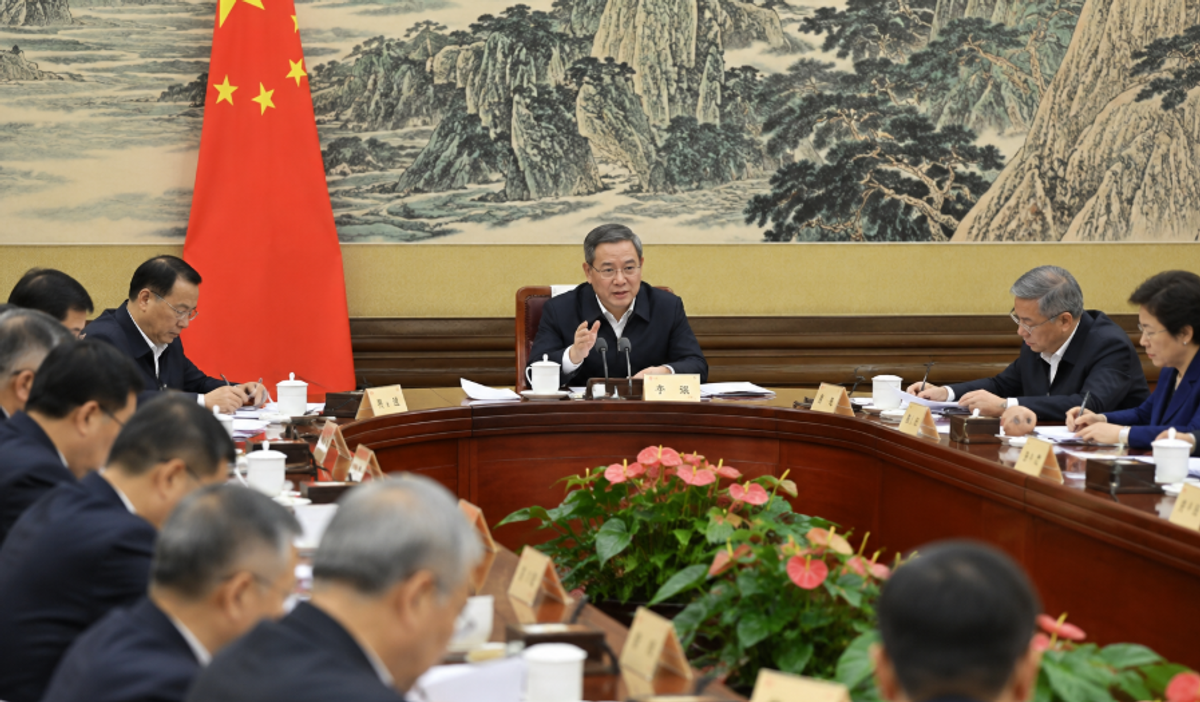
On June 30, 2026, Premier Li Qiang chaired an executive meeting of the State Council in Beijing - and it wasn't a light agenda. The Chinese Premier State Council AI meeting heard a full report on AI development, reviewed China's foreign trade situation, and discussed a concrete path to making China a recognized global trading power. The council also formally approved two major plans tied to the 15th Five-Year Plan: a peak carbon emissions action plan and a national health strategy, both covering 2026 through 2030.
Four big policy areas. One session. Here's what came out of it.
AI Technology Gets Serious Investment Backing
The Li Qiang State Council artificial intelligence report laid out an ambitious direction. Accelerating progress in key AI technologies was called out explicitly, alongside intensifying the construction of ultra large scale intelligent computing clusters in China. But the part that stood out was the direct mention of essential factors - specifically talent and funding.
That's a candid acknowledgment. Policy language about AI infrastructure is common. Saying plainly that you need to throw more money at it and attract better researchers? That's a more honest framing than most government statements manage.
Chinese AI companies are already reshaping the global competition picture, and this State Council session is essentially the government saying: keep going, faster. The China AI startup scene is plugged into this same momentum, with founders increasingly aligning their bets to national deployment priorities.
The meeting's emphasis on the accelerated large scale commercial application of AI-powered products and services was notable too. This isn't about getting more research papers published. It's about getting AI into the hands of users at scale, right now.
Safety Standards and Global AI Governance
One of the more telling parts of the Chinese Premier State Council AI meeting was its language on safety and international cooperation.
The meeting called for minimum AI safety standards to be enforced before mass deployment and for China to deepen international cooperation on artificial intelligence governance. Both in the same breath. That combination tells you something: China isn't separating its domestic AI policy from its global positioning strategy.
China's AI market growth gives it real leverage in any governance conversation. When you're deploying AI at the scale China is operating at, you're not just a participant in global standards discussions - you're one of the people setting the terms.
Foreign Trade: Import Expansion and Brand Premiums
Away from AI, the State Council spent meaningful time on trade posture.
The broad direction: expand imports of quality goods and services and push toward more balanced development of imports and exports. That's politically loaded given recent trade tensions. A stated commitment to import expansion signals China wants to reduce that friction - whether you take it at face value is a separate question.
There's an export-quality angle here too. The meeting pushed for increasing brand influence in the trade of goods and raising the added value of products. If you read between the lines, that's about upgrading China's export profile. Higher margins, stronger brands, less reliance on raw volume.
The push to strengthen digital services and trade in services expansion also got specific attention. When you track global AI industry rankings and see where Chinese companies are placing, it's clear why the government sees digital services as a core component of the major trading power strategy.
Carbon Peaks and the Green Economy Push
The China 15th Five Year Plan peak carbon emissions action plan was formally approved at this meeting. China's pre-2030 carbon peak commitment has been on the books for a while - this is the document that specifies how it actually happens during 2026 to 2030.
The meeting called for cultivating green economy growth engines, accelerating the low-carbon transition across industries, and promoting green production methods and lifestyles. That last item is interesting. Production methods can be mandated. Lifestyle changes need a different kind of policy muscle entirely.
The green economy framing also matters economically, not just environmentally. China's solar, battery, and EV industries are already leading global markets. Doubling down on these growth engines during this planning period is as much about competitive positioning as it is about emissions reductions.
And on the clean energy science side - China recently hit a significant fusion reactor milestone, breaking two records at once. That kind of scientific ambition runs in direct parallel with the carbon peak policy priorities.
Healthcare Built for the Long Game
The national health plan approved at this meeting is framed around building a healthcare system for the entire life cycle. Not just treating sick people. Supporting health from early childhood through old age, with preventive care, chronic disease management, and elderly support all explicitly in scope.
The meeting also highlighted enriching the supply of health products and strengthening quality and safety oversight in China's healthcare sector. Quality control in health products has been a recurring issue domestically. The explicit call for oversight signals this is being treated as a structural gap to close, not a past problem that's already been handled.
Worth noting: the health sector is being positioned as a growth driver, not just a public service. "Vigorously develop the health sector" was the specific phrase used. That kind of language usually signals investment incentives coming downstream.
The Infrastructure Layer Connecting All of It
Here's something worth keeping in mind as you look across all four policy areas. Building ultra large scale intelligent computing clusters in China doesn't just serve the AI industry in isolation. It underpins health data systems, green economy analytics, digital trade platforms - practically everything discussed at this meeting.
The Lingsheng supercomputer ranking at the top of global lists in 2026 is a signal of how seriously China is treating computing infrastructure as a national asset, not just a tech sector talking point. And China's CISCE AI exhibition earlier this year showed how that infrastructure is starting to produce commercial-grade AI products - with companies like Nvidia and Qualcomm showing up to engage directly with the Chinese market.
For ongoing coverage of what's happening across the sector, the AI category news feed tracks major developments as they break.
Key Takeaways
The Chinese Premier State Council AI meeting of June 30, 2026 was a policy-dense session that connected AI ambition, trade strategy, climate commitment, and healthcare reform under a single planning framework.
The thread running through all four areas is the 15th Five-Year Plan. The computing clusters, the green growth engines, the healthcare overhaul - they're chapters of the same long-term document, not disconnected initiatives. How those priorities translate from policy language into actual execution over the next four years is the real story to follow.