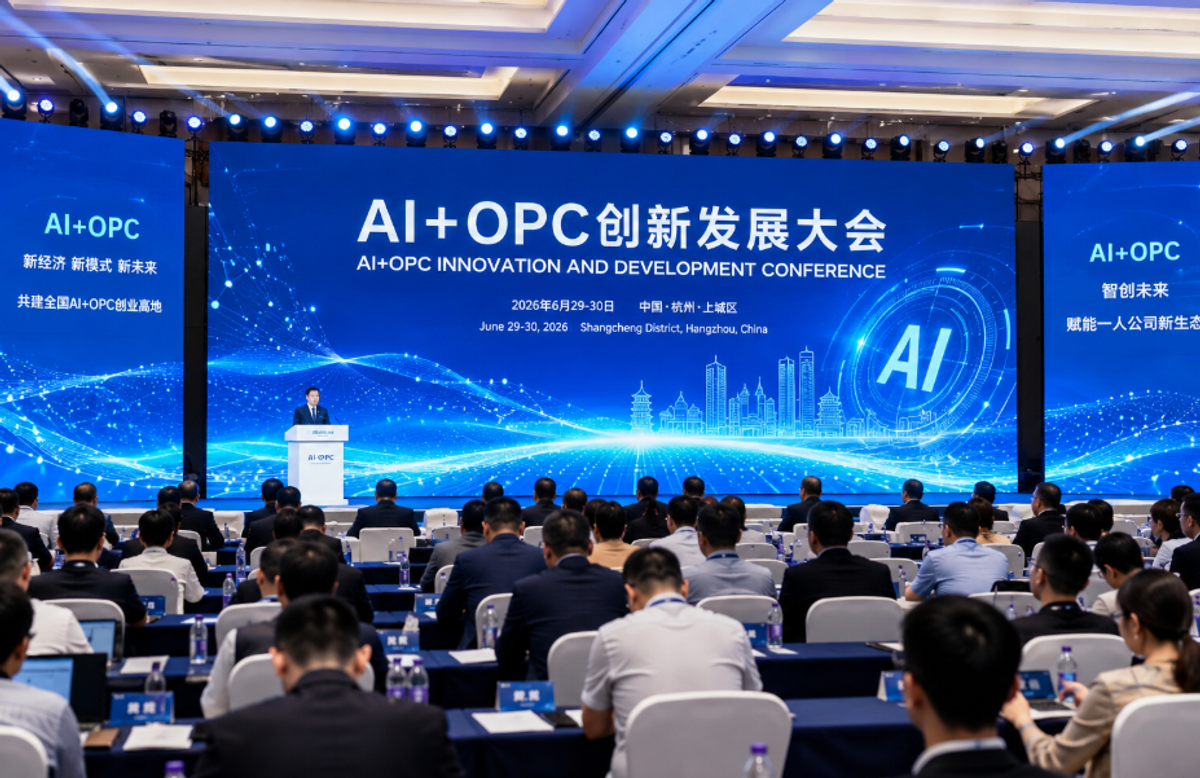
Something significant happened in Hangzhou at the end of June 2026. Around 400 delegates from across China converged on Shangcheng District for the inaugural Hangzhou AI OPC innovation conference - a two-day event that placed one-person companies (OPCs) at the center of China's next economic chapter. If you haven't been tracking this space yet, now's a good time to start.
OPC stands for one-person company - not a freelancer, not a side hustle, but a legally registered, single-member enterprise operating at real business scale, with AI handling much of what once required a full team. For anyone following AI innovation coverage, this conference marks one of the clearest signals yet that China is treating the independent operator model as a serious economic pillar - not a curiosity.
What Is an OPC, and Why Is This the Right Moment?
The concept isn't new. But it's the rise of accessible AI tools that's turned OPCs from a niche experiment into what Zhejiang Province officials are now calling the "super individual economy." The logic is simple. One person, with the right AI stack, can now deliver output that used to require an entire department.
Think about that for a second.
These aren't gig workers or solo consultants. These are super individual operators - builders who combine AI productivity leverage with formal business structure to compete against larger incumbents. The Hangzhou AI OPC innovation conference gave that community its first national-level gathering, along with the institutional recognition it had been building toward. And it followed a broader circuit of AI-focused events that have been reshaping China's startup landscape - including the China AI entrepreneurs conference series that's been drawing significant attention from AI founders nationwide.
What Actually Happened at the Hangzhou AI OPC Innovation Conference
The event ran June 29-30 in Shangcheng District, structured around one opening ceremony and two parallel breakout sessions. Government departments, financial institutions, AI enterprises, industry associations, and OPC operators from around the country were all in the room.
That's a diverse mix. And the sessions reflected it.
One track ran an OPC capital-industry matchmaking salon format - connecting OPC founders directly with investors, including Puhua Capital, who joined a panel alongside operators from Qingju Hub's Future Digital Intelligence Port. The second track tackled AI-powered industry-education integration, with Soochow University's School of Future Science and Engineering weighing in alongside community operators. A national exchange forum specifically for AI+OPC community practitioners rounded out the concurrent programming.
Keynote speakers brought real institutional weight. Pan Yunhe, former executive vice president of the Chinese Academy of Engineering and professor at Zhejiang University, delivered grounded, practical insights on AI's role in reshaping individual economic capacity. Liang Gui, former executive vice governor of Jiangxi Province and ex-director of the Torch High Technology Industry Development Center under the Ministry of Industry and Information Technology, addressed national development trajectory. Zou Ling, head of Hong Hub - Shangcheng District's single-member unicorn startup acceleration community - spoke from the operational frontlines. Moshu OPC Community's Beijing E-Town chapter rounded out the panel exchanges, signaling that cross-regional coordination is already in motion.
The Policy Announcements That Actually Matter
This is where things get concrete.
The 2026 national OPC development observation report was officially released - the first of its kind, establishing a formal benchmark for tracking China's one-person company sector at scale. A catalog of actionable AI+OPC application scenarios was published alongside it, giving operators and local governments something specific to work from rather than vague guidance.
Hangzhou's 2026-2028 action plan to build a national AI+OPC entrepreneurship hub dropped with supporting policies attached - a three-year roadmap with real teeth. Attendees also received a detailed walkthrough of new specifications for AI-enabled OPC community services and evaluation, which sets quality standards for the communities and incubators serving this sector.
On the recognition side: plaques were awarded to priority AI+OPC incubation communities and designated observation sites. The AI+OPC Community Alliance launched officially. And the construction of the national AI+OPC entrepreneurship hub itself was formally kicked off.
None of this happens in isolation. It sits squarely within the priorities coming out of China's state-level AI meetings, where AI cluster development and regional specialization have been consistent themes.
Why Hangzhou, and Why Right Now?
Hangzhou was always a strong candidate for this. It's Zhejiang Province's capital, a city with deep private-sector DNA, a high concentration of tech operators, and a government that has been proactive about building infrastructure for new economic models. Shangcheng District, specifically, already had Hong Hub and Moshu OPC Community operational before this conference took place.
The timing is also tied to a broader infrastructure shift. China AI hardware investments over the past two years have built an AI compute layer that individual operators can now actually access affordably. MWC Shanghai 2026 AI trends showed just how rapidly mobile AI integration is expanding the toolkit available to solo builders. And 4th CISCE AI exhibition highlights told a similar story: the AI stack that once required enterprise budgets is increasingly within individual reach. That's the foundational unlock for the OPC model - and Hangzhou is moving to capture it.
Hangzhou's Bigger Ambition
The stated goal is clear: make Hangzhou a replicable model. The "Hangzhou solutions" framing at the conference refers to a set of locally developed practices - community infrastructure, policy support, capital access mechanisms - that can be documented and exported to other Chinese cities.
That's how city-to-city policy diffusion works in China. One city demonstrates, the center observes, and a national template eventually follows.
The implications extend further than China, though. For the global AI startup ecosystem, the OPC model offers a real proof point for what individual operators can achieve when institutional support actually meets individual capability. You're already seeing echoes of this elsewhere. Chinese open-source AI expansion into Africa and beyond is already spreading the tooling layer these operators depend on. And the broader implication for science and technology breakthroughs is real: when individuals can leverage AI to do research, product development, and market validation on their own, the innovation surface expands in ways large institutions struggle to replicate.
What This Conference Really Signals
The Hangzhou AI OPC innovation conference wasn't a trade show in any conventional sense. It was a policy moment - the kind where a government signals its intentions publicly, drops concrete roadmaps, and builds the institutional machinery to back them up.
For independent operators, that distinction matters more than it might seem. The gap between "the government supports you" and "here's a three-year action plan, a community alliance, and a national hub under construction" is not a small one.
Hangzhou is betting that the one-person company, smart-economy AI model isn't a passing trend. It's a structural shift in how value gets created. And if China's 2026 AI growth story continues on its current trajectory, this conference may look like a founding moment in retrospect.
Keep watching Shangcheng District. The next moves from this hub will tell you a lot about where the broader super-individual economy is heading.