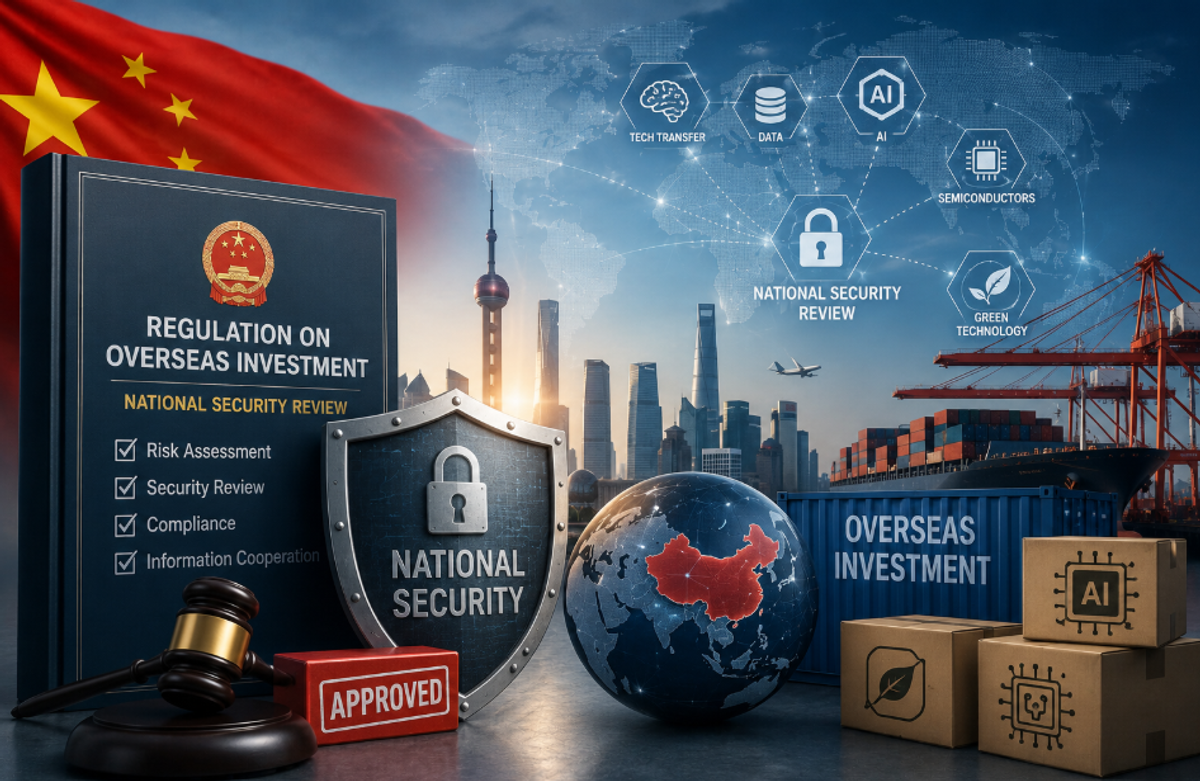
Beijing just raised the stakes. China's national security rules on overseas tech transfers took effect this week, and the scope is broader than most people anticipated. If your business moves technology, personnel, or intellectual property across borders with any Chinese connection, this regulation probably touches you more than you realize.
The State Council's 34-article regulation on outbound direct investment isn't just about money. It covers services. Training. Technical experts sent abroad. And it gives Beijing the legal authority to review, investigate, and block transactions it considers a threat to national security.
What the State Council's 34-Article ODI Law Actually Does
The China Regulation on Outbound Investment 2026 - formally State Council Order Number 837 Outbound Investment - came into effect following its June 1st announcement. Officials called it a "milestone in the history of China's outbound investment development." That's government-speak for: this is serious, and they intend to use it.
The core provisions are straightforward. Outbound investment must conform to the "overall national security concept" while balancing domestic and international priorities. The government gets broad authority to probe trade-related investment barriers imposed by foreign countries and coordinate retaliatory responses. Chinese investors are required to cooperate with authorities during overseas investigations.
Article 3 sets out a holistic approach to national security in the ODI framework, covering not just goods but services, personnel movement, and technology access. That's new territory, and it matters more than most people are giving it credit for.
Unlike older rules that focused primarily on physical goods, this one explicitly catches technical training delivered overseas, access by overseas personnel to China-based code repositories, and the movement of human expertise across borders. Sending your engineers to Seoul to train a partner company's team? Under this framework, that's now in scope.
Cross-Border Tech Transfers Are Now Under Serious Scrutiny
Here's where the China national security rules for overseas tech transfers get genuinely complicated. The cross-border technology transfer national security review mechanism has been expanding quietly for years. What's changed is the explicit extension to services - and that's a big deal.
Sending technical experts abroad counts as an export now. Conducting training overseas counts. The Administrative Regulations on Technology Import and Export (TIER 2026) are being updated alongside this ODI framework to close the loopholes that let certain transactions slip through previously.
Penalties for violating China's new national security outbound investment laws are significant. Forced divestiture is explicitly available as a remedy. That's not a fine you absorb and move on from - that's losing the asset entirely.
The bipartisan US-China Economic and Security Review Commission warned in May that Beijing's enforcement authorities have "immense discretion to determine what constitutes a violation," creating substantial risk for foreign firms. That warning landed months ago. The rules took effect this week. The window to prepare was short, and for many companies, it's already closed.
The end of offshore washing for China-linked tech companies is the practical message Beijing is sending here. The old playbook - register a Singapore entity, shift the IP there, carry on as usual - is under serious pressure now.
The Meta-Manus Case: A Preview of How This Gets Applied
In April, Beijing's top economic planning body blocked Facebook parent Meta from acquiring AI startup Manus. Manus was founded in China. It's now registered in Singapore. The Singapore address offered no protection.
That's the point. The Meta Manus acquisition block is a clear signal that corporate restructuring alone won't sidestep these rules. If the technology originated in China, Beijing is now claiming the right to review where it goes - regardless of what the corporate registration says.
Anyone tracking China's open-source AI push should pay close attention here. The rapid domestic development happening around models like those from the Zhipu AI model launch and infrastructure moves like the ByteDance GPU chip deal represent exactly the kind of domestically developed capability Beijing is fiercely protecting. Foreign acquisitions of this technology now navigate a framework built to scrutinize - and occasionally block - these deals entirely.
Japan Gets Hit First: Twenty Entities on the Control List
In the same week these rules took effect, China's Commerce Ministry added 20 Japanese entities to a dual-use control list, prohibiting Chinese and foreign exporters from selling dual-use items made in China to them. Multiple divisions of Mitsubishi Corporation made the list.
Dual-use items, as the name implies, serve both civilian and military purposes. For Chinese exporters selling to these firms, that now means special licenses, risk assessment reports on the Japanese buyer, and written pledges that goods won't be used for military purposes. That's real operational friction that adds time and cost to transactions.
The twenty Japanese entities dual-use watch list MOFCOM action went further still. Another 20 entities landed on a separate watch list, including Mitsui E&S - which makes engines and ship equipment - plus divisions of both Fujitsu and Komatsu. The Mitsui E S ship equipment export special license China requirement alone could add months to procurement cycles for affected parties.
If your Chinese supplier has any of these firms in its customer base, your supply chain deserves a closer audit this week.
The US Side: Ten Companies, Export Controls, and a Clear Pattern
The same week, China imposed export controls on 10 US companies involved in defense and rare-earth mining, calling it a direct response to Washington's Chinese military enterprise blacklist. Dozens more US firms were banned from public procurement.
Retaliatory. Targeted. And completely consistent with what the new ODI framework authorizes. Trade-related investment barriers investigation: MOFCOM is no longer a theoretical mechanism - it's an active enforcement tool being deployed in real time.
For context on how the broader relationship is shifting, the ongoing China-EU trade consultations and conversations around China-UK economic cooperation are both being read through this lens now. Partners want to know how far Beijing is willing to take this - and the honest answer is: further than before.
What This Means If You're Operating Across the China Border
Three things have changed in practice.
First, PRC individual outbound investment regulatory scope has expanded. This isn't only about corporate entities - individuals resident in China fall within the regulatory reach of the ODI framework now. Founders, engineers, and researchers all count.
Second, how foreign firms can navigate China's hidden tech transfer regulations is becoming a genuine specialty practice area. The rules are deliberately broad. That gives enforcement agencies the flexibility to act - or threaten action - in ways that serve policy goals well beyond pure security concerns. You need to understand that going in.
Third, offshore technology washing prevention compliance requires more than restructuring your corporate chart. Where your engineers sit, where your code lives, where your training happens - all of it is relevant under this framework. Substance matters now in ways it didn't before.
This is a meaningful shift in the global security landscape. From China's AI tech innovations to programs like the China satellite launch program, Beijing is building a strategic perimeter around its most advanced capabilities. The China national security rules on overseas tech transfers are part of that perimeter - and they're not going away.