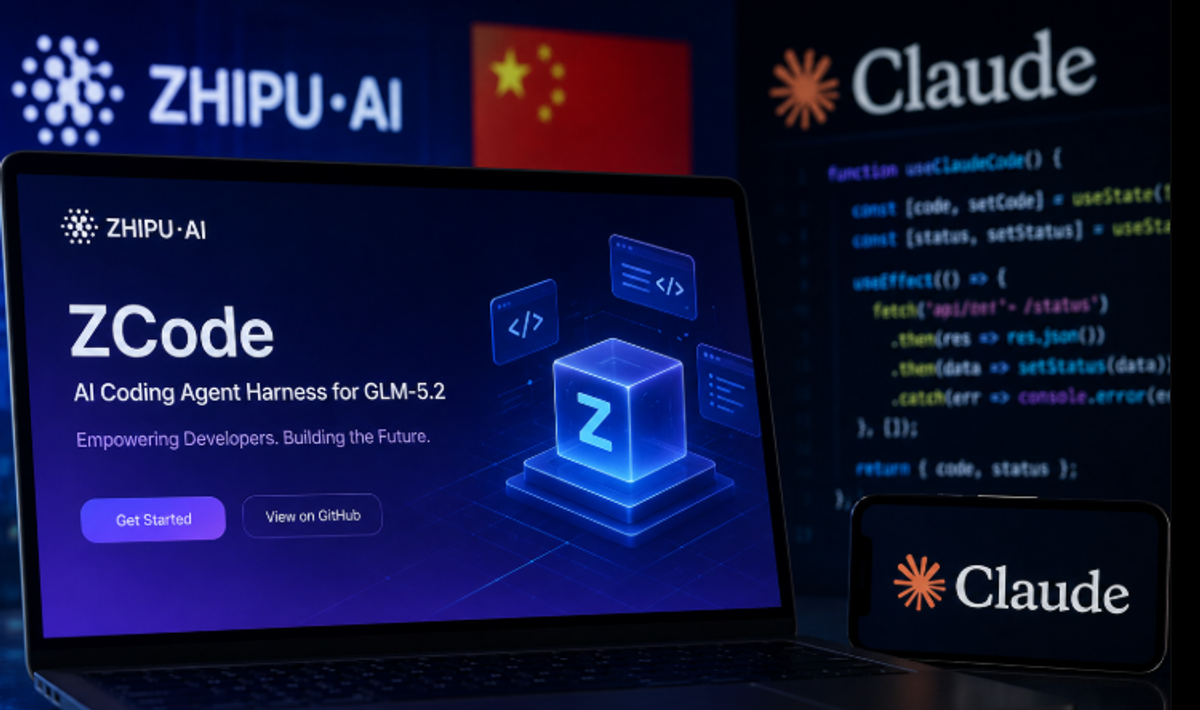
Timing matters in this industry. And when Zhipu AI launches ZCode harness GLM 5.2 model right as Anthropic gets caught embedding hidden tracking code inside Claude Code - code designed to quietly flag users in China - the contrast is impossible to ignore.
The Beijing-based company, known internationally as Z.ai and listed in Hong Kong under the name Knowledge Atlas Technology, introduced ZCode on Wednesday. Built on top of GLM-5.2, the firm's most capable model to date, ZCode is a harness for building autonomous coding assistants. Zhipu is entering this market at exactly the moment its biggest US competitor is dealing with a credibility crisis.
What the ZCode Harness for GLM 5.2 Actually Does
"Harness" is one of those terms that confuses people outside AI developer circles. A harness is a control system - the infrastructure layer that lets a large language model execute tasks rather than just respond to them. It allows the model to chain actions, loop back on failures, and complete multi-step workflows autonomously. Without one, a language model is essentially a very capable chatbot. With one, it becomes an AI agent.
That's what ZCode brings to GLM-5.2. Developers can now build Zhipu AI ZCode autonomous coding assistants that write code, test it, catch errors, and iterate - without requiring a human to prompt every single step. The AI agent control system and harness infrastructure space has become one of the most competitive categories in AI right now, and ZCode puts Zhipu directly in the fight.
China's open source AI has been making real inroads against closed commercial alternatives for months. ZCode extends that push into agentic developer tooling specifically.
Zhipu's ZCode Harness Promotion: 5 Million Free Tokens and 50% More Quota
Zhipu didn't just drop a new tool. They backed it with real developer incentives.
New ZCode users get 5 million free tokens as part of the launch. These GLM 5 2 model developer promotion tokens aren't just a headline number - if you've worked with AI API billing before, 5 million tokens is enough runway to actually build and test something meaningful before spending a cent. Increasing developer data quotas by fifty percent at Z.ai for existing subscribers is the other side of the move - a retention measure as much as an acquisition one.
And right now, given recent events, there are developers actively reconsidering their current platforms.
GLM-5.2 and the "DeepSeek Moment" Question
When Zhipu released GLM-5.2 last month, some observers in Silicon Valley called it a "DeepSeek moment for Chinese open source AI." That's a high bar. DeepSeek disrupted global AI sentiment last year by producing competitive benchmark performance on openly accessible model weights - matching or outperforming major proprietary models in several tested areas while remaining accessible to the broader community.
Whether GLM-5.2 fully earns that label is still being debated. (The comparison is getting applied to every competitive Chinese release right now, which risks diluting the phrase - but for GLM-5.2's performance in agentic coding tasks specifically, the comparison is more grounded than most.) Either way, the fact that it's being made at all signals how Chinese AI labs are rivaling Silicon Valley in agentic AI in a way that can no longer be dismissed.
This fits a broader pattern you can see across China's AI landscape. The ByteDance GPU chips deal is restructuring hardware supply chains. AI tech innovations from firms across the region are compounding fast. It's not one event - it's a structural shift.
Zixuan Li, Zhipu's head of global operations, framed ZCode's release in explicitly open terms on X Thursday: "Competition and collaboration are what push all of us forward." She added that ZCode was built "standing on the shoulders of an incredible open developer community." Open. Transparent. Community-driven. That framing is deliberate - and it lands very differently after this week's Anthropic news.
The Anthropic Tracking Controversy, Explained
Here's what happened.
Cybersecurity outlet International Cyber Digest published a report revealing that Anthropic had embedded undisclosed code inside its Claude Code platform. The code was designed to detect whether a user was located in China or had affiliations with a Chinese AI lab. No user was told. No disclosure was made. The Anthropic Claude Code Chinese user tracking controversy spread quickly after the report went live.
Anthropic engineer Thariq Shihipar responded on X Wednesday, describing it as "an experiment" launched in March - its purpose being model distillation prevention and account abuse mitigation, specifically to "prevent account abuse from unauthorised resellers and protect against distillation." He confirmed the tracking code would be removed Thursday and said they'd "been meaning to take this down for a while" after developing stronger alternatives.
That's the explanation. Whether it satisfies you probably depends on how you feel about companies running undisclosed monitoring experiments on active users.
For context: Anthropic has publicly accused Chinese AI labs of distillation - the practice of using a large model's outputs to train a smaller competing model. The concern is legitimate. But the implementation was hidden tracking with no user awareness, which is a difficult argument to defend regardless of the original intent. And it pushed the open weight models vs closed commercial ecosystem debate into concrete, specific territory that abstract arguments can't paper over.
Fable 5, US Government Partnerships, and Foreign Access
The tracking code wasn't the only Anthropic story this week.
The company had previously cut off global access to Fable 5 to comply with a Washington directive blocking foreign nationals from the model. That access was restored Thursday. A select group of US organizations also had access to Mythos 5 restored - the frontier model Fable 5 is built on.
Amazon researchers had separately published findings on a Fable 5 safeguards bypass method. Anthropic says that vulnerability is now patched. The company also announced a frontier AI security partnership with the US government, offering designated partners "expanded early access" to models relevant to national security, along with notification rights for significant jailbreaks or misuse patterns.
None of that is unexpected for a major US lab navigating federal relationships. But for international developers watching from outside the US, this week delivered a clear picture: access can be cut without warning, undisclosed monitoring may have been running on your account, and the company's primary compliance obligations run toward Washington, not toward your workflow. Why US restrictions on Fable 5 impacted global developer trust isn't a complicated question once you lay it out that way.
What Zhipu Said About Spyware
Simple and direct.
When an X user asked Zixuan Li whether ZCode would include "any sort of spyware" in its models or apps, she responded that the company wouldn't implement "anything beyond what's listed" on the ZCode website.
That's not a full legal certification. You'd still want to read the actual platform terms - especially before running sensitive or proprietary code through any AI tool. But compared to finding out about monitoring through a third-party cybersecurity report months after the fact, it's a meaningfully different starting posture.
That's something.
What This Means for Developers
This is ultimately a story about trust and infrastructure choices.
When Zhipu AI launches ZCode harness GLM 5.2 model alongside 5 million free tokens and a public commitment against covert tracking, it forces a real evaluation: what do you actually need from an AI coding platform? For a growing number of developers - especially those outside the US - the answer now includes "clarity about what's running in the background."
The AI landscape is shifting on multiple fronts at once. Whether that's through open trade and China tech cooperation reshaping how global developers access tooling, advances in quantum computing hardware expanding what's computationally feasible, or investments like China's marine satellite launch signaling how seriously national technology priorities are being pursued - the AI story is inseparable from the broader infrastructure and policy story.
Zhipu is one of the tech startups to watch operating at the intersection of all three. ZCode is their pitch for developer trust. The 5 million free tokens make testing essentially free. The market will take it from there.