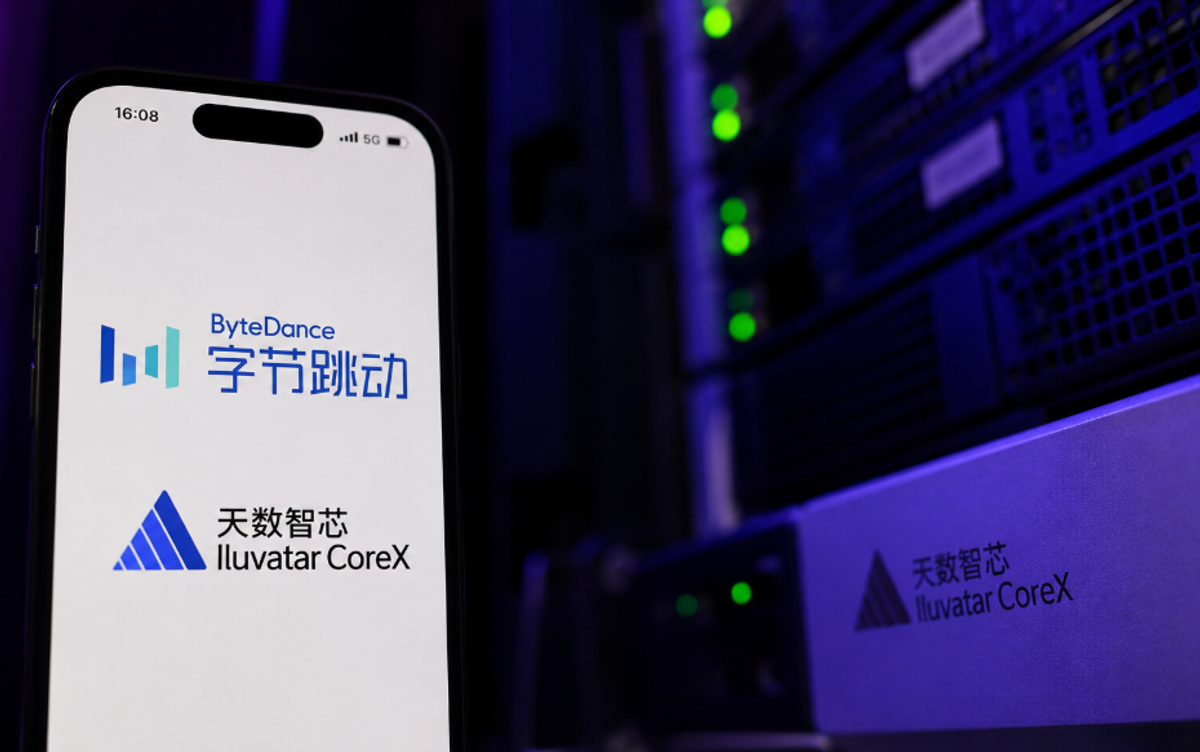
Tianshu Zhixin secures ByteDance GPU chips order for 50,000 units - and if you follow China's AI hardware sector, this is the deal you need to understand. Not because of the number. Because of what it signals: domestic GPU inference, at real production scale, running actual traffic from hundreds of millions of users.
Doubao has 368 million monthly active users. Every time 368 million monthly active users touch the screen to interact with Doubao - sending prompts, generating images, asking questions - computing power burns. Silently. Constantly. At that scale, the question "how much does each inference cost?" isn't academic. It's the difference between a business that works and one that quietly bleeds money.
This is the context that made Tianshu Zhixin's Zhikai series relevant to ByteDance. And this is why the order matters.
ByteDance's Computing Cost Problem Became Unavoidable
Doubao's large-scale model exceeded 140 trillion tokens per day. That's not a marketing figure - that's an enormous, compounding compute cost running around the clock.
When Doubao was free, those costs sat under "user acquisition." Acceptable. Expected. But Doubao Professional Edition's pricing design changed the math entirely. The difference between its standard, enhanced, and premium packages is essentially how much model access a user can purchase, with quota as the product boundary. Once computing power enters the unit economic model, every dollar spent on inference flows directly into gross profit calculations. Managing computing power bills for enterprise-level large language models at this scale stopped being an IT concern and became a business strategy problem.
Investors noticed. The broader China stocks tech surge narrative has been partly fueled by confidence in exactly this kind of domestic efficiency push - companies building the infrastructure to make AI businesses actually profitable, not just impressively large.
ByteDance needed a combination of chip types: high-end for frontier model work, cost-effective for massive inference volume, and edge options for vertical scenarios. More than one approach. More than one supplier.
So restructuring began.
Why ByteDance Split Its AI Training and Inference Supply Chains
Training and inference are not the same problem. They shouldn't share the same supply chain.
Training is building the highway. Huge upfront investment, concentrated workloads, where cluster performance and multi-card interconnection are everything. Huawei Ascend and Cambricon handle this for ByteDance - pre-training, base model iteration, the long runs where failure costs weeks and performance is non-negotiable.
Inference is city traffic. It runs every second. Peaks at noon, drops at 3 am, spikes when a new feature launches. It's variable, noisy, and margin-sensitive. You don't need the most powerful chip - you need a stable, cost-effective chip that won't surprise you with a supply disruption or a price increase.
The separation of training and inference systems is a clear signal that AI computing power has industrialized. ByteDance's third domestic GPU supplier, Tianshu Zhixin, fills the inference tier. That structural opening is exactly what the company stepped into.
A multi-supplier structure also gives ByteDance negotiating leverage and deployment flexibility it didn't have before. And given ongoing semiconductor supply uncertainties, supply chain resilience isn't paranoia - it's basic planning for a company running Doubao Professional Edition pricing across hundreds of millions of users.
How Tianshu Zhixin Secured 50,000 GPU Chips from ByteDance
Two things got Tianshu Zhixin into ByteDance's core supply chain. Architecture choice. And migration friendliness.
Tianshu Zhixin's Zhikai series is built on a general-purpose GPGPU architecture rather than a dedicated ASIC inference design. That distinction is enormous in practice. ASICs are efficient right up until the model changes - and large model architectures are changing constantly, from pure Decoder to MoE to multimodal fusion. A chip optimized for last year's design can become a bottleneck within six months. General-purpose GPUs are programmable, and software updates can release new performance as models evolve without requiring a hardware redesign.
The Zhikai 100 accelerator card specs tell a practical story: 32GB HBM2E high-bandwidth video memory, peak FP16 computing power of 96 TFLOPS, INT8 quantization computing power of 192 TOPS, and a board power of 300W. The memory subsystem was specifically tuned for the memory-intensive characteristics of large model inference - bandwidth and latency matter more than raw compute for most inference workloads.
But specs didn't close this deal. Reducing migration costs for PyTorch and CUDA-based engineering systems closed it. ByteDance runs inference infrastructure built around CUDA operators and PyTorch-based frameworks. Ripping those out is expensive and risky. Tianshu Zhixin's architecture lets existing inference frameworks adapt through a compilation layer without a full rewrite, which shortens deployment cycles significantly.
Industry analyst reports from Changjiang Securities and Guosheng Securities have highlighted this migration compatibility as a key factor in Tianshu Zhixin's commercial positioning. The work happening on the manufacturing side is equally notable - advances in Chinese AI chips 3D stacking technology reflect the same theme: building domestic depth in ways that reduce dependence on foreign supply chains at every layer of the stack.
If you're tracking AI category news out of China's hardware sector, production-level deployments like this one separate meaningful industrial progress from benchmark announcements.
Inference Is Where the Revenue Lives
Training creates the model. Inference runs the business. From a commercial perspective, inference is the longer-term, higher-frequency, and more cash-flow-oriented battleground.
The core competitiveness of inference chips isn't just theoretical TFLOPS. It's unit request cost, batch scheduling efficiency, KV cache management, quantization support, operator adaptation, framework compatibility, and fault recovery tooling. That's a long list. And most enterprise customers won't rewrite production code for a new chip supplier - even a faster one.
This is the window domestic manufacturers are operating in right now. Inference scenarios are more diverse and more sensitive to cost-effectiveness than training scenarios. As long as a domestic chip runs steadily and cheaply enough for specific workloads, customers can justify adoption without rebuilding their entire engineering stack.
ByteDance isn't the only company driving this demand, either. The Meituan AI model launch of Longcat 2.0 shows that China's largest consumer internet platforms are all pushing toward massive inference workloads - and they all need cost-effective domestic supply to make the unit economics work.
Tianshu Zhixin is among the startups to watch in China's AI hardware sector precisely because it's moved from funding stories to production orders with top-tier internet companies.
China's Domestic GPU Market Is Forming Into Tiers
The domestic AI inference GPU market is projected to reach nearly 600 billion yuan in 2026, growing at a compound annual rate of roughly 40% over two years. The macro backdrop supports it: China manufacturing PMI June data shows the kind of industrial expansion that generates sustained enterprise AI demand.
Three tiers are forming:
Huawei Ascend dominates the top - high-end training and high-end inference, complete ecosystem, strong cluster capabilities. Default choice for large state-backed deployments and workloads where ecosystem maturity is non-negotiable.
Cambricon holds mid-to-high-end inference and industry private deployment. Years of technical accumulation, focused product roadmap.
Then there's the general-purpose inference tier, where Tianshu Zhixin and Moore Threads compete on flexible architecture and better cost performance - targeting exactly the massive online inference workloads that Doubao generates.
This tiered competitive landscape is actually healthy for the market. No single chip needs to win every workload. Heterogeneous computing - GPUs, ASICs, NPUs, CPUs coordinated by intelligent scheduling layers - is where large-scale AI infrastructure is heading, and domestic companies that secure a clear position in one tier have a strong foundation to expand from there.
The 50,000-Unit Order Is a Starting Point, Not a Finish Line
Tianshu Zhixin secures ByteDance GPU chips order for 50,000 units - and the significance isn't in the number itself. It's in the threshold it represents. Domestic GPU inference, running production traffic from hundreds of millions of real users. That's the proof point that every other major internet company is quietly watching.
China's investment in frontier technology runs across multiple sectors simultaneously. The progress in quantum computing hardware China and the milestones from programs like CAS Space reusable rocket engine development reflect the same national posture: build domestic depth in every strategic technology, at every layer. The domestic GPU push is part of that same playbook.
As production orders get fulfilled, domestic GPU manufacturers enter a positive cycle - more volume, faster iteration, stronger software ecosystems. The gap between tiers narrows. That's how industrial competence gets built. Not in a single breakthrough. Through sustained, real-world deployment at scale, with hundreds of millions of user requests serving as the proving ground.
The 50,000 units aren't the destination. They're the point at which China’s domestic AI inference chip story stops being a development roadmap and becomes a supply chain.