Summary
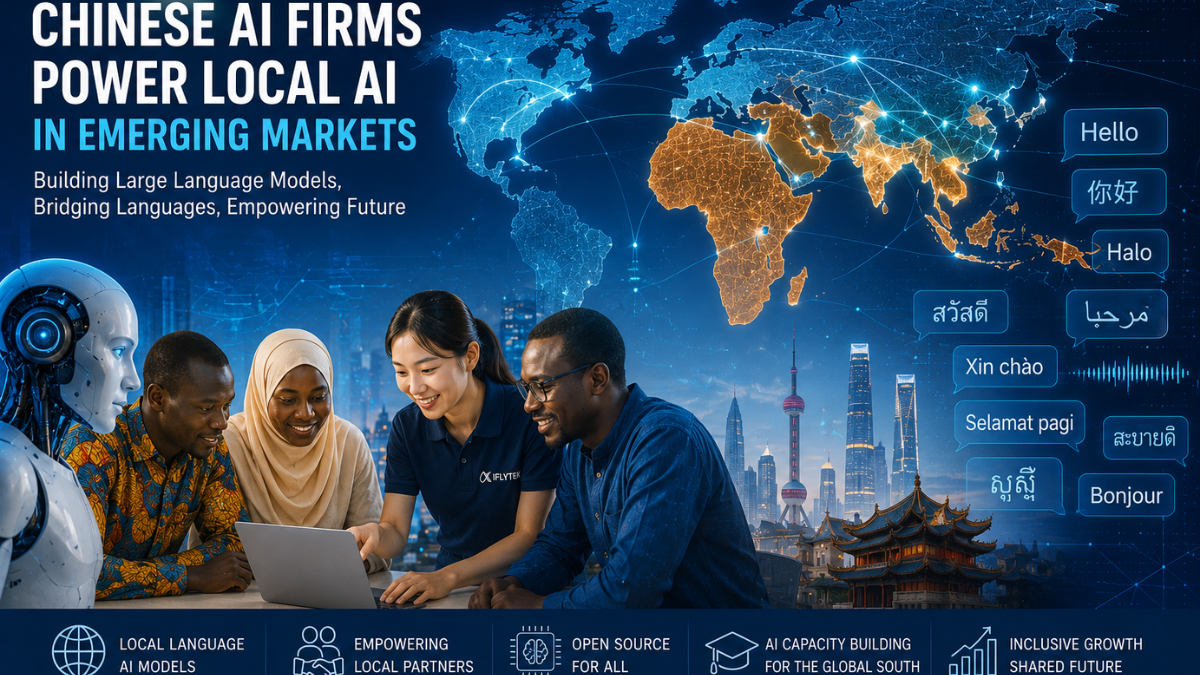
Chinese AI companies local large language models emerging markets are no longer a niche technology story. They’re becoming part of how countries build digital services that actually understand their people, languages, and industries.
At Safaricom’s smart exhibition hall in Kenya, for example, a Chinese-supported digital human can explain core telecom services and interpret financial-report data for visitors. It’s practical, not flashy for the sake of it. And that matters.
For years, major language models concentrated on English and other widely spoken languages. This has left many communities with poor speech recognition, awkward translation, or a lack of useful AI assistance. Chinese AI firms are now working with local partners to close that gap through models trained and deployed for regional needs.
Key Points
- Chinese AI companies are working with emerging markets to build AI models around local languages, data and industries, rather than simply selling a ready-made chatbot.
- iFLYTEK’s Spark supports more than 130 languages, while its ASEAN model focuses on 10 regional languages including Indonesian, Malay, Vietnamese and Thai.
- DeepSeek’s open-source approach is making AI experimentation more affordable for developers in markets where expensive AI services can be a major barrier.
- Huawei has developed a 100-billion-parameter Arabic model using data from sectors such as finance, energy and oil and gas.
- 01.AI and Kazakhstan are working on Q.AI with an emphasis on local deployment, data sovereignty and national AI capabilities.
- The real challenge is not just getting access to a model. Countries also need local developers, computing infrastructure, data and technical expertise to keep these systems running.
- If local skills and infrastructure develop alongside the models, emerging markets could become AI builders rather than permanent AI customers.
Why Chinese AI companies local large language models emerging markets matter
A model that understands local language patterns, rules, and business data is much more useful than a simple chatbot. You can use it in a hospital, classroom, public service portal, call center or bank, without being forced to conduct every conversation in English first.
That’s the core appeal behind Chinese AI firms global south large language model adoption. The focus is not simply selling a finished model overseas. It’s helping national and commercial partners develop systems around their own data and operational realities.
Minor language AI models speech recognition emerging economies need are often ignored by mainstream platforms. The problem is bigger than inconvenience. If your language has little digital representation, you can be sidelined in education, commerce, government services, and the next generation of AI products.
iFLYTEK’s ASEAN model targets language gaps
The iFLYTEK Spark ASEAN multilingual model 130 languages effort shows what a regional approach can look like. Spark supports speech recognition and simultaneous interpretation across more than 130 languages, while the Spark ASEAN Multilingual Large Model Base focuses on 10 regional languages, including Malay, Indonesian, Vietnamese, and Thai.
So, what is the iFLYTEK Spark ASEAN Multilingual Large Model Base? It is a localized model platform designed to support secure, industry-specific AI deployment across ASEAN markets with fewer parameters than many global alternatives.
iFLYTEK launches Spark ASEAN Multilingual Model covering 10 regional languages at a time when businesses need better local accuracy, not just bigger model sizes. In Malaysia, the company has also worked with Enjoy TV & Film Broadcasting Corporation on an intelligent dubbing and translation center supporting more than 130 languages.
That’s useful for media. It can also help public communication, tourism, customer support, and cross-border trade.
For more context on the wider competitive backdrop, see China's global AI competition.
Open-source models make local experimentation cheaper
DeepSeek open source LLM African developers low cost is one of the clearest examples of why open models have attracted attention. Lower token costs and accessible model weights give smaller teams a chance to test, adapt, and deploy AI without absorbing the expense of closed commercial platforms.
Why are open-source models like DeepSeek popular among developers in Africa? Cost is a big reason, but control matters too. Developers can tune models for local languages, run them on their own infrastructure, and build tools that fit local users instead of waiting for a global vendor to prioritize their market.
The Global South digital divide open source AI models discussion often gets framed as a hardware problem. It isn’t only that. Open-source access can help build local skills, local businesses, and local research communities.
You can see this trend playing out through Chinese open-source AI in Africa and China's open-source AI surge.
Still, open source isn’t magic. Teams need computing capacity, trustworthy data, security controls, and people who can maintain the systems after launch.
Arabic and sovereign AI models are changing the equation
Huawei 100 billion parameter Arabic LLM Cairo initiatives point to another model for local AI growth. Huawei’s Arabic model was trained with regional datasets from finance, power, and oil and gas, and reportedly supports users across more than 20 Arabic-speaking countries and regions.
How does Huawei's 100-billion-parameter Arabic model support local industries? It can improve language accuracy in high-value sectors while using data that better reflects local terminology, cultural context, and workflows. That makes a real difference when an AI system is handling technical documentation or customer conversations.
Sovereign AI data infrastructure emerging markets need is about more than where servers sit. It concerns who controls the data, how models are adapted, and whether a country can operate critical AI services independently.
Why emerging economies choose localized on-premise AI models over standard Western LLMs is fairly straightforward: sensitive data, regulatory requirements, language accuracy, and long-term control all push organizations toward local deployment.
Kazakhstan’s Q.AI approach favors local ownership
01.AI Kazakhstan Q.AI sovereign LLM development follows that same logic. The Beijing-based company and Kazakhstan jointly established Q.AI to develop local language models, AI agents, and enterprise platforms.
How is 01.AI collaborating with Kazakhstan to build sovereign AI capacity? The partnership emphasizes on-site deployment, local operation, and systems built around Kazakhstan’s own data, industries, and governance rules. Buying access to a foreign model may solve a short-term problem. Building local capability has a longer runway.
That approach sits alongside a broader wave of Chinese models, including the Kimi K3 language model, the Kimi K3 open-source model, and Meituan LongCat 2.0.
Local AI works best when skills stay local
Chinese AI companies partner with emerging nations to build localized large language models, but the partnership only holds up if knowledge transfers too. A country needs local developers, linguists, researchers, and institutions that can improve the system over time.
Multilingual AI speech intelligence natural language processing tools can help countries move faster, yet they should support local capacity rather than create a new form of dependency.
Safaricom Kenya digital human AI assistant deployments show where this can become visible to everyday users. What role does Safaricom Kenya play in deploying Chinese AI technology? It provides a real-world setting where interactive AI can be tested for customer service and business communication.
Meanwhile, Alibaba's Qianwen AI strategy, Zhipu AI's GLM-5.2, China's AI industry growth, and AI computing supply chains show the infrastructure and model ecosystem behind this expansion.
GlobalByte Perspective
The interesting part of China's AI push into emerging markets isn't simply that Chinese companies are taking their models overseas. The bigger story is how they're approaching those markets.
For a long time, countries with smaller languages had to work around AI systems that were mainly built for English and a handful of other major languages. That creates problems that aren't always obvious from a benchmark score. A model may be impressive overall but still struggle with local speech, terminology or the way people actually communicate.
That's where companies such as iFLYTEK are trying to find an opening. Building models around languages such as Malay, Indonesian, Vietnamese and Thai makes the technology more useful to the people who are supposed to use it. The same idea can be seen in Huawei's Arabic model and the work being done through Q.AI in Kazakhstan.
But there is another side to this story.
Simply having access to LLM (Long-Level Learning) available in the local language does not make a country technologically self-sufficient. Operating the infrastructure, managing data, improving models, and building applications based on them are still essential. Without these capabilities, a country may move from dependence on one foreign AI provider to dependence on another.
That's why the open-source part of this trend is particularly important. Models such as DeepSeek give developers in emerging markets more room to experiment without starting with the cost of a large commercial AI platform. It doesn't solve the infrastructure or skills problem, but it lowers one of the barriers to getting started.
The partnerships in Kenya, ASEAN and Kazakhstan also show why local involvement matters. A model trained for a country's own languages and industries is likely to be more useful than a generic system imported from somewhere else. And if local developers are involved from the beginning, some of the knowledge stays in the market instead of leaving with the technology provider.
For GlobalByte News, this is where the story becomes bigger than China's overseas AI expansion.
The real measure of success will be whether these partnerships leave behind stronger local AI ecosystems. If countries gain models, developers, infrastructure and the ability to build their own applications, the result could be a meaningful reduction in the digital divide. If they only become another market for imported AI products, the long-term impact will be much smaller.
China is clearly betting that localisation and open access can be a competitive advantage in the Global South. The next few years will show whether that approach creates genuine local AI capacity or simply expands the reach of Chinese technology.