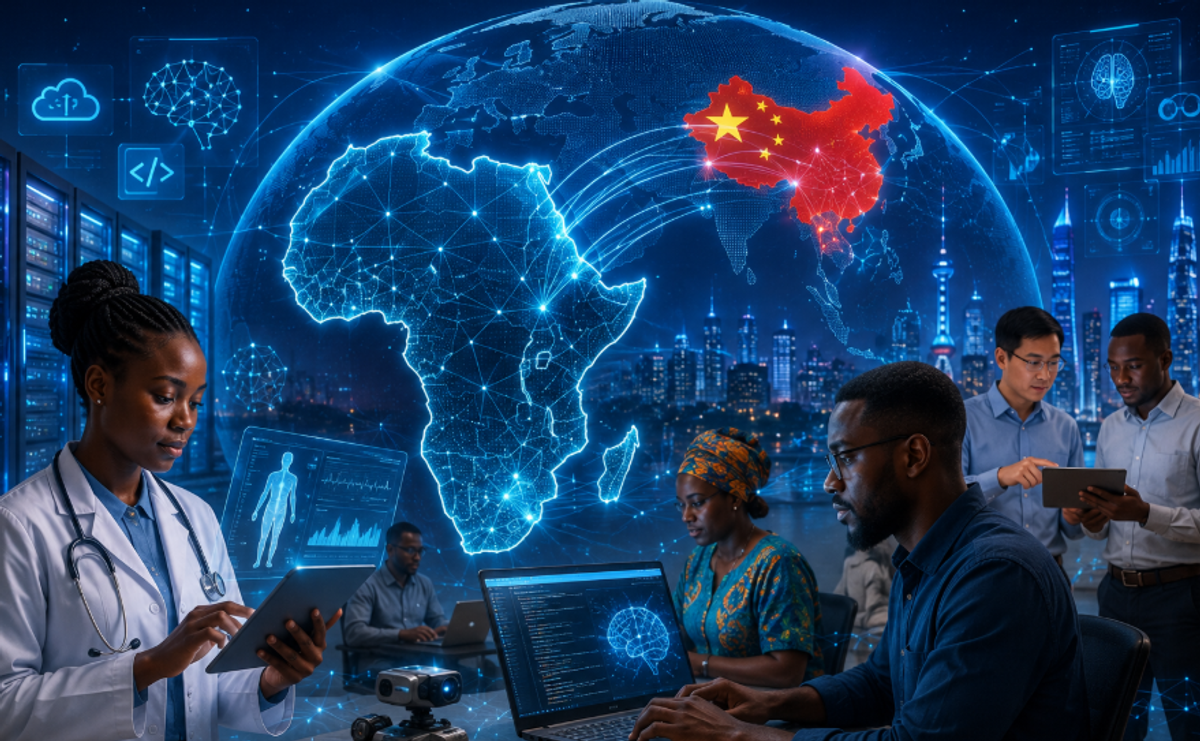
It's not coming. It's already here. Chinese open-source AI adoption in Africa has moved from experiment to real-world deployment - and across Kenya and beyond, developers are already building with these tools, solving real problems for real communities.
So what's driving this? And why does it matter where the AI actually comes from?
Why Chinese Open Source AI Adoption in Africa Offers a Different Kind of Opportunity
Closed-source AI is convenient. You plug in an API key, make a call, get a result. But you don't own anything. The model lives on someone else's server. Your data crosses borders you didn't choose, and the moment pricing shifts or access gets restricted, you're stuck rebuilding from scratch.
Open-weight models flip that. You download the model weights. You deploy locally. You fine-tune on your own data - data that reflects your users, your language, your market. Wu Chenglin, founder and CEO of DeepWisdom in Xiamen, Fujian province, frames it exactly this way: open-source AI lowers the barriers to technology adoption by giving developers actual control over what they're building with.
That's not a minor thing. For emerging tech startups across Africa trying to build AI products without Silicon Valley budgets, local deployment isn't just a preference. It's often the only viable path.
China's Open-Source Push Is More Calculated Than It Looks
Companies like Alibaba, Baidu, and ByteDance have all released open-source large language models in recent years. It's part of a deliberate strategy: accelerate global developer adoption, build community, and establish a foothold in markets where Western AI is expensive or hard to access.
The China AI growth outlook shows just how fast this has scaled. The global AI industry rankings increasingly reflect it too - Chinese AI firms have built genuine global developer followings, particularly in markets where cost sensitivity matters most. And Chinese AI entrepreneurs have been building products designed to travel globally from the start.
This didn't happen by accident. The Chinese AI policy clusters shaping this approach operate at the government level, and Africa is clearly part of the picture.
From Xiamen to Nairobi: What Real Deployment Looks Like
This isn't theoretical. In Kenya, a company used DeepWisdom's Atoms model to build Yotu Health - a mobile AI co-pilot that helps users manage blood sugar levels, schedule medications, and navigate day-to-day health decisions. Practical. Local. Built on a Chinese open-source foundation.
The broader competitive context matters here. Harun Katusya, a Kenya-based data scientist, describes the contest between US players like OpenAI and Anthropic and Chinese developers like DeepSeek as something that directly shapes what's available - and at what cost - to African developers. "Africa sits at the center of this emerging contest," he says, "because it is a massive untapped digital market, and many institutions are rapidly digitizing without strong AI governance frameworks."
That framing - opportunity and risk bundled together - is the honest way to look at this. The AI exhibition highlights from recent Chinese tech showcases reveal tools explicitly built for global deployment, not just domestic use. But deploying without governance is its own kind of problem.
The Sovereignty Question - And Why It's Already in Kenya's National Strategy
Lawrence Nderu, a research fellow at the Department of Computing at Kenya's Jomo Kenyatta University of Agriculture and Technology, makes a distinction that gets to the heart of this. The real advantage of open-weight models isn't just cost. It's control.
"With open-weight models, African teams can host systems locally, reduce dependency, protect sensitive data, fine-tune domain-specific datasets, and build solutions that reflect African priorities rather than simply consuming AI products designed for other markets," he says.
That's AI sovereignty in practice. And Nderu confirms it's now explicitly embedded in Kenya's national AI strategy.
The vision goes further than protecting data, though. He's talking about using open models as scaffolding - to train researchers, develop African language benchmarks, create domain-specific datasets, and ultimately build AI systems owned and governed by African institutions. Not just consuming Chinese open-source AI models. Turning them into something African.
Healthcare, finance, education, agriculture, public administration - in all of these sectors, opaque AI with uncontrolled dependencies isn't acceptable. Trust matters. Regulatory compliance matters. Long-term sustainability, as Nderu puts it, is paramount.
He's also careful to name the risks. Open-source doesn't automatically mean safe. Policymakers need to evaluate these technologies carefully, particularly around data protection. Meanwhile, China supercomputer advances signal where the underlying infrastructure is heading - which matters because local deployment gets easier as models are distilled and made cheaper to run.
Is the governance side keeping up with the deployment side? That's the real question.
The $1 Trillion Projection That Changes the Frame on Chinese Open Source AI in Africa
The African Development Bank Group puts a number on this: AI deployed inclusively could add up to $1 trillion to African economies' GDP by 2035. That's close to one-third of the continent's current total economic output.
Think about that for a second.
That number doesn't assume one proprietary platform wins. It assumes access. Customization. Local ownership. Which is exactly what Chinese open-source AI adoption in Africa - used thoughtfully - can help deliver. For anyone following the latest AI news and how the global AI race intersects with developing markets, this is a story worth watching closely. The stakes aren't just technical. They're economic.
Where Chinese Open Source AI Adoption in Africa Is Actually Heading
The opportunity is concrete. Developers get powerful models without proprietary lock-in. Countries get building blocks for AI sovereignty. Startups can build products that actually fit local context instead of importing assumptions designed for entirely different markets.
But none of that happens automatically. Governance has to keep pace. Institutions need to evaluate what they're adopting and why. African researchers, developers, and policymakers have a role here that goes well beyond downloading model weights and running inference.
The real win isn't adopting Chinese open-source AI. It's using it to build something African.