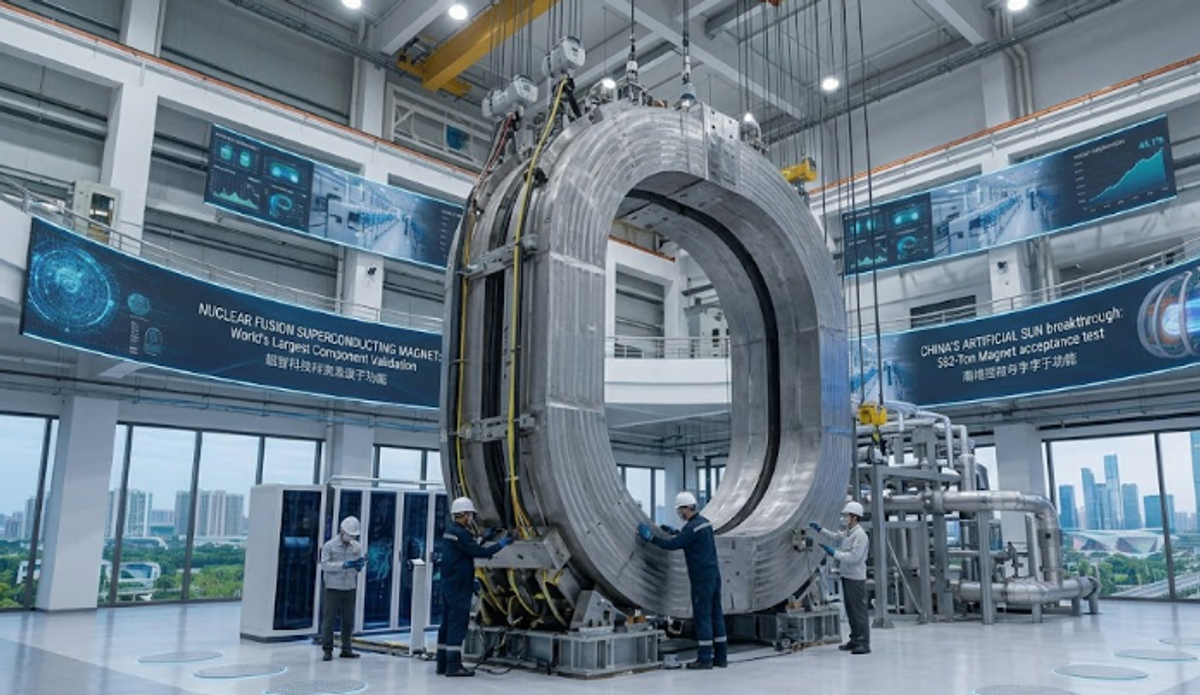
China's fusion scientists didn't just make progress last Saturday. They made history - twice.
Researchers at the Hefei Institute of Plasma Physics, part of the Chinese Academy of Sciences, announced back-to-back breakthroughs in superconducting magnet technology. Two major milestones. One day. And both are directly connected to what's now being called the world’s largest fusion reactor magnet test in 2026 - an effort years in the making that just cleared its two most demanding technical hurdles.
If you follow science and energy breakthroughs in clean power, this is the one to read this week.
The World's Largest Fusion Reactor Magnet: Breaking ITER's Record in 2026
Let's start with the one getting the most attention.
A toroidal field superconducting magnet - weighing 582 metric tons - cleared a full expert panel review on Saturday. Wu Yu, a researcher at the Hefei Institute, confirmed it's currently the world's largest toroidal field magnet designed for a nuclear fusion reactor. Its volume is 1.3 times that of the equivalent component in the International Thermonuclear Experimental Reactor. Its energy storage capacity is three times higher.
Three times.
That's not incremental. The 582 metric tons toroidal field superconducting magnet specs here reset the benchmark entirely - and give next-generation reactors far more engineering room to work with.
So what does a toroidal field magnet actually do? It generates the magnetic field that keeps superheated plasma - running hotter than hundreds of millions of degrees Celsius - from touching the reactor walls. Without a toroidal field magnet, plasma confinement under extreme conditions, the plasma tears through the containment structure and the reaction collapses. The magnet is what keeps the whole thing controlled.
That's why it must stay stable under ultralow temperatures, intense radiation, high electric currents, and enormous mechanical stress. All at once. Continuously. For about 60 years.
The Solenoid Coil Nobody Was Talking About (Until Now)
The second breakthrough got less coverage. That's a mistake worth fixing.
A high-temperature superconducting central solenoid coil completed full-condition parameter testing on Saturday, with key performance indicators reaching what the team described as world-leading levels. Qin Jinggang, deputy director of the Hefei Institute, put it plainly: the central solenoid operates under the most demanding conditions in the entire reactor, and it plays a critical role in both starting and sustaining the fusion reaction.
Think of it as the ignition system. Without it, the plasma current never gets going. No plasma current, no reaction. Qin said the solenoid coil is "a key technology for moving fusion energy from laboratory experiments to practical electricity generation." That's not marketing language - it's a precise engineering statement about a part the whole device depends on.
The high-temperature superconducting central solenoid coil parameter test results now put China at or near the front globally on this specific component.
There's another layer to this story. China is now producing these components domestically. Special stainless steel and insulating materials that previously came from foreign suppliers are manufactured at home. Fusion reactor core components expected to operate continuously for 60 years require materials with almost no commercial precedent - and China's doing it without imports. The Compact Fusion Energy Experimental Device program helped break that foreign technological monopoly, and the results are showing up directly in these tests.
What the 2030 Net Power Gain Target Actually Looks Like
Song Yuntao, director of the Hefei Institute of Plasma Physics, confirmed the Burning Plasma Experimental Superconducting Tokamak is currently under construction in Hefei. The stated target: achieve net fusion power gain - more energy out than goes in - and demonstrate electricity generation around 2030.
Four years from now.
Fusion works by combining atomic nuclei to release energy. It's the same mechanism powering the sun. Scientists have been trying to replicate it in a controlled environment on Earth for decades, and the engineering challenges have kept moving the goalposts. The Comprehensive Research Facility for Key Systems of Fusion Reactor Mainframe represents China's most serious infrastructure commitment to finally crossing that line.
If the net fusion power gain electricity generation timeline holds, the implications go well beyond China. Carbon-free electricity, essentially no long-lived radioactive waste, hydrogen isotope fuel that's far more abundant than uranium. Saturday's tests moved that promise measurably closer to reality.
China's Broader 2026 Tech Momentum
These milestones don't exist in isolation.
China's Lingsheng supercomputer recently topped the Top500 global rankings. AI-driven innovation in 2026 is reshaping competitive dynamics across industries. China's electronics industry posted profit growth of roughly 103.9 percent year on year, driven by global demand for high-end computing chips and memory chips and a surge in B2B semiconductor and AI device raw material manufacturing. Industrial economics growth in China driven by emerging AI industries is a real, measurable trend - not just a headline.
The convergence between 6G and next-gen technology, advanced hardware and gadgets, and clean energy infrastructure is tightening fast. Global technology competition is intensifying across every frontier simultaneously. Countries building foundational infrastructure today - in compute, in energy, in materials science - are the ones shaping the next several decades of industrial economics.
What the World’s Largest Fusion Reactor Magnet Test 2026 Signals Going Forward
China's progress here shifts expectations globally. The Hefei Institute of Plasma Physics has consistently delivered on its fusion reactor milestones, and the successful completion of both magnet tests means the Burning Plasma Experimental Superconducting Tokamak is on track.
The world’s largest fusion reactor magnet test in 2026 produced two specific, independently reviewed engineering validations - not projections, not simulations. A 582-ton toroidal field magnet that outpaces ITER's specs by a wide margin. A central solenoid coil that reaches world-leading performance levels under the most punishing conditions inside the device. Both are now ready to go into an actual reactor targeting real electricity generation before the end of the decade.
Emerging tech startups and established players at the intersection of clean energy and advanced computing are watching these milestones closely - because the countries that solve fusion infrastructure first will shape energy economics for a very long time.
Whether the 2030 date holds exactly or slips a year or two, the hardware is real. And it's getting harder to argue that fusion power is still just a distant promise.