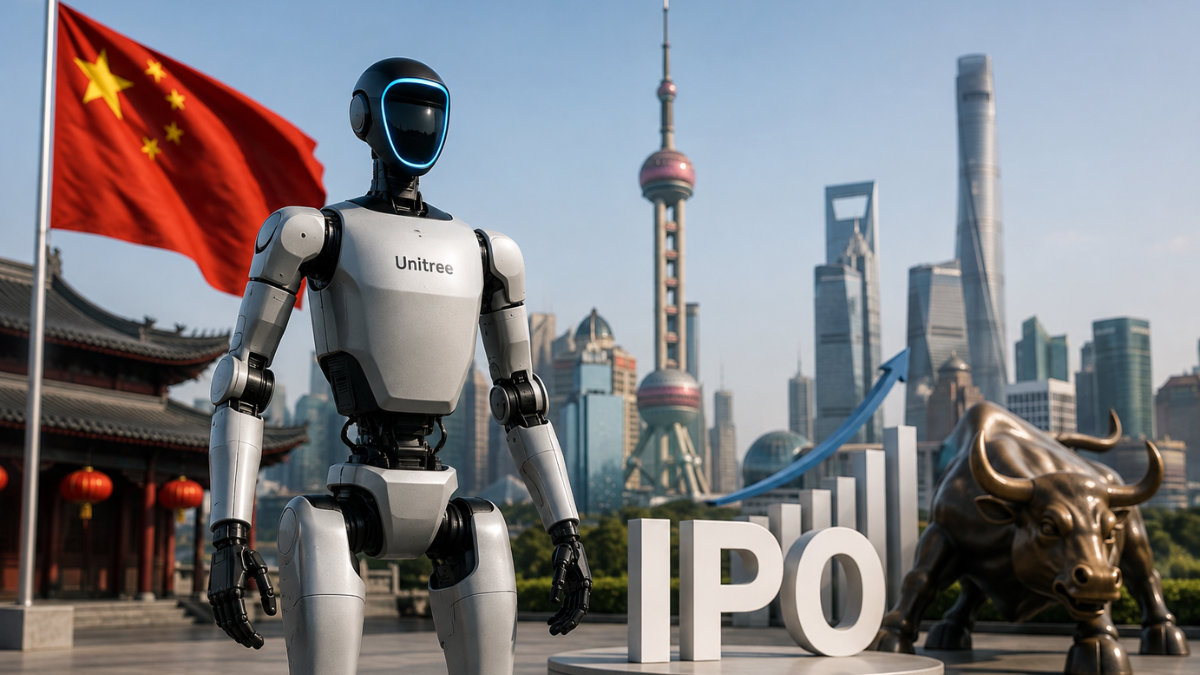
The Unitree Technology Shanghai IPO valuation: Citic has put a sharp number on one of China’s most-watched robotics listings. Citic Securities, the IPO sponsor, estimates the Hangzhou-based robot maker could be worth 50.6 billion to 55.9 billion yuan, or more than $7.4 billion, six to 12 months after it lists in Shanghai.
That’s a big expectation for a company building machines that still look, at times, like they belong in a lab demo. But Unitree is no longer just a curiosity. Its quadruped and humanoid robots are becoming a test case for whether China can turn embodied AI into a serious public-market story.
For background on Unitree’s STAR Market approval, the listing is also a useful marker in China’s robot race.
Why the Unitree Technology Shanghai IPO valuation Citic report matters
Citic’s assessment places the Unitree IPO valuation in the 50 billion yuan range, above many investors’ expectations for a young hardware company. The broker reportedly values Unitree at roughly 20 times expected 2026 sales and about 80 times forecast earnings.
Those are ambitious multiples. They assume Unitree can keep converting viral robot demonstrations, research demand, and industrial interest into repeatable revenue.
The Unitree Technology $7.4 billion valuation Shanghai listing is not a confirmed market price. It is a valuation view prepared ahead of price discovery, and actual demand could move the final figure in either direction. Still, a Unitree Citic Securities IPO report carries weight because Citic is sponsoring the offering.
Citic’s case rests partly on Unitree’s role in the embodied intelligence ecosystem and Unitree valuation story. Investors aren’t only pricing today’s robot sales. They’re pricing the possibility that adaptable, lower-cost robots become useful in factories, logistics, research, services, and eventually homes.
That last part is where things get speculative. Fast.
What Unitree plans to do with 4.2 billion yuan
The company plans to raise 4.2 billion yuan for innovation and production. Put another way, Unitree Robotics’ 4.2 billion yuan IPO fundraising is aimed at turning technical momentum into manufacturing capacity.
The simple headline version: Unitree aims to raise around 4.2 billion yuan for humanoid robot production.
More production matters because humanoid robotics manufacturing is expensive, messy, and heavily dependent on its components, testing, supply chains, and software iteration. You can build a compelling prototype with a small team. Building thousands of reliable units is another problem entirely.
Unitree’s product line includes quadruped robots such as the Go2 and humanoid machines. The Unitree Go2 robot price launch on the Shanghai STAR market angle may draw consumer attention, but the investment thesis goes much further than one robot-dog model. Unitree is positioning itself as a general-purpose robotics company, not a gadget brand.
And that’s where the pressure starts. If production costs stay high or commercial customers remain cautious, a rich valuation can look fragile very quickly.
Unitree Technology Shanghai IPO valuation: Citic and the Tesla comparison
The Unitree vs Tesla humanoid robot IPO comparison is inevitable, even if it’s imperfect. Tesla has a vastly different scale, vehicle business, capital base, and distribution footprint. Unitree, meanwhile, is a specialist robotics company trying to prove that China can commercialize capable machines at speed.
Still, Unitree quadruped and humanoid robots compete with Tesla Optimus for attention, talent, customers, and investors’ imagination. Boston Dynamics also remains a major reference point, especially for mobility and robot performance.
Does Unitree compete with Tesla and Boston Dynamics? Yes, in broad product categories and future market ambition. No, not as a like-for-like business today.
You should view Unitree’s advantage as focus, speed, and a Chinese manufacturing ecosystem built around cost. Its weakness is that the commercial market for humanoids remains early. There’s plenty of excitement, but not enough long-term purchase history yet.
The wider physical AI outlook helps explain why investors are paying attention. Similar momentum is visible in Japan’s physical AI push and in research around self-dressing robot technology. Different projects, same race to make machines useful in the physical world.
The geopolitical risk investors can’t ignore
The China-US tech rivalry in the humanoid robot market is no longer an abstract backdrop. It can affect access to customers, components, partnerships, and regulatory approvals.
Reports say the US sanctions on Chinese robotics unit Unitree Covered List issue could restrict foreign-made advanced robots from obtaining equipment authorization needed for US sales. In June, Unitree was also reportedly added to a US Department of Defense military list alongside other Chinese technology firms.
Why did the US add Chinese robot maker Unitree to its Covered List? The concern reflects Washington’s broader scrutiny of advanced Chinese technology and potential military links, rather than a judgment on every commercial product the company sells.
For Unitree, the practical problem is uncertainty. The US Department of Defense military list designation for Chinese robot maker Unitree may not stop its domestic business, but it can complicate global expansion and make overseas buyers more cautious. That’s a real discount factor for any investor.
A major test for Shanghai’s technology market
The Hangzhou-based Unitree Technology general-purpose robotics IPO arrives during a renewed focus on high-growth domestic listings. Its outcome will be watched alongside China A-share resilience, China AI valuation trends, and CXMT’s IPO surge.
Unitree could become an A-share IPO benchmark for robotics. It will also test whether public investors believe China’s AI sector growth can translate into durable corporate earnings.
The company’s future will depend on more than flashy movement demos. Buyers need robots that work safely, repeatedly, and at a cost that makes sense. That’s the hard part of smart manufacturing competition.
What to watch after the listing
The Unitree Yushu Technology IPO listing date and final offer price will give investors their first hard read on demand. After that, watch production volume, gross margins, enterprise orders, and whether international restrictions limit expansion.
The Unitree Technology Shanghai IPO valuation Citic estimate is a vote of confidence in China’s robotics ambitions. But confidence alone won’t justify 50 billion yuan. Unitree needs to show that its robots can move beyond demonstrations, scale responsibly, and solve problems customers will actually pay for.
GlobalByte Perspective
At GlobalByte News, we look at Unitree’s $7.4 billion Shanghai IPO targets through a balanced, pragmatic lens.
For years, the robotics narrative was dominated by viral video demos—agile quadruped dogs doing backflips and humanoids walking through lab courses. Unitree’s upcoming listing on Shanghai’s STAR Market is a turning point. It forces the market to ask a simple question: Can flashy engineering translate into sustainable corporate profits?
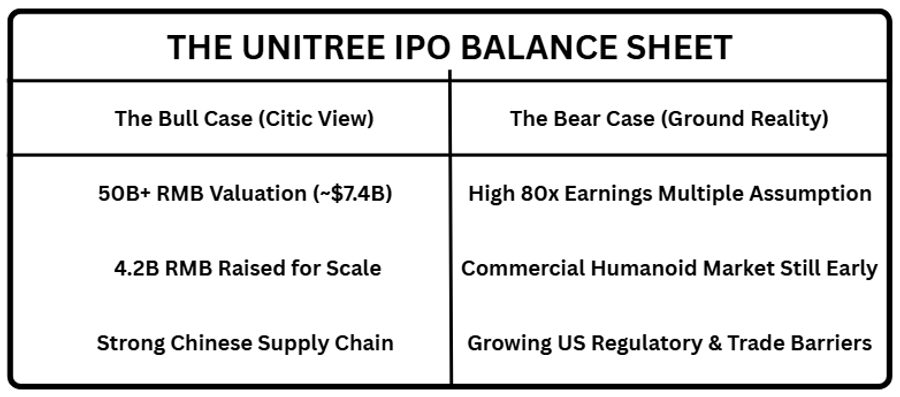
Unitree IPO: Opportunity vs. Risk. The company's planned Shanghai listing combines a multi-billion-dollar valuation and strong manufacturing advantages with challenges including high valuation expectations, an emerging commercial humanoid market, and growing geopolitical headwinds.
Citic Securities’ forecast values Unitree at nearly 80 times its projected earnings. That is a high bar for any hardware company. Building a prototype with a small engineering team is one thing; setting up factory lines that can output thousands of reliable, cost-effective humanoid units every month is an entirely different operational challenge.
Beyond the factory floor, there is the global regulatory environment. With the US adding advanced foreign-made robotics to its Covered List and restricting access to Western markets, Unitree faces friction outside China. This means their primary growth story relies heavily on domestic industrial adoption and local government backing.
Our Take: Unitree’s IPO is a major test for the entire physical AI sector. If Unitree can convert its early lead into clear enterprise sales and solid gross margins, it will set a benchmark for hardware startups globally. But if enterprise demand stalls, a $7.4 billion valuation could quickly face pressure. In robotics, hardware is hard, and public market accountability is even harder.