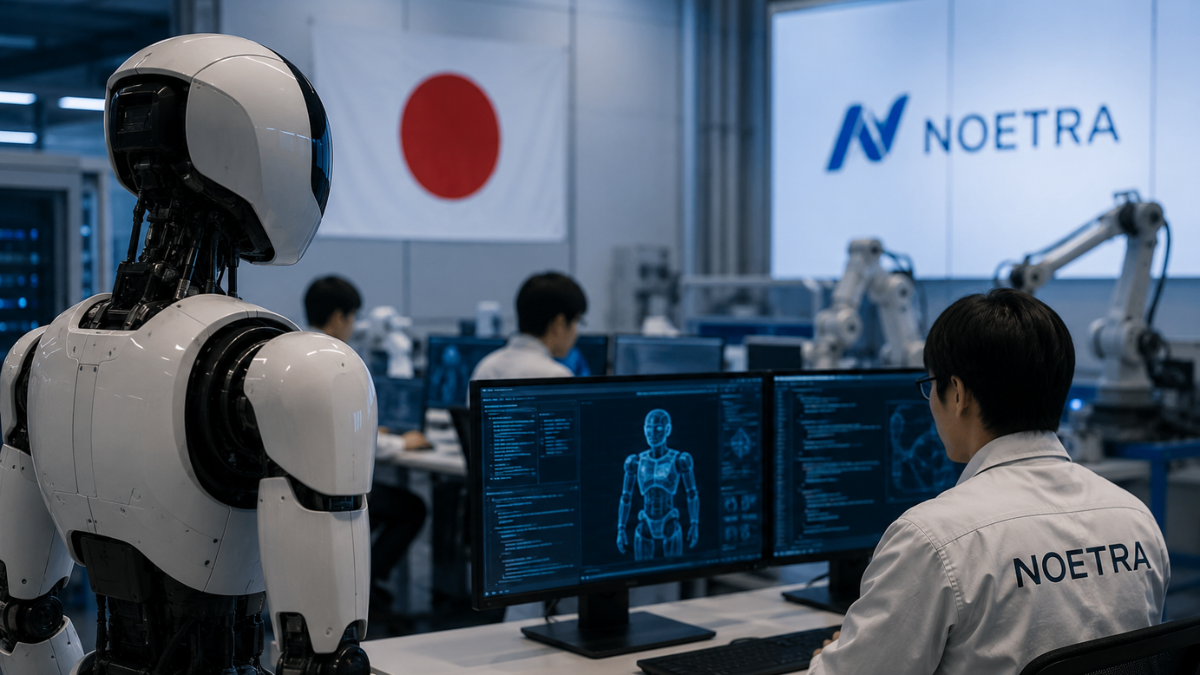
Japan doesn't usually talk about "last chances." But that's exactly the phrase Hironobu Tamba used when describing Noetra, the government-backed venture now at the center of Noetra Japan’s Physical AI ambitions. Tamba is the company's CEO, and he didn't sugarcoat it in a recent interview: Japan has one real shot left to build its own foundational model for robots and industrial machines, or it risks falling permanently behind the US and China.
That's a heavy statement from someone who also holds an executive role at SoftBank. But look at the numbers behind it, and the urgency starts to make sense.
What Exactly Is Noetra?
Noetra is developing a Japan foundational model for physical AI, essentially the software brain that lets robots perceive, reason, and act in the real world rather than just chat in a text box. Unlike the large language models dominating headlines out of Silicon Valley, this is a physical AI foundational model for robotics built specifically for manufacturing floors, shipyards, and eventually nursing homes.
The project isn't a scrappy startup running on venture capital alone. It's backed by more than 380 billion yen (about $2.33 billion) in government funding for its first year alone. That's the kind of money usually reserved for national infrastructure, not a robotics AI company. And honestly, that's the point. Japan is treating this as infrastructure.
Who's Actually Behind It
This is where things get interesting. The SoftBank Honda Sony-backed AI startup Noetra has pulled in 44 companies as backers, a coalition that reads like a who's who of Japanese industry. SoftBank brings capital and AI ambition. Honda brings decades of robotics and manufacturing know-how. Sony brings sensor technology and consumer electronics muscle.
Tamba described the effort in fairly plain terms: "We've been able to bring together people who have been working on AI in Japan." Not flashy language. Just a statement of fact from someone trying to consolidate a fragmented, talent-starved field before it's too late.
That fragmentation is a real problem. Japan has some of the best industrial robot makers on the planet, yet its AI talent has often scattered abroad or into smaller, disconnected efforts. Noetra is meant to be the gravitational center that pulls it all back together.
The Hardware Side: 27,500 Nvidia Rubin Chips
None of this works without serious compute. Noetra is procuring 27,500 Nvidia Rubin chips, a massive commitment that signals just how seriously Japan is taking Nvidia Rubin chips procurement as a national priority, not a corporate line item.
Construction on the AI infrastructure is set to begin in April 2027, with operations targeted to start in June 2028. That's a tight but deliberate timeline. Building out chip clusters at this scale takes years, not months, and Japan is racing a clock set by Washington and Beijing, both of which are pouring comparable resources into their own physical AI stacks. If you want a sense of how competitors elsewhere are approaching similar buildouts, the embodied intelligence computing infrastructure being developed in China follows a strikingly similar logic: control the chips, control the model, control the outcome.
Why This Matters for Data and Sovereignty
Here's the thing that gets lost in the funding headlines. Noetra isn't just about raw horsepower. Tamba framed the company's mission as giving Japanese companies access to a reliable and safe foundational model where they manage their own data, rather than routing sensitive manufacturing or healthcare information through foreign cloud providers. That's a sovereignty play as much as a technology one.
Think about it from a factory owner's perspective. Would you want your production line's operational data sitting on servers you don't control, subject to laws you didn't write? Probably not. This is a big reason Japan’s sovereign AI infrastructure investment has accelerated so quickly, and it echoes a broader shift happening globally as companies rethink physical AI solutions for business and where that data actually lives.
The Bigger Political Picture
Prime Minister Sanae Takaichi's administration isn't putting all its chips on Noetra alone. It's also backing Rapidus, a foundry venture aiming to manufacture cutting-edge semiconductors domestically. Together, these two bets represent Prime Minister Sanae Takaichi’s AI strategy in its clearest form: build the chips at home, build the models at home, and stop depending on outside suppliers for either.
China and the US are locked in their own AI race, and Japan knows it can't out-spend either giant. What it can do is out-specialize them, leaning on its existing strength in Japanese industrial robotics supply chain manufacturing rather than trying to out-build hyperscale data centers from scratch.
The 10 Million Robot Goal
Now for the number that tends to grab attention. Tokyo wants 10 million AI-enabled robots deployed by 2040, spread across manufacturing, shipbuilding, and nursing care. Japan's aging population makes that nursing figure especially urgent. Fewer working-age people means more reliance on machines for elder care, and that's not a hypothetical problem decades out. It's already happening.
Manufacturing and shipbuilding round out the plan, sectors where Japan still holds genuine global leadership. The idea is to pair that hardware dominance with domestically built AI, closing a gap that's left Japanese firms buying foreign software to run Japanese-built machines.
How Japan's Bet Compares Globally
Japan isn't operating in a vacuum here. China has been aggressive on multiple fronts, from embodied robot mass production hitting five-figure unit counts, to new humanoid robots and digital ID rules meant to track machines the way countries track citizens. Even capital markets are catching on, with the robot race going public as firms rush toward IPOs to fund the next phase.
Regional governments are placing their own infrastructure wagers too. Wuhan's AI agents infrastructure bet and Ningbo's growing robotics investment portfolio show how much regional capital is chasing this space. Meanwhile, chipmakers are racing too, with self-driving chip advances putting pressure on established players.
Trade shows are reflecting the shift as well. Recent events highlighting the AI economy and 6G innovation, and an AI exhibition with Nvidia and Qualcomm, both underscore how fast the underlying chip and connectivity stack is moving. Even the automotive AI and car chip race is intersecting with physical AI, since many of the sensors and processors overlap with robotics hardware.
Against that backdrop, Noetra Japan Physical AI looks less like an isolated moonshot and more like Japan trying to keep pace in a race that's already well underway.
Where This Leaves Japan
So where does this actually land? Somewhere between promising and uncertain, honestly. The funding is real. The industrial partners are real. The chip order is real. What's not yet proven is execution, and execution is where a lot of ambitious national tech projects have stumbled before.
Still, Tamba's "last chance" framing isn't dramatic for the sake of headlines. Japan has the robotics hardware. It has the manufacturing base. What it's lacked is a unifying AI layer to tie it together, and that gap has been closing fast in other countries while Japan debated. Noetra, for better or worse, is the attempt to close it before the window shuts entirely.