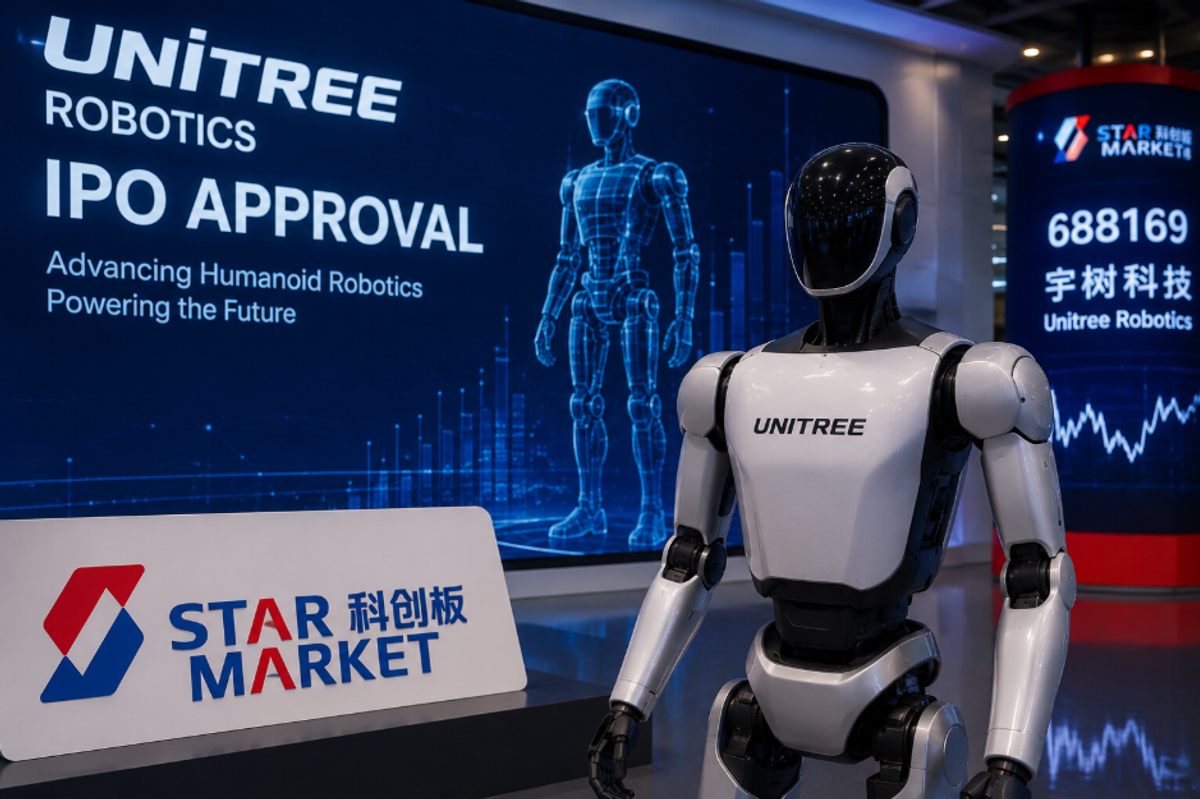
China's best-known humanoid robot maker just cleared a major regulatory hurdle. The Unitree Robotics STAR Market IPO approval came through from the China Securities Regulatory Commission (CSRC) this week, confirmed via a notice on the regulator's official website. If you've been watching China's AI startup ecosystem, this is the moment a lot of people have been waiting for.
Unitree isn't just any robotics startup. The company made global headlines when its G1 humanoid robots performed martial arts demonstrations at the Temple of Heaven. Its consumer-grade quadruped line helped it spread R&D costs across a large volume base before the humanoid push - a deliberate strategy for amortizing expenses through scale. And Meituan, yes, the food delivery giant, holds a stake as an external institutional shareholder. When this company goes public, people pay attention.
What the CSRC Registration Approval Actually Covers
The process here is worth understanding. The CSRC received the audit opinion from the Shanghai Stock Exchange, reviewed Unitree's IPO registration documents, and issued its registration approval. From this point, Unitree must follow its prospectus and issuance plan precisely. Any material developments before the stock issuance is completed have to be flagged to the SSE right away.
That part is standard procedure. The approval itself is the milestone.
Professor Hu Qimu of the Maritime Silk Road Institute at Huaqiao University told the Global Times: "This marks the company officially opening the door to the capital market." His point cuts to the core of why this matters for an embodied artificial intelligence listing on the A-share market. Private funding rounds and bank lending have limits. Long-term equity capital, raised through a public offering, changes what's possible at the R&D level.
The 4.2 Billion Yuan Plan
Unitree plans to raise 4.2 billion yuan. The prospectus breaks it into three uses: R&D on intelligent robot models and robotic bodies, development of new intelligent robot products, and construction of an intelligent robot manufacturing base. These aren't vague line items.
The company has already shipped over 5,500 humanoid robot units - more than most competitors globally. So this isn't a "prove the concept" raise. It's a scale-up play. The manufacturing base component in particular suggests Unitree is planning for production capacity well beyond what its current setup allows.
Unitree cleared the SSE's review of its IPO application back on June 1. This week's CSRC registration approval was the final gate - and it opened. Unitree is also only the second company to file an IPO application under China's pilot pre-review mechanism for high-quality technology companies, a fast-track process the CSRC introduced in June 2025 to cut the lag between filing and approval for strategically important firms. It worked.
Not Just Unitree - a Broader Tech Wave
This isn't a one-company story. Three significant listings are moving at roughly the same time, and together they're reshaping China's AI industry in ways that go beyond any single IPO.
XPHOR, a Shanghai-based company focused on high-performance silicon photonic integrated chips, had its STAR Market IPO filing accepted by the SSE on Tuesday. It plans to raise 2.43 billion yuan. Silicon photonics doesn't get the same consumer headlines as humanoid robots, but its role in AI compute infrastructure is significant - and given China's open-source AI surge, getting that hardware layer right is a clear priority.
Then there's Shanghai Enflame Technology, one of China's "four GPU unicorns," whose STAR Market IPO application was approved by the listing review committee in June. It's part of the same wave, and it's why China's competing AI companies are showing up in capital market filings rather than just VC announcements.
The pattern is deliberate. China's hard tech push - robots, chips, GPUs, photonics - is moving from private funding into public equity. That's a structural shift, not just a market trend, and it fits squarely into China's trade and economic strategy that's been building for years.
Why the STAR Market Rules Are Changing for AI
At the 2026 Lujiazui Forum in Shanghai on June 17, CSRC Chairman Wu Qing announced the commission will expand the applicable range of its fifth listing standards for the STAR Market to cover the artificial intelligence sector. He also said the market will support more "hard tech" enterprises in quantum technology, bio-manufacturing, and embodied intelligence.
The fifth listing standards exist specifically for pre-profit companies with high R&D intensity and longer timelines to break even. Extending that to AI explicitly signals how regulators categorize these firms - not as speculative tech plays, but as strategic infrastructure. That framing matters for valuations, disclosure requirements, and investor expectations alike.
Professor Hu Qimu put the broader case plainly: in high-tech sectors, technological iteration is rapid, return cycles are long, and companies need to continuously invest substantial resources into R&D. Public markets handle that kind of capital allocation in ways that bank lending can't. Beyond the mechanics, he noted the capital market also serves as a vehicle for ordinary investors to share in the gains from strategic emerging industries. That's a political framing as much as a financial one - and it's the framing China's tech ambitions in frontier technology are increasingly built around.
What This Means If You're Watching the Space
The Unitree Robotics STAR Market IPO approval isn't just a corporate milestone. It's a data point about where China's regulatory environment is heading for hard tech. The fast-track pre-review mechanism, the expanded fifth listing standards, and the CSRC chairman making these announcements from a top financial forum - these aren't coincidences. They're a coordinated signal.
For global investors, this creates early access to a listed humanoid robot company on the public A-share market - something that didn't exist until now. Given the evolving China-EU investment outlook and continued interest in cross-border portfolio diversification, the emergence of Chinese embodied intelligence stocks in public markets is worth tracking closely.
For the latest AI news and analysis as Unitree's share issuance moves forward, and for the broader AI tech innovations to watch coming out of China's tech sector, this approval is really just the opening act. The product side - including the consumer robotics line that helped build Unitree's financial base - keeps evolving too, and the robotics and gadget coverage has more on where that's heading.
Three major listings in roughly one month. Rules changed from the top of China's securities regulator. A humanoid robot company approved via a mechanism only one other firm has used. Whatever you think of Chinese tech's long-term trajectory, the pace right now is hard to miss.