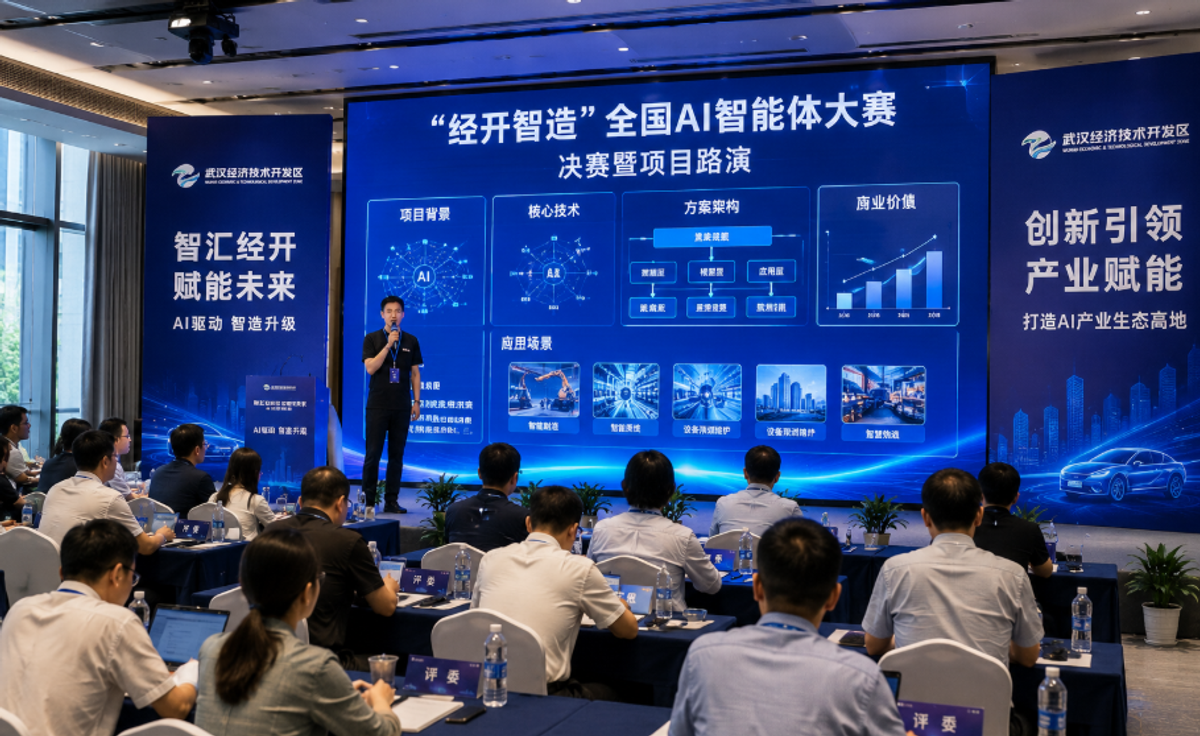
The Jingkai Intelligent Manufacturing National AI Agent Competition held its finals on July 3rd at the Wuhan Economic and Technological Development Zone AI OPC community in the South Taizi Lake area. Twenty-one teams from across China competed. Some were established companies. Others were university-led innovation groups. A handful were solo developers with one sharp idea and a serious technical edge.
By 8:30 a.m. - a full half hour before the opening bell - the roadshow hall was already packed.
Who Was in the Room
Each team got their window. They presented the technology stack, the architecture, the market case, and the industrial application plan. Then the judges pushed back. Hard.
University teachers, student teams, and independent developers made up a significant chunk of the field - and that actually shaped the energy of the whole day. This wasn't a polished corporate showcase. It was messier and more interesting than that. Young scientific and technological innovation forces were, by most accounts, the main drivers of the event. You could feel the weight of first-time exposure: entrepreneurs presenting ideas they'd built from scratch, in front of investment panels who weren't going easy on anyone.
For anyone following tech startups driving AI in China's secondary cities, the mix of talent here was genuinely representative of where that innovation is actually coming from.
The Cangjie Hongmeng Migration Agent: Weeks Become Hours
One project stopped the room more than others.
Chen Yuanping, a Zhejiang-based entrepreneur attending his first-ever roadshow final, demonstrated the Cangjie Hongmeng Migration Agent - a tool that automatically converts mini-programs into native Hongmeng applications in a single step. His pitch was direct: what once took a development team a full week can now be done in a day, or sometimes a few hours. Automated mini program to native Hongmeng app migration has been a persistent friction point in the Chinese app ecosystem. HarmonyOS adoption requires apps, and porting them manually is slow, expensive, and error-prone.
That's the kind of efficiency claim that gets investment teams leaning forward.
The judges did exactly that. After a round of pointed technical questions covering the roadmap, market strategy, and implementation plan, they extended a direct invitation for Chen's team to set up operations in the Wuhan Economic and Technological Development Area. That doesn't happen at every pitch.
Beijing Turing Culture and the Wuhan Engineers Behind It
Not every project at this national AI competition came from a local team. But some had stronger Wuhan roots than the name on the slide suggested.
Beijing Turing Culture brought an AI-powered intelligent teaching assistant. The core algorithm development was handled entirely by a local Wuhan technical team. Wu Ruixin, the company's planning editor, explained what the product actually does: it converts traditional paper textbooks into interactive, adaptive intelligent teaching tools. Several universities have already piloted it. More have reportedly inquired about licensing.
"AI technology lowers the threshold for industrialization," Wu said. "With local technical forces, good ideas can be transformed into products much faster."
And that's worth sitting with for a moment. The collaboration pattern here - a Beijing-headquartered company, Wuhan-based engineering team, national university market - mirrors how China's AI innovation push is increasingly working outside the traditional tech hubs. It's distributed. It's faster than you'd expect. And it produces deployable products, not just concepts.
AI Selecting AI: How They Cut 100+ Entries to 21
The Jingkai Intelligent Manufacturing National AI Agent Competition received over 100 project submissions since launch. Teams from outside the Wuhan region accounted for more than 30% of applicants. For a zone-level competition, that's a meaningful cross-regional draw.
Here's what made the screening process genuinely unusual: the initial evaluation was handled by AI agents. The "AI selecting AI" approach uses intelligent algorithm-based scoring to filter project submissions before any human judge gets involved. It's a deliberately self-referential design choice - an AI agent competition using AI agents to run its own gatekeeping. For anyone tracking AI agent developments across industrial application scenarios, it's a real-world deployment case, not a concept demo.
Whether algorithmic screening produces better results than expert human review is still an open question. But the choice signals confidence in the technology's current capability.
Capital in the Room: Funds, Parks, and Same-Day Deals
A competition this size isn't just about recognition. Honestly, for most teams, it's about connections.
Investment institutions attended as judges - Jiangcheng Fund, Chegu Science and Technology Innovation Fund, and the Bai Gai Tou project team all participated in the evaluation panel. A representative from the Wuhan Science and Technology Innovation Bureau confirmed the explicit goal: facilitate on-site capital introductions, and let high-quality projects negotiate both investment and park settlement in the same room where they pitched.
That compresses a process that typically takes months into a single day. It also means a Zhejiang entrepreneur pitching for the first time in Wuhan can walk out of the same event with a potential funding conversation and a zone-settlement invitation already on the table.
This kind of capital-and-park bundling fits a broader pattern visible across smart manufacturing and urban tech policy in China's development zones. Getting founders and funders in the same room isn't just convenient - it's a deliberate acceleration strategy for accelerating transformation of technological achievements in central China.
WETA's AI Ecosystem: More Than One Competition
The Jingkai Intelligent Manufacturing National AI Agent Competition is one event. WETA's broader AI build-out is a longer story.
The AI OPC community in the South Taizi Lake area currently hosts over 60 science and technology enterprises, spanning intelligent manufacturing, smart mobility, and large-model applications. WETA's existing "Automotive Valley" foundation gives it a natural edge for industrial AI and intelligent connected vehicle applications - the supply chains, engineering talent, and infrastructure are already in place. You don't build from scratch; you build on top.
Progress in intelligent chip development and China's semiconductor manufacturing race feeds directly into what zones like WETA are building. Connected vehicles need chips. Smart manufacturing needs chips. The industrial AI ecosystem here doesn't operate in isolation - it's wired into a broader hardware and software stack that's actively developing.
WETA's stated aim is building a "highly competitive intelligent manufacturing industrial cluster." That language shows up in a lot of official documents across China. But the competition format here - national reach, AI-driven screening, same-day capital access - suggests the zone is trying to close the gap between announcement and execution faster than most.
And it fits the wider context: China's global AI agenda is pushing hard on real industrial deployment, not just research output. Wuhan's positioning in that story is increasingly central, not peripheral.
What This Competition Actually Tells You
The projects at the Jingkai Intelligent Manufacturing National AI Agent Competition weren't theoretical proposals dressed up as pitches. Cangjie Hongmeng cuts migration time from weeks to hours. Beijing Turing Culture's teaching assistant is already running in universities. These are working products in active markets - at pitch stage, yes, but with real traction behind them.
So the signal here isn't that Wuhan has big AI ambitions. Lots of cities do. The signal is that this particular competition format - national intake, AI-driven screening, embedded capital access, zone-settlement invitations - is a replicable model for turning competition events into actual industrial pipeline.
For science and innovation coverage that goes beyond Beijing, Shanghai, and Shenzhen, Wuhan is a city worth watching. And this competition is a reason why.