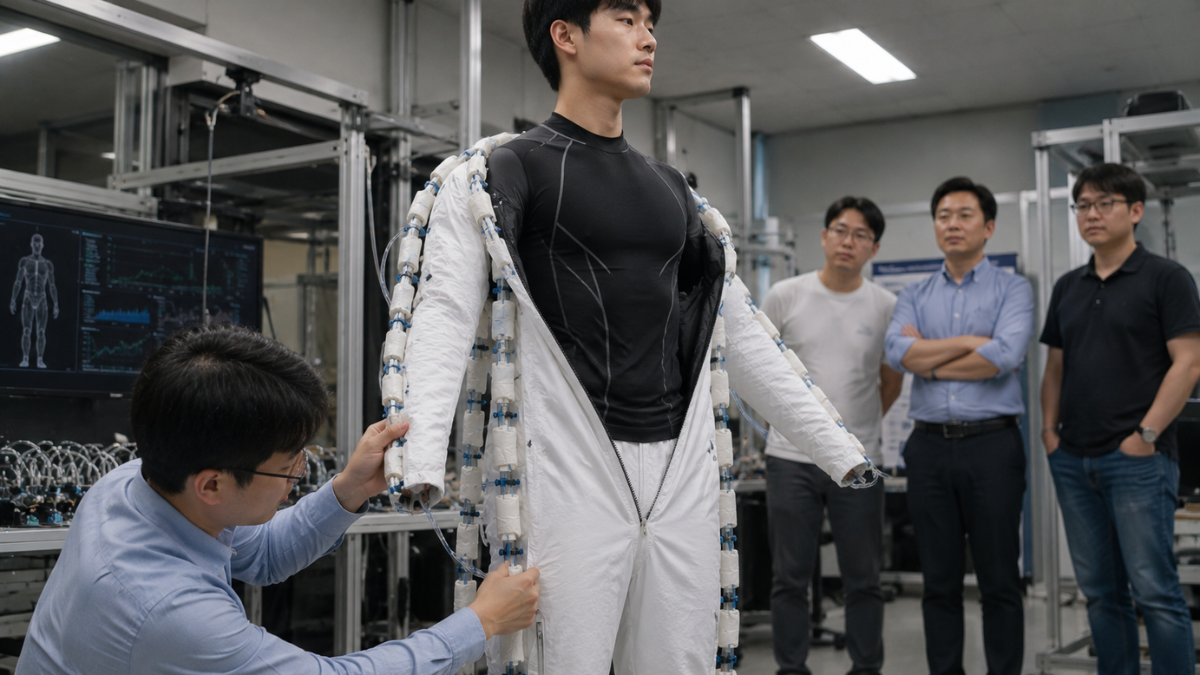
Imagine riding a bicycle when it starts to rain. You can't pull over. You can't reach for your jacket without losing balance. That exact frustration is what sparked one of the more quietly impressive breakthroughs in soft robotics this year - self dressing robotic technology KAIST Stanford researchers just officially unveiled.
The system uses flexible, air-pressure-powered "vine" structures embedded directly into clothing. When pressurized, they guide the fabric along your body from the inside out. No hands needed. No standing still required. And according to the team, a full suit takes about 10 seconds.
Honestly, that number sounds implausible until you understand how the mechanism actually works.
What Is SWAG and How Does the KAIST Stanford Self Dressing System Work?
SWAG stands for Self Wearing Adaptive Garments - and the acronym is very much intentional. The system was jointly developed by researchers at KAIST (Korea Advanced Institute of Science and Technology) and Stanford University's CHARM Lab, led by professor Allison M. Okamura.
Here's the basic idea. Thin, soft tubes are woven into the lining of a garment. When air pressure is applied, these tubes extend at their tips - growing outward, much like ivy climbing a wall. As each vine advances, it pushes the fabric inside-out, wrapping the clothing around whatever surface it encounters. It follows the contour of your arm. Your leg. Your torso.
That last part matters a lot. It doesn't need a flat surface or a motionless person to work on. It adapts as it moves.
Professor Jee-Hwan Ryu from KAIST's civil and environmental engineering department put it plainly: the vine robot can navigate narrow gaps, work on sloped or sticky surfaces, and follow curved body shapes without any complex control algorithm behind it. That's a meaningful design decision. Most assistive robots lean heavily on sensor arrays and algorithmic coordination. This one doesn't need either.
Dr. Nam Gyun Kim, KAIST postdoctoral researcher and lead author of the paper published in IEEE Robotics and Automation Letters, described it this way: the vine stays close to the person and dresses them by turning clothing inside-out as it extends - essentially like pushing a sock over your foot, except the sock does it on its own.
Why Growing at the Tip - Not Moving the Whole Body - Changes the Physics
Most robots shift their entire structure to move. Vine robots don't. They extend from the tip only, with the body behind staying completely still.
That's not just a curiosity. It's what makes this approach viable for dressing people. A robotic arm threading fabric over a limb needs a precise, pre-programmed path - one wrong calibration and it snags, stops, or worse, pushes the wrong way entirely. A vine grows along the path of least resistance, pressing fabric close to the skin as it goes.
Pneumatic eversion-based systems like this are an established area in soft robotics research. But applying them specifically to hands-free automatic dressing assistance is genuinely new territory. The inflatable subvine structure reduces friction between garment and skin, which is why the fabric glides rather than bunches.
The self dressing robotic technology KAIST Stanford developed requires no camera input, no pre-mapping of the wearer's body shape, and no deliberate cooperation from the person wearing the clothing. You can be moving. You can be on a bicycle in the rain. The vine adapts regardless.
Who This Technology Is Actually Built For
The most obvious beneficiaries are people with limited mobility. For elderly individuals or those with physical disabilities, getting dressed is a daily challenge that often requires caregiver help. Vine robot technology for elderly and disabled users could change that dependency - offering real independence without any redesign of the clothing itself.
But the research team isn't stopping at assistive care. Semiconductor cleanrooms are a serious target. Workers suiting up in contamination-controlled environments currently handle their own protective garments with bare hands, which creates contamination risk at every single gear-up. Soft robotics for semiconductor cleanrooms PPE could eliminate that entirely.
Emergency responders are another priority. Firefighters, hazmat teams, paramedics - all of them need to put on personal protective equipment fast, often without anyone nearby to help. An air pressure powered self wearing suit that takes 10 seconds changes the calculus for first responder deployment in a real way.
Before that happens at scale, corporate guidelines for implementing automated PPE suits in cleanrooms and emergency environments will need to catch up. But the hardware is getting there faster than the policy frameworks are.
For a broader sense of how physical AI for business is evolving right now, assistive robotics like this is increasingly central to what companies are planning for 2026 and beyond. And as the robotics market goes public, investor interest in wearable assistive tech is accelerating alongside the bigger industrial names.
The Case for Mechanical Engineering in a Software-First World
Professor Ryu said something worth slowing down on. With AI dominating robotics conversations, most public attention lands on software - the algorithm, the training data, the model. But this self dressing robotic technology KAIST Stanford built is a case where mechanical engineering does work that software can't replicate without adding enormous, often impractical complexity.
And he's right.
A lot of next generation assistive wearable robotic devices assume that smarter algorithms are always the answer. More sensors, better models, faster inference. But sometimes designing the physics correctly means the system works without any of that overhead at all. The vine robot requires no control algorithm. It functions the way it does because of how it's physically built - not because of what it's been programmed to do.
That distinction matters enormously at scale. Deploying mechanical engineering solutions for automatic dressing across hospitals, cleanrooms, or emergency fleets simply isn't viable if every unit needs calibration, connectivity, and compute. A physically self-governing system is dramatically easier to maintain and much harder to break.
We're seeing a broader tension play out around this idea. As AI reshaping global competition drives investment toward software-heavy robotics, hardware-first approaches like SWAG serve as a useful reminder that physics still solves problems algorithms struggle with. And while AI accelerating human capability is a real and documented trend, at the edge - in field hospitals, remote clean facilities, areas with no connectivity - pure mechanical solutions often outlast the digital ones.
Where the SWAG Robot Fits in the Larger Robotics Picture
Self dressing robotic technology from KAIST and Stanford doesn't exist in isolation. The broader robotics sector is moving fast, and this kind of hardware innovation fits into a growing wave of embodied systems that are reaching real-world deployment.
General-purpose embodied robots are already hitting production at meaningful scale. The infrastructure behind embodied intelligence infrastructure is being built out rapidly. Robot investment portfolios are expanding into assistive tech categories that were barely on the radar two years ago. And AI agents for intelligent systems are increasingly being paired with physical platforms at scale.
Policy is catching up, if slowly. Active debates around humanoid robot regulation show that governments are beginning to take physical AI seriously - and assistive robotics like SWAG will eventually need their own regulatory frameworks before clinical deployment becomes broadly viable.
It's also worth noting the South Korea dimension here. The Korean tech ecosystem chips and hardware story is getting louder globally. KAIST partnering with Stanford on this research isn't a coincidence - South Korea is pushing hard to be a hardware-first robotics power, and SWAG is exactly the kind of research that makes that claim credible.
10 Seconds. No Hands. Real Applications.
The self dressing robotic technology KAIST Stanford published isn't just a clever prototype. It's a reframe of what robotic assistance can look like - one where well-designed physics replaces complex algorithms, and where getting dressed stops being a daily barrier for people who need help.
Soft robotics applications in emergency services, eldercare, and cleanroom environments are massive, underserved markets. The vine robot - small, pneumatic, and elegantly simple - might be what finally cracks them open.
And it all started with a researcher caught in the rain on a bicycle, wishing his jacket could just put itself on.