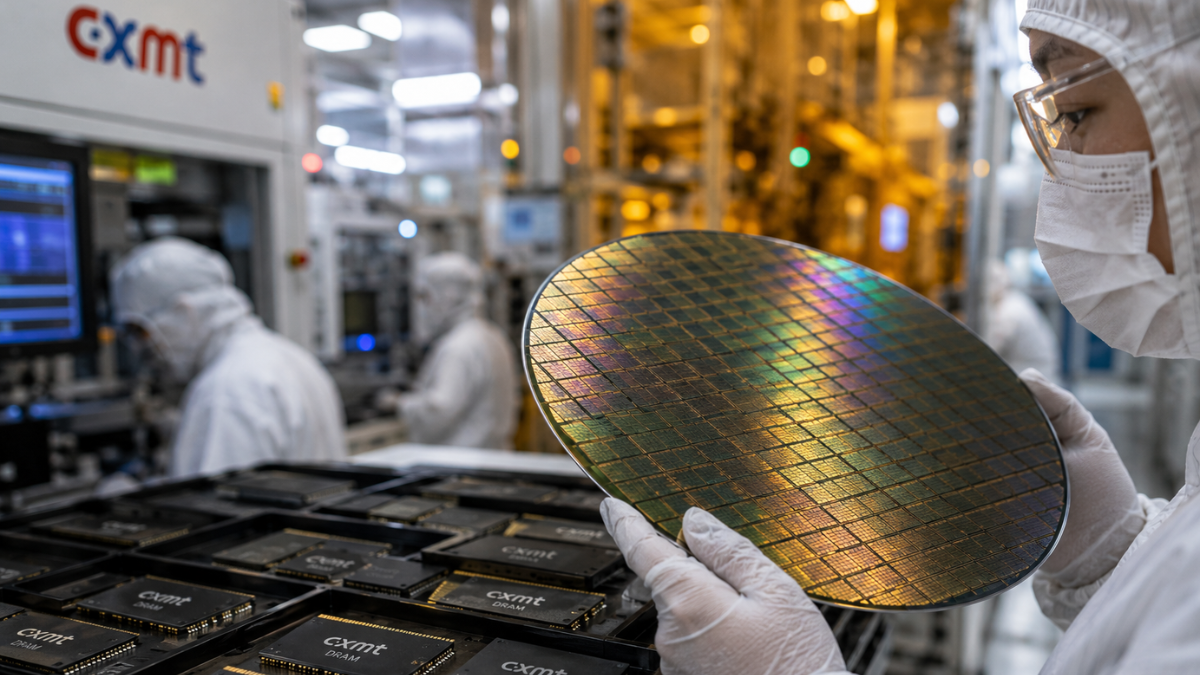
ChangXin Memory Technologies just pulled off the largest A-share IPO of 2026. At 8.66 yuan per share and 66.6 billion RMB in total fundraising, the CXMT DRAM localization trillion-yuan market cap IPO is more than a stock market debut. It's a signal - a serious one - that China's memory chip ambitions have moved past talk and into genuine commercial scale.
So what happened here, and why should you care?
CXMT's Trillion-Yuan Market Cap IPO Is Already Breaking STAR Market Records
The numbers are striking. CXMT's STAR Market debut drew 9.43 million effective subscription accounts with a lottery rate of roughly 0.47% - both of them new records for the exchange. Multiple institutions are now projecting a post-listing market cap somewhere between 2 and 3 trillion RMB, which would put ChangXin Memory among the most valuable semiconductor companies anywhere on the planet.
That kind of oversubscription doesn't happen by coincidence. Investors - retail and institutional alike - were competing hard for shares in a company that posted 1,688% year-over-year net profit growth in Q1 2026.
For context on what made this listing possible structurally, China chip listing rules shifted meaningfully in 2025 in ways that opened the door for mega-raises like this one. And if you're tracking where this fits in a broader pattern, the China A-share tech IPO outlook in 2026 has been notably strong for semiconductor plays despite some choppiness earlier in the year. CXMT's listing comes at a moment when capital markets are paying close attention to chip-adjacent stories, and this one delivered on the hype before trading even started.
From Startup to Fourth-Largest DRAM Maker
CXMT didn't exist as a meaningful market participant a decade ago. Now it's the world's fourth-largest DRAM manufacturer with 7.67% global market share as of Q4 2025, per Omdia's data.
Full-year 2025 revenue hit 29.1 billion RMB. Then Q1 2026 alone produced 24.8 billion RMB in net profit. The company projects 50 to 57 billion RMB in first-half 2026 net profit, driven by the AI memory super-cycle that's pushed demand for both standard DRAM and high-bandwidth memory to levels the industry wasn't modeling two years back.
What's fueling a lot of that domestic demand is the rapid build-out of China’s domestic computing infrastructure, which increasingly relies on locally produced memory at scale. CXMT's product lineup now covers LPDDR5, DDR5, and LPDDR5X in volume production (all achieved between 2023 and 2025). Its latest LPDDR5X 10667 products have been sampled and reportedly match the specifications of international leaders (which, for a company without EUV access, is genuinely impressive). Production capacity is expected to reach roughly 350,000 wafers per month by the end of 2026, according to Citrini Research - approaching Micron's output level.
That's the scale this company is operating at now.
Samsung and SK Hynix Are Accidentally Clearing Space
Here's something that doesn't get enough attention. Samsung, SK Hynix, and Micron are all pivoting hard toward high-bandwidth memory for AI accelerators. The margins are better, the contracts are bigger, and the AI build-out is pulling them in that direction. But that shift means they're stepping back - often voluntarily - from mainstream DDR5 and LPDDR5 segments.
CXMT walked straight into that gap.
That's partly why Morgan Stanley recently downgraded both Samsung and SK Hynix, citing CXMT's capacity expansion as a structural risk to Korean memory dominance. Not a rounding error in their analysis. A structural risk. It's a notable public acknowledgment from a bank that covers these companies closely, and it validates what some market observers have been saying quietly for a while. The Korean chipmakers’ target China market picture is getting increasingly complicated - Korean firms are still trying to hold volume share in China even as CXMT squeezes margins in the segments they used to own.
The CXMT Tencent DRAM supply deal made clear earlier this year that major Chinese tech buyers aren't just running pilots with CXMT memory. They're writing multi-billion-dollar contracts. That's a qualitatively different signal.
The Alibaba Investment That Worked Out Extremely Well
Alibaba put in 7.6 billion RMB for roughly 5% of CXMT. At IPO valuation, that stake is now estimated at approximately 130 billion RMB.
One of the better corporate investments in recent Chinese tech history, honestly.
All IPO proceeds go straight into DRAM production expansion - no overhead padding, no holding company maneuvers. The entire capital raise is pointed at one thing: more chips, faster. This fits a pattern you're seeing across the sector. The domestic chip suppliers’ surge isn't anecdotal anymore - Chinese tech buyers are redirecting procurement to local producers at measurable scale, and survey data backs it up. The Tianshu Zhixin ByteDance chip deal is another example of how these domestic supply chains are solidifying around real purchase orders. CXMT sits near the center of all of that.
The Real Challenges - And There Are Genuine Ones
None of the above means CXMT's path is straightforward.
The biggest structural issue is process node technology. Without EUV lithography equipment - restricted by China’s semiconductor export restrictions that have blocked the machines needed for leading-edge nodes - CXMT trails international peers by approximately two technology generations. That gap shows up directly in unit cost, and it doesn't close through effort alone.
HBM production remains unresolved. Yield challenges are real, and until those are cracked at scale, the highest-margin category in memory stays out of reach. Counterpoint Research director MS Hwang estimates that Chinese manufacturers won't match Korean leaders in high-end products until at least 2030. The Chinese AI chip localization push involves genuinely creative engineering around the semiconductor wall - but engineering workarounds don't erase the physics of process nodes outright.
The Samsung DRAM fab timeline adds another complication. Samsung has pulled its Yongin facility forward to a 2029 production target, which means CXMT's window to consolidate mainstream market share before Samsung re-expands isn't unlimited. CXMT also needs to hit roughly 15% global market share before generating enough EBITDA to self-fund capital expenditures - which stacks a financial performance condition on top of the technical ones.
And there are IP risks. They're manageable, but they're there.
What the CXMT DRAM Localization IPO Means for Global Memory Markets
The Unitree IPO Star Market approval earlier this year signaled that China's robotics sector was maturing into public capital markets. CXMT's listing signals something arguably bigger - that domestic DRAM production is no longer a development project. It's a commercial reality, with a trillion-yuan market cap attached to it.
The CXMT DRAM localization trillion yuan market cap IPO isn't just a financial event. It's a reference point for how seriously the global memory industry needs to treat Chinese competition at the mainstream tier - DDR5, LPDDR5X, consumer and server memory outside HBM. CXMT is already competing there. The gaps that remain are real. But so is the momentum, and so is the capital now deployed behind it.
Whether you're watching from an investment angle, a supply chain angle, or just trying to track where global chip competition is heading - this one matters.