The race has already started. Not between countries launching the most rockets- but between whoever processes data fastest once those rockets get there. The computing in space orbital data center battleground isn't a theoretical future scenario. It's happening right now, and the consequences reach well beyond aerospace.
If you've been following the latest AI developments, you already know the AI boom has a cooling problem. Literally.
Record heat waves aren't just a weather story anymore. They're a data center crisis. As AI models get bigger - and they're getting bigger fast - the chips powering them generate enormous heat. Keeping those chips running takes energy at a scale that's starting to alarm governments. The International Energy Agency put data centers at roughly 1.5% of global electricity consumption in 2024. That number is heading sharply upward.
So some of the smartest engineers in the world are looking up.
Why Earth-Based Data Centers Are Hitting Their Limits
The problem isn't just heat. It's everything at once: rising electricity costs, water-hungry cooling systems, climate-related disruptions, and limited land near population centers. Building more data centers on Earth delays these problems. It doesn't solve them.
Space offers something no ground-based facility ever will. Natural cooling through radiative heat dissipation. Near-unlimited solar energy. The ability to serve the entire planet from a single orbital layer. That's not a minor advantage - that's a structural shift in the physics of computing infrastructure.
The Computing in Space Orbital Data Center Battleground Takes Shape in China
China is moving faster than most observers expected.
A coordinated build-out spans Beijing, Tianjin, Shanghai, and Hangzhou. Beijing anchors research, development, and standard-setting. Tianjin handles space-ground computing integration. Shanghai builds the industrial ecosystem. Hangzhou focuses on intelligent applications - anchored by the Three-Body Computing Constellation, which is already operational in orbit.
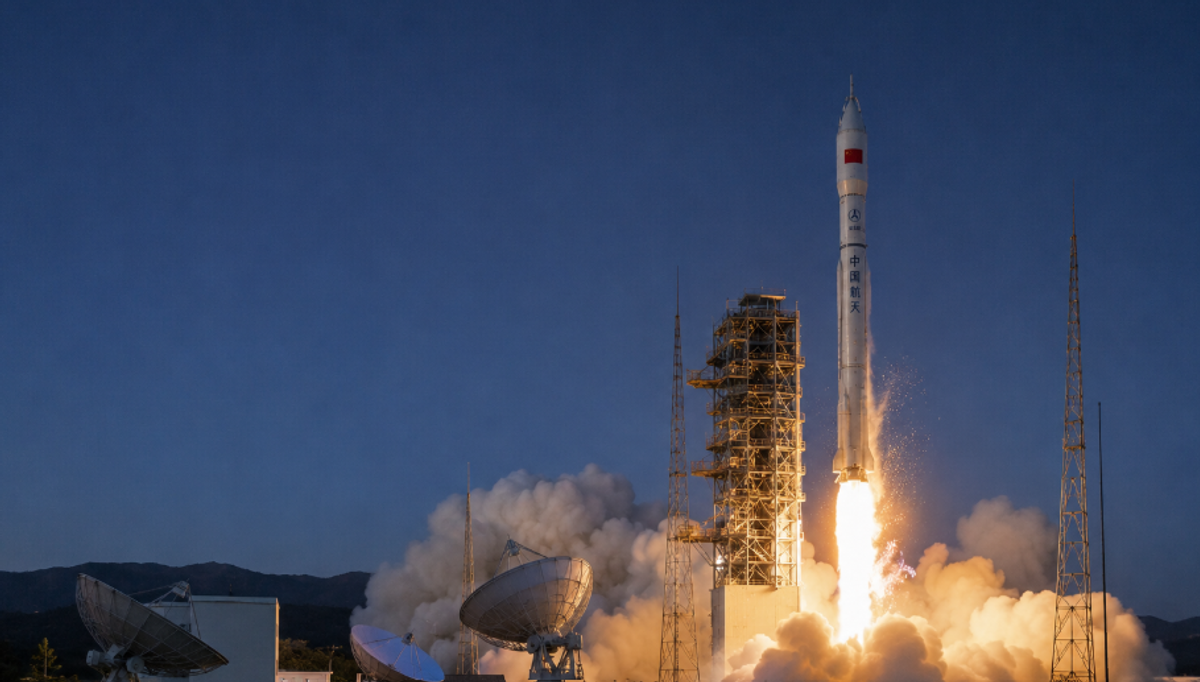
Led by Zhejiang Lab, the constellation targets thousands of satellites delivering a combined 1,000 peta operations per second. Twelve satellites are already there. The Long March 2D rocket carried them to Jiuquan, and the network is live.
Each satellite carries domestically produced space-borne AI servers rated at peak seven hundred forty-four TOPS per satellite, reaching five POPS in aggregate across the current twelve-satellite network. Core components rely entirely on native aerospace-grade chips and radiation-hardened processes - no foreign dependencies in the critical path. The Three Body Computing Constellation Zhejiang Lab has built here is, frankly, more operationally advanced than most Western reporting acknowledges.
On the communications side, inter-satellite laser communication architecture LEO has stabilized at 100 Gbps between satellites, with satellite-to-ground laser links 120 Gbps confirmed in testing by the China Center for Information Industry Development. Round-trip latency within China and the Asia-Pacific sits at 30 to 50 milliseconds - sufficient for real-time emergency scenarios. Xu Zifan, deputy director of the Advanced Computing Research Office at CCID, has confirmed core devices are 100% domestically controlled.
For the full story of how China takes AI to orbit, the Beijing Space Computing Innovation Center launch covers the policy layer in detail.
Three Models for In-Orbit Processing of Space Collected Data
Not all space computing works the same way.
The first model is in-orbit processing of space-collected data: satellites collect raw sensor information, process it onboard, and downlink only high-value results. No raw firehose to Earth. Just answers. Bandwidth consumption drops by more than 90%, and response times shrink from hours to seconds. Understanding bandwidth reduction via onboard processing of satellite data is the key insight here - reducing bandwidth consumption by ninety percent changes the economics of every Earth observation mission currently flying.
The second model runs in reverse. Ground operators upload data to the constellation, which processes it using space's thermal and power advantages, then returns results. Think of it as cloud computing that happens to orbit at 500 kilometers.
The third - and most ambitious - is an integrated space-ground collaborative computing network, where orbital and terrestrial infrastructure share workloads dynamically. Each handles what it does best.
Practical applications span real-time wildfire and flood alerts, crop-stress monitoring, illegal-fishing detection in remote oceans, and polar-ice tracking. All without waiting for a downlink window. How space-ground cloud computing helps in real-time wildfire and flood alerts isn't abstract anymore - these systems are operational.
The Tech Making Space-Based Intelligent Infrastructure Development Real
Three fronts have had to advance simultaneously for any of this to work. And honestly, all three were unsolved problems not long ago.
Computing. Radiation-hardened chips for space computing are the foundational requirement - ordinary silicon fails in orbit. The Zhejiang Lab constellation uses fully localized, radiation-tolerant AI processors. That engineering work is now influencing how China approaches the next-generation chip competition more broadly.
Power and thermal management. Galactic Aerospace's Lingxi 03 satellite illustrates the current direction with flexible solar wings - compact, lightweight, modular, and capable of capturing more energy per unit mass than rigid panels. Chief Scientist Zhang Shijie has specifically highlighted pump-driven fluid loop heat dissipation as the key breakthrough. How Galactic Aerospace liquid loop dissipation powers high-performance orbital payloads is one of the more underreported engineering achievements in this space right now.
Communications. The inter-satellite laser communication architecture LEO linking this whole system together runs at 100 Gbps between satellites and 120 Gbps to the ground in testing. All core devices domestically developed.
You can track the orbital infrastructure security risks side of this story separately - because as these networks grow into critical infrastructure, the threat landscape grows with them.
The Global Race: SpaceX, the EU, and Everyone Else
China isn't alone here.
SpaceX has outlined plans for up to one million low Earth orbit satellites with onboard processing capabilities. SpaceX low Earth orbit satellite data centers at that scale would represent the largest orbital computing presence by a significant margin. The EU Space Data Center initiative framework is pushing for sovereign European capability in orbital compute. Russia is building out onboard computing for its Sfera constellation. Japan is investing in in-orbit processing for Earth observation specifically.
Emerging space computing startups across the US, UK, and Asia are entering the picture too - often focused on specific verticals like maritime surveillance or agricultural monitoring.
At its core, this is an extension of the AI market share battle already playing out on the ground, just moved one dimension higher. Whoever controls the orbital compute layer gains leverage that's very difficult for competitors to match.
The Obstacles That Get Glossed Over
Here's where the press releases start leaving things out.
Orbital congestion is real. Studies suggest the LEO band between 300 and 2,000 km can safely accommodate only around 175,000 satellites under current collision-avoidance assumptions - that's the one hundred seventy-five thousand satellites collision avoidance cap. With Starlink already holding tens of thousands of slots, the math gets uncomfortable fast. Why low Earth orbit constellations face collision avoidance limits by 2030 is a question the industry hasn't answered cleanly.
Then there's the ITU clock. Understanding International Telecommunication Union spectrum filing rules for satellite constellations: operators get a seven-year deployment framework for non-geostationary constellations to bring frequency filings into use, followed by phased deployment milestones. Miss them, lose the spectrum. For programs with ambitious timelines and high technical complexity, that's not a footnote.
And the software layer - building a reliable operating environment for a distributed cluster that operates in radiation, with nodes you can't physically touch when they fail - that's still largely unsolved territory.
None of this makes space computing a bad bet. It makes it a harder one than the announcements suggest.
What the Computing in Space Orbital Data Center Battleground Looks Like in 2026
The 2026 AI tech innovations landscape is already treating space computing as a serious competitive axis, not a future scenario. That framing is right.
The real competition is moving toward software stacks and standards - the same dynamics that determined which cloud platforms won on Earth. Whoever builds the orbital equivalent of a proper developer abstraction layer, and does it before the spectrum windows close, will have built something genuinely difficult to displace.
For ongoing space and science coverage on how this plays out, this is one of the more consequential stories to follow over the next five years.
The Race Is Already Well Underway
Why computing in space is the next tech battleground for artificial intelligence isn't a hard question to answer once you understand the constraints on the ground. The heat goes away. The energy is free. One satellite sees more of the planet in a single orbit than a thousand ground stations cover in a day.
The computing in space orbital data center battleground is unfolding across two dimensions simultaneously: hardware and satellites on one axis, software stacks and spectrum rights on the other. China has moved first on hardware. SpaceX has scale on the launch side. Europe has regulatory influence. And the ITU's seven-year clock is running for everyone.
This isn't a story about who launches more hardware. It's about who gets the full stack right - and does it before the orbital lanes fill up. That competition, more than any single satellite launch or policy announcement, is what makes the computing in space orbital data center battleground one of the defining technology contests of this decade.