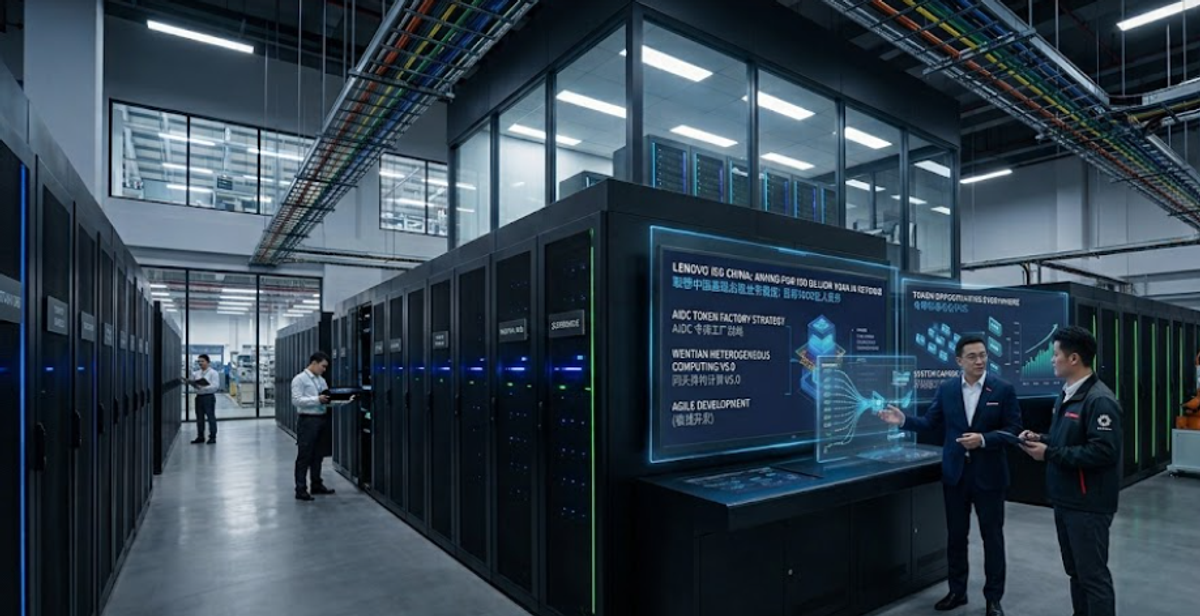
One number is anchoring every strategic conversation inside Lenovo's infrastructure division right now. The Lenovo ISG China AI computing infrastructure revenue target - 100 billion yuan by 2027- announced publicly by Chen Zhenkuan, Vice President of Lenovo Group and General Manager of the China Infrastructure Business Group, is the kind of goal that only makes sense if you're already building real momentum. Lenovo is. The ISG segment posted 136.24 billion yuan in total revenue for fiscal year 2025/26, a 32% year-on-year jump, and the global AI server order backlog has already crossed 140 billion yuan.
The broader China AI sector growth outlook only reinforces the timing. Demand for AI compute infrastructure is accelerating, and Lenovo is working hard to sit at the center of that expansion.
Lenovo ISG China AI Infrastructure Revenue: The Numbers Behind the Claim
Lenovo Wentian, the dedicated AI computing brand within Lenovo China's Infrastructure Business Group, had a strong 2025. By year-end, it ranked among the top three in China's x86 server market, recorded the fastest growth rate in the AI server segment, and held the number one share in China's HPC TOP100 for eleven consecutive years.
Eleven years. In a market that moves as fast as this one, that's not just history - it's a sustained operational capability.
ISG also achieved full-year profitability while growing 32%. That's the harder part. Posting large revenue numbers in an AI hardware cycle isn't surprising; holding margins while scaling at that pace is. The Chinese AI companies’ infrastructure race is putting price pressure on every vendor in the ecosystem, so Lenovo's profitability milestone carries more weight than it might appear. The Lenovo China infrastructure business group revenue 2027 target of 100 billion yuan sits within this context - not a speculation, but a stated goal from a business already operating at scale.
Why Agile Development Became Central to Wentian's Strategy
Zhou Tao, General Manager of the Server Business Unit at Lenovo China's Infrastructure Business Group, is direct about the problem. GPUs update so quickly that even well-resourced product teams can't reliably predict which chip will dominate the next generation. Committing to an 18-month development cycle and hoping the market matches your forecast is no longer viable.
So the team changed the model entirely.
Lenovo's agile development roadmap for GPU server prototypes works like this: select a GPU from suppliers, build a prototype fast, put it in front of customers for real evaluation, and - once approved - move immediately to mass production. Launch timelines dropped from 18 months to a few months. The same R&D budget that previously funded two products now covers more than ten per year.
That's a structural shift, not a marginal efficiency gain. The approach isn't without tradeoffs - compressing development cycles leaves less time for extended reliability testing, which matters when enterprise customers are committing hundreds of millions of yuan to a deployment. But in a market where today's flagship GPU is next quarter's mid-range product, speed is the more critical capability.
Executing this approach requires deep supply chain coordination. At the Lenovo Wentian Brand Renewal and Computing Power Ecosystem Conference in late June, nearly 20 global and domestic partners covering CPUs, GPUs, memory, and storage were present. The partnership between Lenovo Wentian and core computing component suppliers spans everything from China AI computing chip supply dynamics to China server DRAM supply chain developments - and Wentian needs visibility into both to keep the agile model functional.
Supernode Specs and Wanquan V5.0: What the New Hardware Can Do
The Wentian supernode computing solution specs are specific. A single node supports up to 40 GPUs, with FP8 computing power exceeding 28 PFLOPS and HBM memory crossing 5.76 terabytes. That configuration targets trillion-parameter large model training and inference - not a generic compute problem, but a precise performance requirement that only the most demanding enterprise workloads actually stress.
Released alongside the supernode is the Wanquan Heterogeneous Intelligent Computing Platform V5.0. It handles orchestration, scaling, and performance optimization across training and inference workloads. The practical goal is closing the gap between lab performance and production performance - which is where most enterprise AI deployments quietly fail.
The domestic Chinese supercomputing stack has matured considerably over the past few years, giving Wentian a stronger foundation to build on than it had at launch in 2023. For context on where Chinese infrastructure hardware ranks globally, China supercomputing global rankings show how quickly the gap with international benchmarks has narrowed.
From Hardware Sales to Token Production: Where the Real Competition Is
Huang Shan, strategic director of Lenovo China's infrastructure business group, laid this out plainly in a conversation with 21st Century Business Herald reporter Li Zhiqiang in late June. Choosing the right GPU is just the starting point. You also need to select the right large model, figure out which hardware and model combination delivers the best token economics, and operate the full stack so the data center actually generates tokens at margin. That's the Lenovo AIDC token production system approach - and it's a meaningfully different product than a fast server.
Chen Zhenkuan described the competitive transition this way: the industry is moving from "capability competition" to "production paradigm competition." It's not about which vendor has the most powerful hardware anymore. It's about who can deliver a complete, reliable, scalable token production system that enterprises can actually run a business on.
That framing makes the Lenovo ISG China AI computing infrastructure revenue target easier to interpret. 100 billion yuan by 2027 isn't a hardware revenue forecast. It's a platform bet.
The China AI data center infrastructure buildout across the country is accelerating this shift, as operators increasingly think in token output metrics rather than rack density. And AI infrastructure integration trends 2026 show energy, compute, and software bundling into unified offerings - which is exactly the direction Wentian's platform strategy is heading.
How the Token Factory Works for Enterprise Customers
One of the clearest examples from the conference involved BAIC Foton, the commercial vehicle manufacturer. Lenovo Wentian deployed a privatized Token Factory for the automaker - an on-premises AI compute environment running advanced models on private hardware, with no data routed through shared cloud infrastructure. Private deployment of advanced computing power protects automotive industry data while giving BAIC Foton access to frontier AI capabilities.
That's not a small distinction.
Vehicle production data, engineering specifications, and competitive R&D are genuinely sensitive. Running advanced AI inference privately, without data sovereignty concerns, directly addresses the real objection that enterprise buyers bring to AI infrastructure conversations. Enterprise AI solutions demand 2026 is trending strongly toward private deployment models, and Wentian is positioned to capture that.
Lenovo has also been investing in ecosystem depth through initiatives like the Anhui Lenovo Strong Chain Supplement Venture Capital Fund and robotics partnerships including PoundCe robot - signals that the company is building infrastructure for an intelligent economy broadly, not just the current server refresh cycle.
The Competitive Context Around Lenovo ISG China's Infrastructure Revenue Target
The Chinese AI clusters policy targets set by the State Council create strong demand tailwinds - but they also channel capital toward every credible domestic vendor. Lenovo Wentian is winning on speed and ecosystem depth right now. Sustaining that into 2027 requires consistency across multiple product generations.
Advances in China AI chip 3D stacking advances at the semiconductor level will keep reshaping server configurations, which is another reason the agile development model matters as a structural capability rather than a one-time efficiency play. At major industry events like the AI exhibition zone hardware player’s showcases, the density of serious competitors is visible in ways quarterly reports don't capture.
Hitting the Lenovo ISG China AI computing infrastructure revenue target by 2027 requires Wentian to keep winning on hardware speed, platform completeness, and ecosystem depth - simultaneously, across multiple product cycles.
Key Takeaways:
- Lenovo ISG China AI computing infrastructure revenue target: 100 billion yuan by 2027, with domestic market leadership as an additional goal
- ISG posted 136.24 billion yuan in revenue in fiscal year 2025/26, up 32% year-on-year, and achieved full-year profitability
- Global AI server order backlog exceeds 140 billion yuan
- Wentian supernode: 40 GPUs per node, 28+ PFLOPS FP8 computing power, 5.76+ TB HBM memory - built for trillion-parameter model workloads
- Agile development cut product launch timelines from 18 months to a few months; annual product count expanded from 2 to 10+
- The strategic framing: "production paradigm competition" over "capability competition" - token output over raw hardware specs
- Private token factory deployments address data sovereignty requirements for regulated industries like automotive