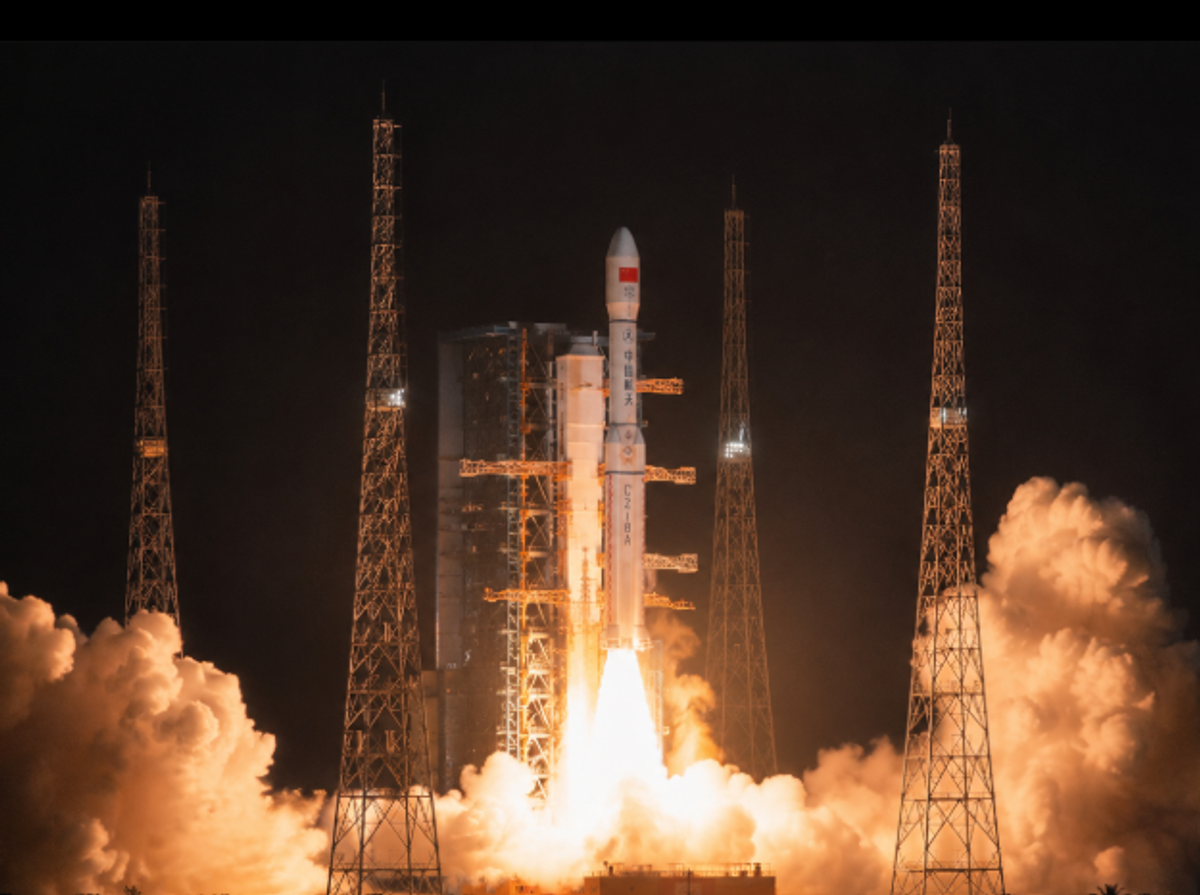
Two launches. Five days apart. The number of Qianfan constellation satellites in orbit exceeds 238, and the story behind that number is bigger than most tech headlines are letting on.
On the night of July 5, a Long March 8A rocket lifted off from the Hainan International Commercial Space Launch Site and deployed 15 new satellites into the Qianfan polar orbit network using a one-rocket, twenty-satellite configuration. Two days earlier, on July 4, a Long March 6A rocket launched from the Taiyuan Launch Center, placing 18 networking satellites into orbit - setting a new single-mission deployment record for the constellation. Both missions succeeded. Satellites separated on schedule. No issues.
That's 33 new satellites in under a week. Fast Technology's reporting on the Qianfan polar orbit network noted both launches within the same news cycle, a pace that tells you something about where this buildout is actually heading.
What Is the Qianfan Constellation?
Also called the G60 low Earth orbit satellite internet constellation, Qianfan is China's flagship satellite broadband network. Shanghai Yuanxin Satellite develops, manufactures, and commercially operates it. It's officially classified as a national-level aerospace information infrastructure with full independent controllability - meaning every component, from satellite platforms and communication payloads to rocket launches and ground tracking and control, runs entirely on China's domestic industrial chain. No foreign suppliers.
You'll often see it described as the Chinese version of Starlink, and with 238 satellites now in orbit, the comparison gets more credible every month. But the ownership model, the supply chain, and the geopolitical intent are meaningfully different - and those differences matter for how the network gets used globally.
As the Starlink rivalry intensifies, China clearly isn't building slowly.
The Hardware: What's Actually Flying Up There
The networking satellites use a lightweight flat panel stacked satellite configuration - essentially a way to pack many satellites onto a single rocket without running out of room. It's the same basic packaging logic that made rapid constellation buildouts economically viable elsewhere, and it's a big reason why recent Long March satellite launches have been able to scale payload counts mission over mission.
Each satellite carries Ku and Q/V multi-band communication payloads. They're equipped with phased array antennas and laser inter-satellite links, which allow data to travel between satellites directly rather than bouncing everything down to a ground station. That's how you deliver low-latency connectivity in places where ground fiber optics simply can't reach - deep ocean, mountain ranges, deserts. Bypassing ground infrastructure entirely using Ku and Q/V band links is what gives this constellation coverage capability that terrestrial networks will never match.
Dynamic network resource allocation is built in too. The system can redistribute bandwidth in real time - useful for geological disaster emergency communication, ocean-going vessel networking, civil aviation airborne internet access, and agricultural and forestry IoT data collection where demand spikes unpredictably.
The satellites are also technically designed for compatibility with the next-generation 6 G communication standard, feeding directly into China's broader 6G connectivity push and the goal of seamless network connectivity across land, sea, and air.
Direct to Phone: The Civilian Breakthrough
This is the part that changes things for ordinary users.
Unlike traditional satellite internet setups - which require dedicated hardware, a router, or an external antenna - Qianfan is designed so that existing mobile phones can connect directly to satellite communication without any hardware modifications. No special SIM. No add-on device. Just your phone.
Direct satellite connection from mobile phones has been technically verified. Public access is expected between late 2026 and early 2027. That puts usable satellite connectivity within reach of anyone with a standard handset - rural residents, travelers, first responders, people in areas where cell coverage was never built.
Given the domestic foundation behind this network - from the progress in domestic chip innovation to China's space-based data processing infrastructure - the confidence behind that 2026-2027 window seems reasonably well-founded.
Beyond Consumer Broadband
The everyday mobile user is the headline story, but this constellation handles considerably more.
Enterprise cross-border data transmission is a specific focus. Companies operating internationally can route data through Qianfan and keep it within a domestically controlled, auditable network. For businesses with strict data sovereignty requirements, that's not a minor feature - it's often a primary reason to choose this over alternatives.
Zoom out, and you can see Qianfan as part of a larger Chinese vision for an integrated air-space-ground digital infrastructure that fills gaps no fiber network can close. That connects to China's orbital AI ambitions, the accelerating orbital data-center race, and ongoing investment in reusable rocket technology to keep per-satellite launch costs manageable at scale.
What Comes After 238 Satellites in Orbit?
238 satellites in orbit is a genuine milestone. It's also a small fraction of what full global coverage requires.
The target count for the complete constellation exceeds 14,000 satellites. Starlink surpassed the 6,000 mark over a year ago and hasn't stopped launching. The gap is real. But Shanghai Yuanxin Satellite's manufacturing capacity for 2026 is reportedly outpacing original projections, and the launch cadence is visibly accelerating - two missions in five days isn't a coincidence; it reflects a deliberate operational tempo.
Alongside China's computing leadership in frontier hardware and its engagement with global connectivity agreements at the UN level, Qianfan represents a long-term strategic play - not just for Chinese users, but for underconnected regions of the world looking for viable alternatives to Western-operated networks.
By the time Qianfan constellation satellites in orbit exceed 1,000, the real question won't be whether the network delivers. It'll be who gets access, under what terms, and through which agreements. That's the geopolitical layer underneath this week's launch numbers, and it's worth watching.