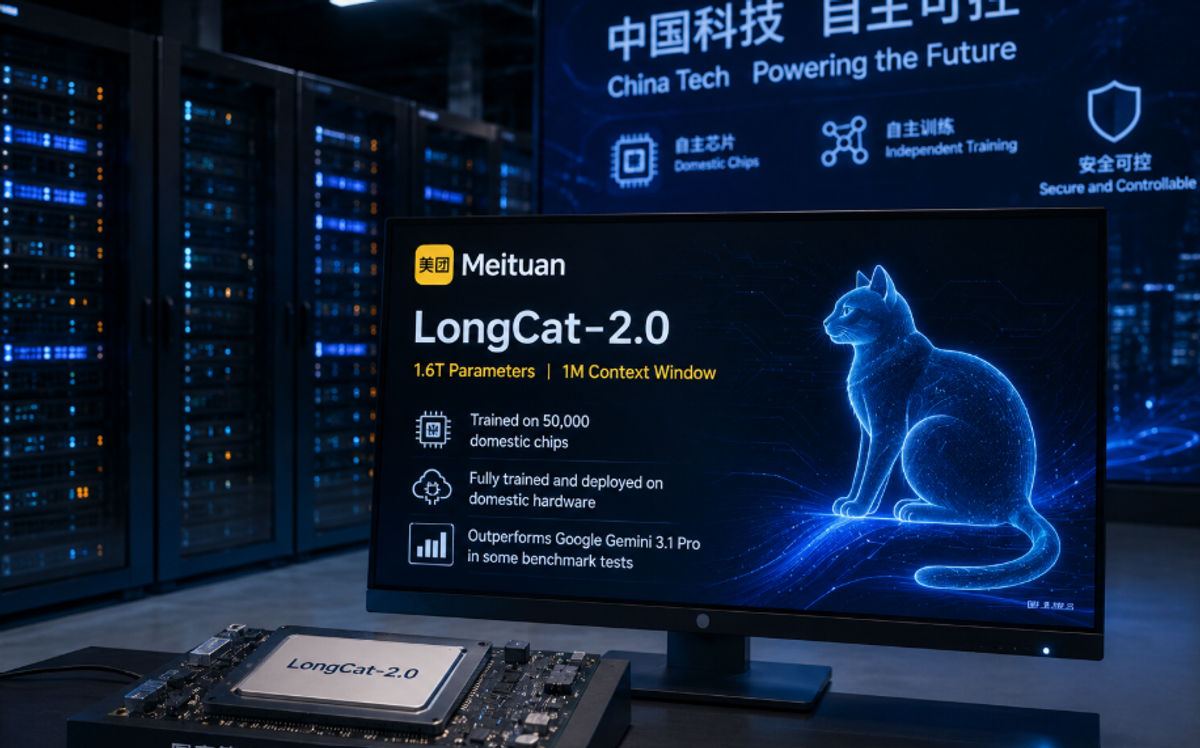
China's food delivery giant just did something the Western AI world didn't expect this soon. The Meituan LongCat 2.0 AI model launch, first reported by the South China Morning Post, introduces a 1.6 trillion parameter large language model with a one million token context window - and the whole thing was trained entirely on domestically produced Chinese hardware. No Nvidia. No imports. Built from scratch on domestic silicon.
That's a big claim. So let's look at what actually happened.
What Is LongCat 2.0 and Why Do the Numbers Matter?
The Meituan large language model context window here sits at one million tokens, meaning the model can process roughly a million words of input in a single pass. For enterprise tasks like legal document analysis, large codebase review, or extended conversational memory, that's genuinely useful - not just a benchmark figure for press releases.
At 1.6 trillion parameters, it puts LongCat 2.0 in a weight class that very few publicly disclosed models match. If you've been tracking Chinese AI developments over the last two years, the parameter race has clearly been accelerating fast across multiple labs. But the scale of the model isn't the headline.
The hardware story is.
How Meituan Trained LongCat 2.0 Without Nvidia Hardware
Here's the thing: before this, Chinese AI labs had domestic chips available, but they mostly used them for inference - running a finished model after training was done elsewhere. Pre-training, the far more resource-intensive process of actually building the model from scratch, still depended heavily on Nvidia's hardware. That was just the accepted constraint for years.
LongCat 2.0 broke it.
The model was trained on a 50,000-chip domestic computing cluster - a full production-scale training infrastructure, comparable in chip count to what leading Western labs use for frontier model development. Except it runs entirely on ASIC intelligent computing supernodes built from Chinese silicon. No Nvidia reliance at any stage of the pipeline.
And to make 50,000 chips work together efficiently during training? That's a genuinely hard coordination problem. The Huawei HCCL integrated communication library handles that layer - keeping inter-chip communication synchronized across the entire cluster. At that scale, getting it running cleanly enough to produce a trillion-parameter model is a real engineering achievement.
This fits directly into China's AI cluster strategy, which has been pushing for exactly this kind of sovereign computing infrastructure for several years now.
The Google Gemini Benchmark Results
The Meituan LongCat 2.0 AI model launch came with benchmark data showing it outperforms Google Gemini 3.1 Pro on some tests. Take that with the usual caution - benchmark comparisons are selective, and "some tests" isn't the same as "universally better." But the results are real, and they're not pulled from obscure or cherry-picked evaluation sets.
The bigger point is what those results actually prove. Domestic hardware pre-training on Chinese AI chips doesn't just "work" technically - it produces a model competitive enough to beat a top-tier Western system on real tasks.
That wasn't obvious before. Now it is.
What This Actually Means for China's AI Independence
Nvidia chip restrictions have shaped Chinese AI development for years. The CXMT Tencent server deal earlier this year showed how aggressively Chinese companies are building domestic supply chains across the hardware stack. Meituan just demonstrated that the AI training layer is no longer the weak link in that chain.
For smaller Chinese AI startups - including the growing wave of one-person AI companies that have been building rapidly over the last 18 months - this is a proof point they can actually use. The question of whether China self-reliant artificial intelligence hardware could handle pre-training at serious scale has been answered. It can.
Internationally, Chinese open source AI adoption is already spreading across Africa and Southeast Asia. Models fully trained without US-controlled hardware sit in a different legal and geopolitical position than those that depend on restricted chips. That distinction matters more as export dynamics evolve.
The domestic buildout isn't isolated to AI, either. China's quantum computing push is part of the same broader hardware independence drive. And MWC Shanghai AI signals from earlier this year pointed to Chinese companies treating full-stack domestic infrastructure as a strategic priority, not a contingency plan.
The Sputnik news report on Chinese AI hardware development described this as a sign of rapid ecosystem maturation. That's accurate. The pace of progress on bypassing US technology constraints in large-scale AI has been faster than most analysts predicted even two years ago.
What Comes Next
The Meituan LongCat 2.0 AI model launch is a milestone, not a finish line. There are still real gaps - software tooling maturity, chip yield rates, and the cost of running a 50,000-chip cluster at production scale. Those aren't small problems.
But the core question everyone was circling - can China train frontier-scale AI models without Nvidia? - just got a concrete answer from a working system. Not a prototype. A deployed model with a trillion parameters and benchmark results to back it up.
For anyone keeping up with the latest AI news, this one shifts the assumptions underneath a lot of other conversations.