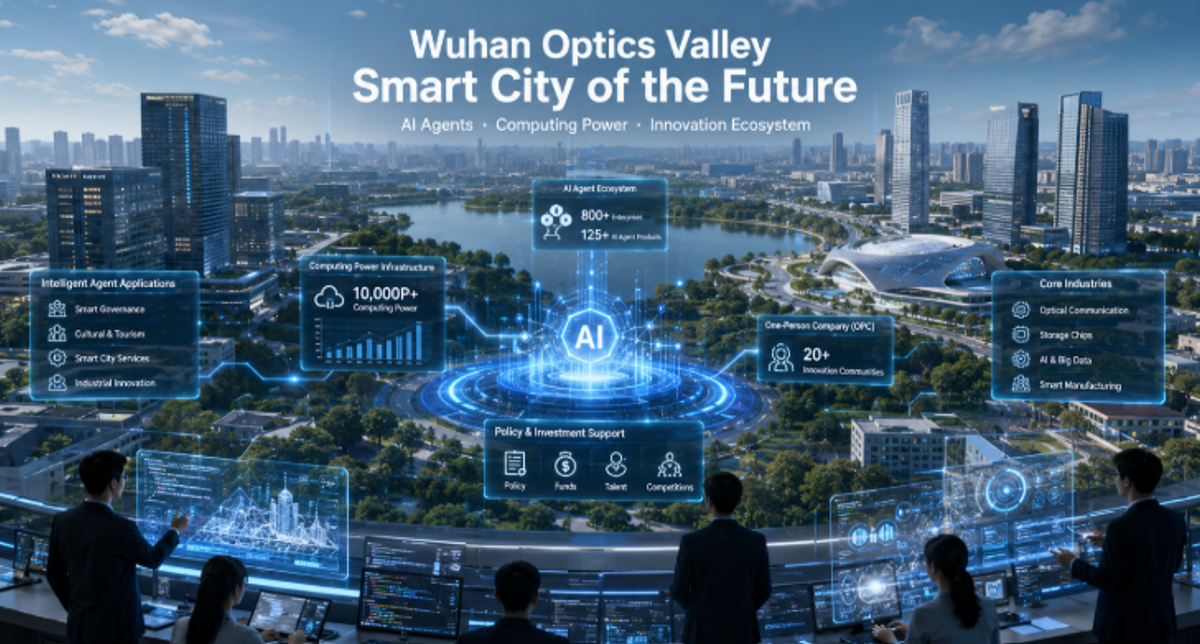
China's AI race isn't slowing down. If anything, it's accelerating at the regional level - and one major tech zone just put serious money behind that. The East Lake High-tech Development Zone recently released the Wuhan Optics Valley Intelligent Body Gravity Plan, a three-year initiative committing over 1 billion yuan in policy support, computing power, and dedicated investment funds. The goal isn't to run a limited pilot. It's to build a fully operational intelligent agent city across the entire zone.
If you've been tracking China's AI development, this is one of the most detailed regional commitments you'll see this year.
What the Intelligent Body Gravity Plan Actually Covers
The Gravity Plan anchors on two core tracks: intelligent agent toolchain development and intelligent agent application. Building the tools and the use cases simultaneously - that's a more integrated approach than most regional AI programs attempt, and it's worth paying attention to.
Support runs across six dimensions: scenarios, computing power, platform, fund, talent, and competitions. Specifically, the plan:
- Establishes the Optics Valley Intelligent Agent Scenario Release Hall
- Guides a 10 billion yuan AI fund cluster toward the intelligent agent track
- Launches China's first national intelligent agent + FDE (Frontier Deployment Engineer) training project
- Opens scenario opportunities across government office, cultural tourism, and smart city operations
- Awards up to 3 million yuan for benchmark smart city scenarios, selected annually
Three million yuan per benchmark scenario isn't token support. That's enough for a serious early-stage team to actually build and deploy something real.
Why the Infrastructure Behind the Gravity Plan Is Unusually Strong
The computing story at Wuhan Optics Valley doesn't get enough attention outside China. Honestly.
Wu Zhiqiang, executive dean of the Wuhan Artificial Intelligence Research Institute (Peking University's Wuhan affiliate), says it plainly: computing power, data, and talent are the three pillars of the intelligent economy. Wuhan has a credible case for all three. The zone already hosts the Wuhan Artificial Intelligence Computing Center, the Wuhan Supercomputing Center, and intelligent computing infrastructure from all three major Chinese telecom operators. Computing capacity ranks among the highest in central China.
The target: usable computing power exceeding 10,000P within the year. For startups, the Gravity Plan covers up to 50% of rented intelligent computing power costs.
That subsidy matters more than it sounds. Compute bills kill early-stage AI teams before they can prove anything - cutting that cost in half changes the economics entirely.
This hardware-first foundation connects directly to broader trends in China's AI cluster strategy, where concentrated infrastructure investment consistently precedes ecosystem growth rather than following it.
The Market Shift Driving the Timing
The 300% annual growth rate in China's enterprise AI agent market isn't a projection. It's current.
The overall market has already crossed 48 billion yuan, and it's still accelerating. What caused this? AI moved from talking to doing. The shift from the large model era to what practitioners are calling the "human-machine symbiosis era" means intelligent agents don't just generate content - they plan, execute, and adapt across multi-step processes. For context on how large-scale Chinese AI models are evolving alongside this shift, the pattern is consistent: the model layer is stabilizing, and the application layer is where the growth is concentrating now.
Optics Valley is moving while that window is open.
Companies Already Showing Up
The launch event wasn't just policy announcements. Real products were on display.
Qiankongjian Embodied Intelligence showcased industrial embodied AI applications. Greatek Dongzhi demonstrated intelligent agent industry tools. Fumu Technology's founder Weng Jie was direct about his read: vertical intelligent agents built for social governance are heading for explosive growth, and Optics Valley's industrial depth, available talent pool, and policy environment create a structural advantage that's genuinely hard to replicate elsewhere.
Shuming Technology CEO Luo Biwen brought a different angle. Their AIWIN Task Economy Operating System unifies scattered demands, capabilities, and execution processes - moving agents from "single-point intelligence" to what he calls "systematic execution." Why launch it in Optics Valley? In Luo's words, the compute foundation, density of application scenarios, and active builder ecosystem made the location obvious.
That kind of reasoning echoes what's played out in places like the Hangzhou AI innovation model, where dense OPC (one-person company) communities created startup velocity nobody quite predicted.
The Developer Ecosystem Push
Getting companies in the door is one challenge. Keeping builders around is another.
Wuhan Optics Valley's three-year target: attract 10,000 intelligent agent developers. The mechanism includes 10+ AI competitions per year, a dedicated intelligent agent fund, and a talent pipeline covering attraction, cultivation, retention, and utilization. Twenty OPC innovation communities are already operating, with more than 800 enterprises in the zone and 125 mature intelligent agent products already launched.
These aren't projections. These are the starting line.
The broader approach reflects how China's tech startup ecosystem has been scaling effectively - clusters that combine hardware, capital, and dense community create compounding effects that no single incentive can replicate. Cross-regional data collaboration through the Hanshu Yisuan platform extends the reach further, while the research backbone draws from China's network of science and technology research hubs, giving the zone academic depth alongside commercial momentum.
The Hardware Layer Nobody Should Overlook
Officials framed the timing around what they called the "super cycle" of storage chips and optical communication. That framing is deliberate.
Intelligent agents need hardware. Wuhan's existing position in China's semiconductor supply chain and optical communication manufacturing gives this AI ecosystem a physical foundation that software-only hubs simply don't have. Add the trajectory of Chinese open-source AI expansion and the pace of China's frontier tech breakthroughs at the hardware level, and the vertical integration picture becomes clear.
Companies like Qiankongjian, building embodied intelligence products, show that the agent economy isn't purely software-driven. The intelligent hardware and gadgets layer is load-bearing in this ecosystem - and Wuhan already has it.
What This Actually Means for the Region's AI Standing
The Wuhan Optics Valley Intelligent Body Gravity Plan stands apart from generic AI investment announcements because of its specificity. Concrete targets: 10,000P compute, 10,000 developers in three years, 10+ competitions per year, 3 million yuan per benchmark scenario, 125 products already launched.
That granularity suggests operational planning, not headline creation.
The structural ingredients are already in place - hardware, data, talent, capital, and real industrial scenarios spanning government office, cultural tourism, and smart city applications. Whether every target gets hit is a fair question. But the Wuhan Optics Valley Intelligent Body Gravity Plan isn't building from scratch. It's accelerating something already in motion - and with the enterprise AI agent market growing at 300% annually, the timing is about as favorable as it gets.