China's domestic GPU hardware has come a long way. The software stack that runs on it? That's a different conversation entirely.
Scientific computing underpins almost everything serious in modern research and engineering - weather forecasting, aircraft design, drug discovery, materials physics, even visual effects pipelines. And almost all of it was built, layer by layer over decades, around NVIDIA's CUDA ecosystem and other foreign GPU architectures. Trying to move that software onto domestic hardware turns out to be far harder than it sounds.
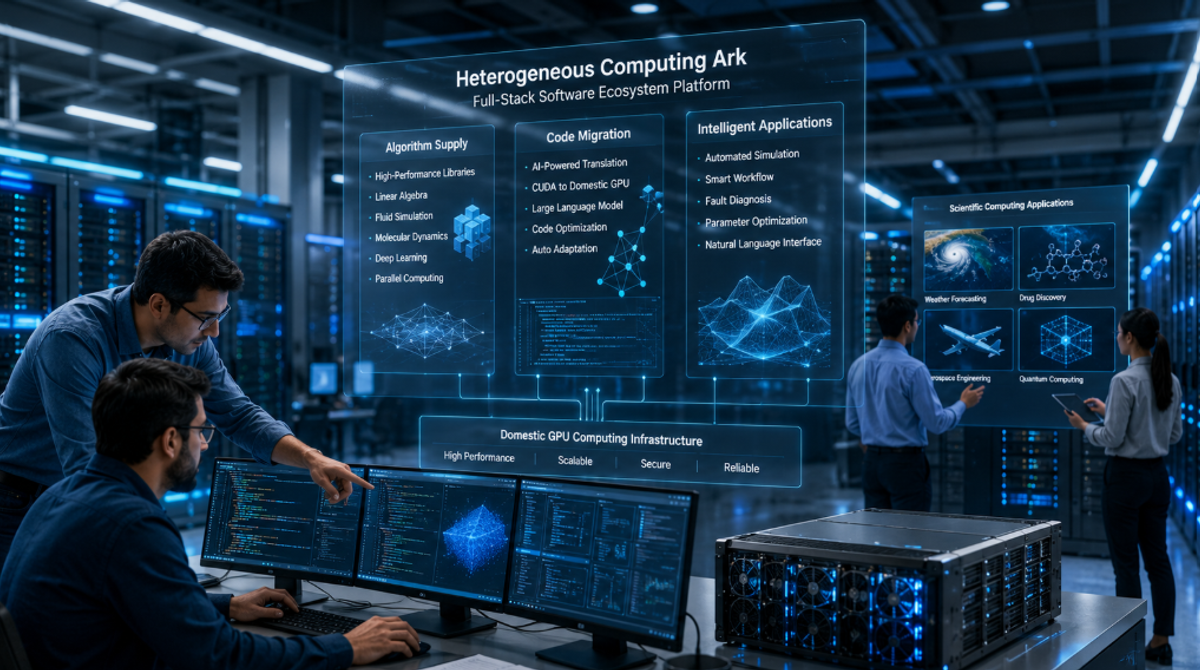
The Heterogeneous Computing Ark CAS full-stack platform is the most substantial attempt yet to solve this at the foundational level. Developed jointly by the Computer Network Information Center of the Chinese Academy of Sciences (CNIC CAS), the University of Science and Technology of China, the Institute of Mechanics of CAS, and Sugon, it addresses the domestic GPU software problem across three distinct layers: algorithm supply, code migration, and intelligent simulation automation. Not a patch. A full platform.
What the Heterogeneous Computing Ark CAS Full Stack Platform Is Actually Solving
The performance problem on domestic hardware isn't just about raw compute.
Wang Yangang, researcher at the Computer Network Information Center CAS supercomputing center, explained the core issue clearly: the underlying algorithms in most high-performance computing software have been co-developed with specific hardware architectures over many years. Without re-optimizing those algorithms for domestic GPU architectures, you can't extract the hardware's actual potential. Porting code from a foreign ecosystem isn't the same as building for a domestic one - and that distinction matters enormously in practice.
This is why mainstream scientific computing software lags on domestic architectures even when the hardware specifications look competitive on paper. The integration between algorithms and hardware runs deep. Switching platforms means starting that integration almost from scratch.
The broader race around AI computing platforms that can perform on domestic hardware has made this software bottleneck impossible to ignore - and the CAS team's approach is one of the more systematic responses to date.
Nine Derivatives Pivot: Algorithms That Actually Belong on Domestic Hardware
The first layer of the platform is called "Nine Derivatives Pivot" - an algorithm library developed specifically for domestic GPU architectures, not adapted from foreign ones.
That distinction matters. A ported algorithm runs on new hardware. A native one exploits it. Nine Derivatives Pivot covers 16 high-performance solvers across linear algebra, parallel computing, fluid simulation, biological computing, and deep learning. Final testing shows many core modules hitting over 10x performance acceleration compared to naive implementations on domestic hardware. That's not incremental improvement - that's what happens when algorithms are designed for a specific architecture instead of squeezed into one.
Professor Cheng Wan of the University of Science and Technology of China made a point that lands for anyone who's done serious research work: packaging optimized algorithms into a reusable system means researchers stop spending energy on infrastructure and actually spend it on science. Each solver functions as an independent node within the library, keeping the system composable as it expands.
The investment in AI clusters and infrastructure across the industry has raised the stakes for algorithm-level optimization - hardware that can't run its software efficiently is just expensive metal.
BoundX: A Large Language Model That Translates CUDA
Now here's the genuinely novel part.
Scientific computing software has accumulated decades of CUDA code. A medium-sized simulation package can run to hundreds of thousands of lines. Manually rewriting it is economically implausible for most organizations. Conventional rule-based conversion tools, meanwhile, break consistently on the complex logic patterns that show up in serious scientific computing code.
Wang Yangang's team built BoundX - a large code conversion model trained specifically on domestic GPU programming patterns, CUDA specifications, and real migration experience. The key move was integrating domain knowledge into the model directly, rather than using a general-purpose base and hoping for the best. The model learned to understand the semantic intent of CUDA code and re-express it in domestic GPU equivalents, not just match syntax patterns. Developers upload a CUDA module; BoundX handles conversion, environment adaptation, and compilation.
Professor Zuo Decheng of Harbin Institute of Technology raised the reliability angle, and it's worth sitting with: manual code migration under deadline pressure introduces subtle bugs that can be nearly invisible at testing time. AI-assisted CUDA code migration catches logic issues during the translation process itself, making the output both faster to produce and more consistent. That's a real engineering argument, not just a speed claim.
The Chinese open-source AI ecosystem is producing increasingly capable domain-specific models - and as trillion-parameter model training becomes more accessible, the gap between general-purpose and specialized models keeps closing.
Agent HiReFlow: When Simulation Gets Smart Enough to Run Itself
Algorithms adapted. Code migrated. Third problem: actually using the software without a PhD in GPU programming.
Running a real engineering simulation isn't just pressing "go." You configure parameters, monitor solver behavior mid-run, diagnose failures, restart jobs - all manually, all with room for inconsistency. Wang Lei, a researcher at the Institute of Physics CAS, put it plainly: in research fields like materials physics, different people running the same simulation with different manual configurations often get different results. Reproducibility has been a genuine, persistent pain point in computational science for years.
Agent HiReFlow addresses this through a multi-agent architecture where users describe simulation goals in natural language, and the system handles parameter configuration, monitoring, and fault diagnosis automatically. Cheng Wan compared it to switching from manual transmission to automatic cruise control. The driver states the destination - not the gear sequence.
Standardized, automated workflows don't just save time. They make results reproducible and traceable in ways that matter for publishing and peer validation. Wang Lei said it directly: those are the properties that finally address a long-standing problem.
Nie Hua, chairman of Zhongke Kekong Information Industry, noted an industry implication worth paying attention to. Many small and mid-sized enterprises need simulation capabilities but can't maintain specialist computing teams. If Agent HiReFlow abstracts enough complexity, it shifts scientific and research computing from an expert-only capability toward something genuinely accessible.
Inside the Heterogeneous Computing Ark Full Stack Platform: Why All Three Layers Matter
Separately, each component solves a real problem. Together, they close a loop that point solutions can't.
Nine Derivatives Pivot builds the algorithm foundation. BoundX brings existing CUDA-based software into that ecosystem without manual rewrites. Agent HiReFlow makes the resulting stack usable without GPU programming expertise. Improvements in each layer flow upward: better algorithms make migrated code perform better, and better-performing code expands what the automation layer can handle. It's a reinforcing system, not three parallel tools that happen to share a brand.
Sun Degang, Party Secretary of CNIC CAS, framed the goal clearly: push domestic computing systems past hardware leadership into full software ecosystem capability - where development is convenient, and applications are actually easy to use. That requires all three layers, not just one.
And honestly, the pace at which next-gen computing hardware is advancing means the software side needs to move just as fast. The consistent message coming out of AI innovation conference insights across China's tech sector is that software ecosystems, not compute specs, are the real competitive constraint.
What This Means for Organizations Running CUDA Workflows
The Yisuan Fangzhou software ecosystem for domestic computing isn't positioned as a finished product. The development team has committed to ongoing iteration in AI for Science, domestic GPU adaptation, and high-performance scientific computing toolchains.
For organizations currently dependent on NVIDIA's CUDA ecosystem, the strategic calculation is shifting. The server memory supply chain and broader semiconductor landscape are already under sustained pressure. A mature domestic software stack that handles code migration and algorithm adaptation reduces exposure to that volatility in ways that become more relevant as dependencies deepen.
There are platform security considerations worth evaluating before deployment too - any AI-based code translation system processing proprietary scientific software should be assessed carefully for code confidentiality and data handling practices. That's not a reason to avoid the platform; it's a due diligence step that shouldn't be skipped.
The hardware and chip technology picture keeps evolving fast. What the Heterogeneous Computing Ark CAS full stack platform represents is the software side making a serious, systematic run at closing the gap - and the three-layer architecture gives it a realistic shot.