Summary
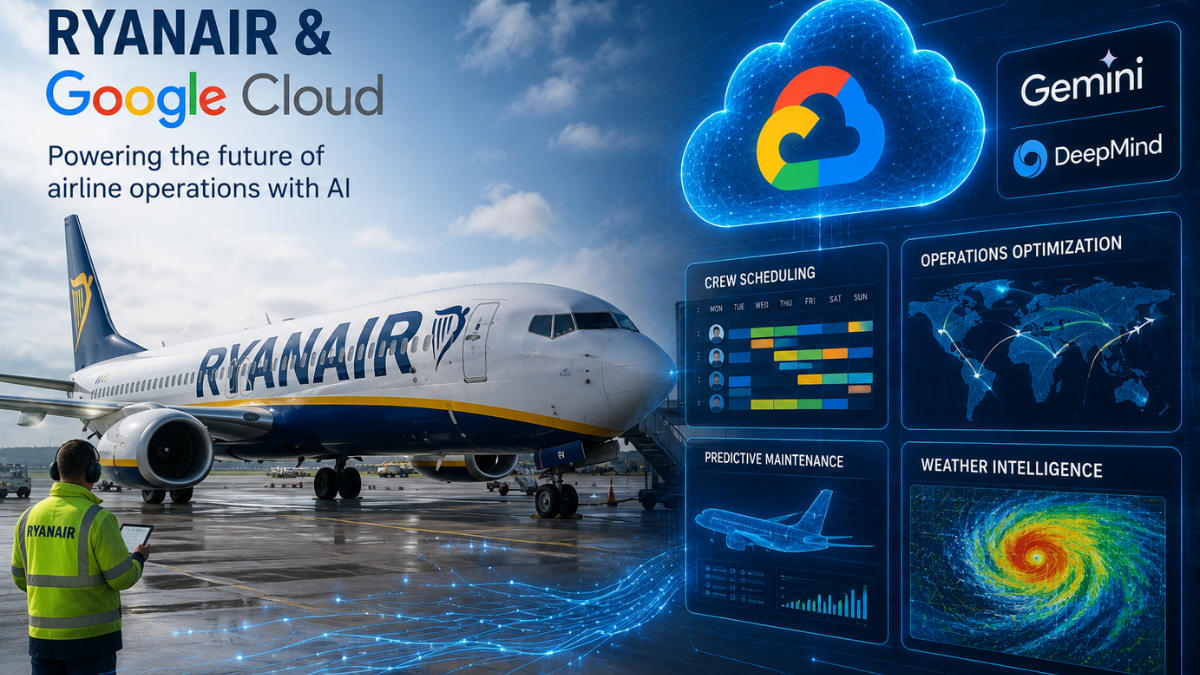
The Ryanair Google Cloud Gemini AI partnership airline operations plan signals a serious technology shift for Europe’s biggest airline by passenger numbers. Over five years, Ryanair will bring Google Cloud, Google Workspace, Gemini Enterprise, and selected DeepMind models into daily work across its network.
It’s not just another airline AI pilot. Ryanair aims to serve approx 300 million passengers per year by 2034, and such scale puts enormous pressure on crew planning, maintenance windows, weather decisions and their related systems.
Key Points
- Ryanair is signing a five-year deal with Google Cloud to bring Gemini AI and other Google tools into its airline operations.
- The airline plans to use Gemini Enterprise and AI agents for crew scheduling and handling operational decisions.
- Ryanair will continue using AWS alongside Google Cloud, giving the company a dual-cloud setup.
- Around 35,000 employees will get access to Google Workspace and Google Cloud services.
- Google DeepMind's AlphaEvolve and WeatherNext will be used for fleet operations, maintenance planning and weather-related work.
- The move comes as Ryanair works toward its target of carrying 300 million passengers a year by 2034.
- The real test will be whether AI can actually reduce delays, improve planning and make day-to-day operations more efficient.
Ryanair Google Cloud Gemini AI partnership airline operations goals
Ryanair signs five year Google Cloud agreement to deploy Gemini AI across operations while continuing to use Amazon Web Services. That matters because airlines don’t have much room for IT downtime. A delayed app, failed operations dashboard, or unavailable crew system can ripple through an entire day’s flying.
The Ryanair dual cloud strategy Amazon Web Services Google Cloud approach is designed to reduce that risk. In plain terms, the airline won’t depend on one provider for every critical system.
This mirrors a wider enterprise shift. Cloud providers are competing hard for workloads tied to AI cloud sales growth, while the pace of AWS cloud growth shows why companies still want flexibility across platforms.
Ryanair’s stated target is simple: better availability, faster decisions, and less disruption when plans change.
A dual-cloud model built for airline resilience
The Ryanair Google Cloud Gemini AI airline operations partnership adds Google Cloud to an existing AWS footprint. It’s a practical move, not a flashy one. Dual cloud approach helps Ryanair prevent IT outages and boost infrastructure resilience by avoiding a single point of failure for key services.
Airline operational resilience cloud infrastructure AI isn’t exciting until something breaks. Then it becomes the whole story.
For an airline, resilience can mean having access to operational data when storms build, an airport closes a runway, or a crew member becomes unavailable at short notice. It also requires security discipline. As companies connect more systems and AI agents, agentic application security and carefully governed native AI tools become part of the operational conversation.
That said, dual cloud isn’t free of headaches. Teams have to manage data access, costs, integrations, and accountability across two environments. The payoff only arrives if the architecture is well run.
Gemini Enterprise moves into crew scheduling and disruption control
Ryanair Google Gemini AI deployment crew scheduling is one of the most immediate use cases. The airline plans to use Gemini Enterprise custom AI agents aviation industry teams can tailor for specific tasks, including operational decision support.
Generative AI custom agents automate crew scheduling and reduce flight disruption by helping teams assess options faster. Say a flight is delayed, a crew approaches its legal duty-time limit, and another aircraft is available at a nearby airport. A human controller still owns the decision, but AI can surface viable combinations before the delay turns into a cancellation.
That’s the real value of AI flight disruption management automated decision making. Not magic. Better options, presented faster.
Ryanair rolls out Google Workspace and Gemini Enterprise to 35000 workforce members, bringing collaboration tools and AI assistance to a sizeable employee base. The Ryanair 35000 employees Google Workspace rollout could also reduce the friction of sharing schedules, maintenance updates, and disruption plans between teams in different locations.
Businesses are spending heavily on these capabilities, though results remain uneven. The gap between purchasing licenses and extracting value is clear in the debate around enterprise AI spending. Ryanair will need clean data, clear approvals, and staff who trust the recommendations enough to use them.
DeepMind models could sharpen maintenance and weather planning
Google Cloud DeepMind AlphaEvolve WeatherNext airline AI tools will support fleet operations and maintenance scheduling. Ryanair hasn’t disclosed every technical detail, but the direction is clear: use specialised models to predict constraints earlier.
How Ryanair uses Google DeepMind AlphaEvolve and WeatherNext for flight scheduling will likely depend on connecting model outputs to real-world operations data. WeatherNext AI assist airlines with weather forecasting by providing more useful forecasting inputs, which can help planners anticipate wind, storms, and airport capacity problems before they hit the schedule.
What role does AlphaEvolve play in airline fleet maintenance? Ryanair has positioned it as support for fleet and maintenance planning. In practice, that could mean AI predictive maintenance flight scheduling software that spots patterns, ranks maintenance work, and helps aircraft spend less time unexpectedly grounded.
Generative AI in airline operations and fleet maintenance has a real limitation, though. Models can suggest an action, but they can’t sign off an aircraft as airworthy. Engineers, regulators, and safety procedures remain in charge. As they should.
Why this matters beyond Ryanair
Ryanair is using enterprise AI models to reach 300 million passengers by 2034. Ryanair's annual target of 30 million passengers is ambitious, and technology is just one part of achieving it. More aircraft, airports, staff, and operational discipline will be equally important.
Still, aviation industry scales generative AI for fleet maintenance and passenger experience because small improvements add up quickly at airline scale. A few minutes saved on disruption handling, a better maintenance forecast, or an earlier weather warning can protect a much larger day of operations.
You can see the same investment pattern in AI computing infrastructure, physical AI solutions, and broader AI-powered industries. Aviation has higher safety stakes than most sectors, which makes cautious deployment more useful than loud promises.
How does AI improve operational efficiency in commercial aviation?
It can improve forecasts, maintenance prioritisation, crew planning, and communication. Google Cloud Gemini Enterprise deployment for commercial airline management works best when the AI is connected to reliable live data and clear human oversight.
Ryanair expands technology stack with dual cloud AWS and Google integration at a moment when the generative AI enterprise boom is pushing companies to prove real operational gains. For passengers, success will be measured less by the model name and more by whether flights run with fewer avoidable disruptions.
GlobalByte News Perspective
Ryanair's Google Cloud deal is interesting for a simple reason: the airline is putting AI into the parts of the business that passengers usually never see.
There is nothing particularly exciting about an AI tool helping someone write an email. Airline operations are different. A single delayed aircraft can affect crew availability, maintenance schedules and several other flights. The more flights Ryanair operates, the harder those decisions become.
This is where Gemini could actually prove useful. If an artificial intelligence system can provide planners with better options in a matter of seconds, looking at available crews, aircraft, schedules, and operational constraints, it could save significant time during a disruption. It doesn't need to replace decision-makers. It should only help them reach the right decision quickly.
The decision to keep AWS while adding Google Cloud is also worth watching. Ryanair is clearly not putting everything behind one cloud provider. That can make the infrastructure more resilient, but it also means the airline now has another environment to manage, integrate and secure.
And then there is the 35,000-employee rollout. That's where this deal becomes much bigger than a normal AI experiment. Ryanair isn't testing Gemini with a small team and waiting to see what happens. It is putting Google's technology across a large part of its workforce and connecting it with real operational work.
Still, the technology has limits. AI can help with maintenance planning or weather information, but it cannot decide that an aircraft is safe to fly. Those decisions will remain with engineers, aviation authorities and trained staff. In aviation, an AI recommendation is only useful when the people responsible for safety can trust it.
For GlobalByte News, the interesting part of Ryanair's move isn't simply that another major company is adopting Gemini. The thing is, AI is slowly moving from the front end of businesses into the systems that help them run smoothly.
If Ryanair can use this AI technology to reduce disruptions, improve crew planning, and make maintenance more efficient & effective, this agreement could serve as a useful example for the broader airline industry. If this technology adds another layer of complexity without delivering those improvements, the five-year commitment will have a completely different character.
The real story, then, isn't Ryanair using AI. It's whether AI can make one of Europe's biggest airlines easier to operate at massive scale.