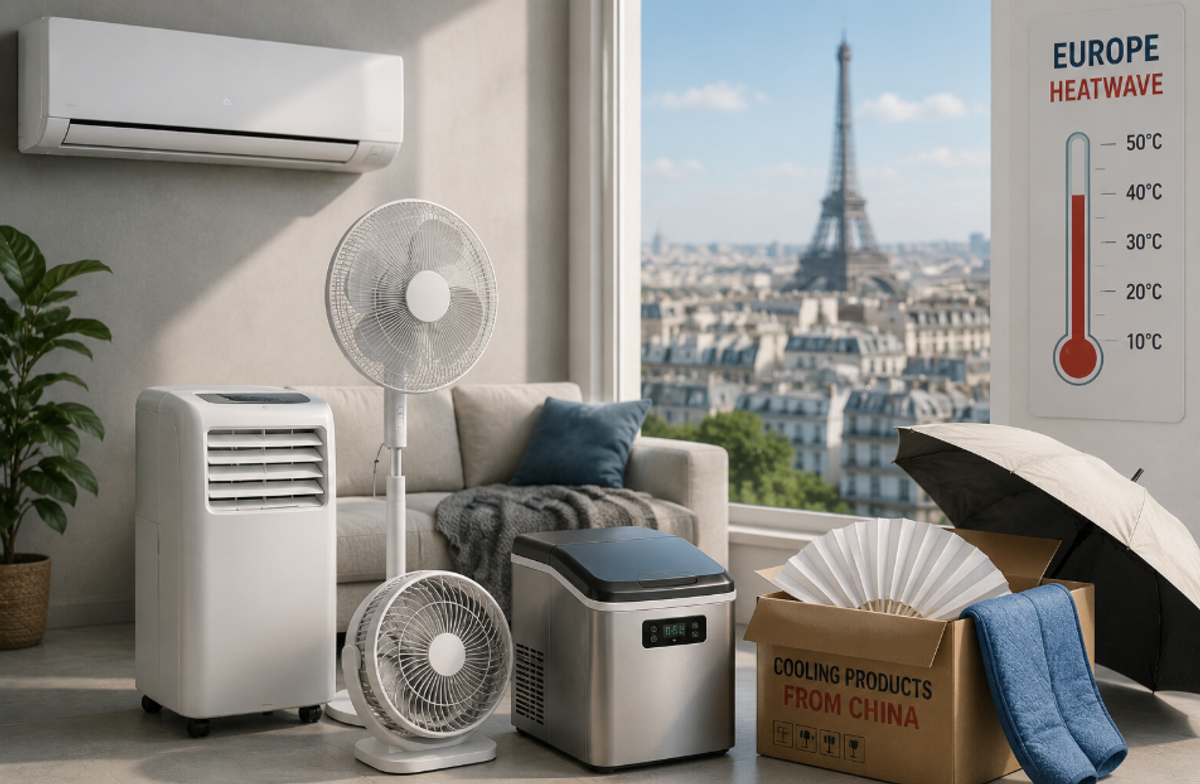
Europe is hot. Not just warm - record-breakingly, historically, stay-inside hot. An omega block atmospheric pattern has been trapping heat across the continent for weeks, pushing temperatures past 40°C in countries that simply weren't built for it. And the response from Chinese factories? Swift, precise, and frankly impressive. Europe's surging demand for Chinese cooling products has gone from a seasonal footnote to a full-blown supply chain event, with TCL reporting sales jumps of over 300 percent in France and Nordic markets, fan orders in Sweden surging 375 percent, and Yiwu merchants who were making rain umbrellas a decade ago now shipping solar-powered fan hats to Spain by the container load.
This isn't just a hot summer story. It's a story about manufacturing agility, cross-border logistics, and why Chinese factories keep answering when the world needs cooling - fast.
The Sales Numbers Behind Europe's Surging Demand for Chinese Cooling Products
TCL's European air-conditioning team shared data that's hard to ignore. Sales in France and the Nordic region jumped more than 300 percent. Spain posted 100 percent growth. And inventories of TCL mobile air conditioners were cleared out entirely across the UK, France, and Germany.
To keep pace, TCL cut production cycles from the usual 30-40 days down to 10. That's not a minor tweak. That's a fundamental retooling of the factory floor. The company is also exploring direct trailer shipments to Europe and chartered air freight for project orders, because standard sea freight timelines no longer fit the urgency here.
AliExpress data tells the same story. In June, mobile AC units, ice makers, and electric fans all saw explosive growth across Europe. Ice-maker sales in the UK rose tenfold year-on-year. Cooling appliances in Germany grew 4.6 times. Fan sales in Spain jumped 94 percent week-on-week. These aren't gradual seasonal shifts - they're demand spikes driven by extreme heat arriving faster than warehouses can restock.
Joybuy and JD.com's European retail data confirmed the pattern consistently, with Chinese brands leading the mobile cooling category across multiple markets.
Why European Homes Can't Simply Install a Regular Air Conditioner
Here's something that gets missed a lot in the coverage. Most European homes - especially older buildings in France, Germany, Italy, and the UK - aren't set up for traditional split-system air conditioning. European historical building air conditioning restrictions mean you often can't drill through walls or mount external units on listed facades. Certified HVAC installers are expensive and booked weeks out. And in rental housing, landlords frequently ban structural modifications outright.
That's exactly where Chinese-made easy-install mobile units fit. Skyworth Air Conditioning's customized quick-connect models for France have been particularly popular - buyers skip the installer entirely, and costs drop sharply. Some French inventories sold out within seven days, with warehouses struggling to restock fast enough.
Haier's Expert series was designed for this specific problem. Easy-mount wall plates, L-shaped brackets, flexible drainage options, enlarged piping space - it handles different wall configurations and cuts installation time by up to 50 percent compared to conventional units. When certified installer labor in Western Europe can run hundreds of euros per job, that gap matters enormously to buyers. For the latest cooling gadgets built around real European constraints, Haier's approach has become the benchmark.
Haier's Pearl Premium series also hits Europe's top A triple plus energy efficiency rating for residential AC, which is increasingly important as continental electricity prices stay elevated. The company's European HVAC business grew more than 20 percent overall, with own-brand sales up 23 percent. In Spain, Haier ranked first by both volume and value. In Poland, second in the residential market. That's not luck - those are the results of deliberately customizing for European conditions. How Chinese manufacturers customize easy-install air conditioners for European user habits, from installation logistics to running costs, is the real product story here. And it's playing out across Chinese hardware breakthroughs in the broader manufacturing sector too.
Yiwu Is Moving Faster Than Anyone Expected
The Yiwu International Trade City is one of the largest small-commodity wholesale markets in the world, and it's been running at full pace this summer.
Zhang Jiying, head of Yiwu RST Umbrella Industry, has been exporting to Europe since 2005. Back then, mostly rain umbrellas. But as European summers have intensified year after year, consumers have shifted toward sun umbrellas, fan-equipped umbrellas, and misting fan umbrellas. Her factory now produces about 10,000 umbrellas a day, shipping primarily to Spain, Italy, and France via sea freight and China-Europe freight trains, with the Yiwu-Madrid rail route taking around 16-18 days.
Fan-hat seller Jiang Yongtao notes that more suppliers have entered the market - competition is real - but demand is strong enough that factories are still shipping new orders daily. Yiwu Senwai Hat Industry's electric fan hats, priced for wholesale, are now finding their way onto European retail shelves for the first time. Cooling-sleeve seller Dong Wei had previously exported mainly to Southeast Asia. This year, buyers from Spain and Italy started placing orders - pointing to a wider behavioral shift in how Europeans think about outdoor heat protection.
Understanding how Yiwu small commodity merchants cut cooling product production cycles to ten days is key here. Official Yiwu data shows cross-border e-commerce transactions reached 81.18 billion yuan in the first five months of 2026, up 10.23 percent year-on-year.
The Logistics Side Is Getting a Serious Upgrade
Getting products to European consumers quickly used to be the weak link in this chain. That's genuinely changing.
AliExpress has been building local European fulfillment capacity for years. During the 2026 618 shopping festival, orders shipped from local warehouses in Spain, France, and Poland exceeded 50 percent of total orders for the first time - surpassing direct cross-border shipments. That's a structural shift. The EU's tightening of tax rules on low-value parcels has pushed more merchants toward local warehousing, which also means faster delivery times and fewer customs complications for buyers.
How cross-border logistics networks handle urgent chartered air freight for cooling products is now a genuine competitive advantage for Chinese exporters. The broader context matters too: China-UK economic cooperation is expanding in ways that extend well beyond raw trade volume, and logistics infrastructure is central to that. It's also visible in how the Chinese electronics market has developed vertically integrated supply chains that respond to demand spikes faster than Western competitors can match.
Cynthia Li, a 26-year-old office worker in the UK, told the Global Times that her friends in London have been buying Chinese cooling appliances on Amazon all summer - standing fans from Midea and Xiaomi, mostly. That's not a niche trend. That's mainstream European consumer behavior in 2026.
Beyond Air Conditioners - The Full Cooling Economy
It's easy to focus on air conditioners because the numbers are dramatic. But the Europe surging demand for Chinese cooling products story is wider than that.
Zheng Li, international trade director at a Ningbo-based company, says ice-maker shipments to Europe rose more than 70 percent year-on-year in the first five months, now accounting for about 15 percent of total sales. Ningbo-based ice maker shipments to Europe have gone from a niche export to a core product line practically overnight.
Midea's Comfee portable air conditioner - around 250 euros, mobile app control, cools a bedroom fast - is showing up in European apartments as a first-ever home cooling solution for people who never owned an AC before. Xiao Jing, a Xiaohongshu user living in France, says it's popular precisely because it doesn't require any installation expertise whatsoever.
The 2026 digital economy innovations feeding into cross-border e-commerce platforms like AliExpress are also enabling smarter demand forecasting, letting manufacturers anticipate regional spikes before they hit rather than scrambling to catch up after.
Chen Jing, vice president of the Technology and Strategy Research Institute, framed it bluntly: "Whatever cooling needs Europe has, Chinese products can almost offer a corresponding solution." She noted that China's supply chain advantage isn't just about price - it's about a systematic response capacity built on complete industrial chains, flexible manufacturing, fast delivery, and cross-border e-commerce channels. How Chinese appliance brands bypass European installation bottlenecks with portable split ACs is a case study in that systematic capacity.
What the Heatwave Trend Means Long-Term
The thing is, this summer isn't an anomaly. Climate scientists have been consistent about it. Extreme heat events in Europe will become more frequent, more intense, and longer-lasting. The omega block atmospheric pattern driving this year's crisis isn't a once-in-a-generation fluke.
Professor Cui Hongjian of the Academy of Regional and Global Governance has pointed out that China's supply chain response goes beyond ordinary consumer goods exports - it has, as Chen Jing noted, become part of the supply system for climate emergency materials. That's a significant reframing. Why Europe's severe heatwaves are driving massive demand for Chinese cooling products is increasingly inseparable from the question of how the world adapts to climate change at scale.
China's open-source AI momentum is also starting to show up in smart home appliance integration, from app-controlled cooling units to predictive energy management. Chinese tech startups in the home appliance space are treating the European cooling surge as a live product proving ground. And AI-driven hardware trends are quietly reshaping how these products are designed and manufactured.
For anyone tracking China's computing ambitions or the broader emerging science and tech trends shaping global industry, the cooling product surge is a useful data point: Chinese manufacturing doesn't just produce at scale. It adapts at scale - and that's becoming the more important capability.
The Heat Isn't Going Away - And Neither Is This Demand
Europe's cooling problem doesn't get solved next spring. The aging housing stock, the historical building restrictions, the years of underinvestment in home climate infrastructure - none of that changes quickly. What does change is how well-prepared European consumers will be when the heat arrives next summer.
Chinese manufacturers - from TCL and Haier at the top, all the way down to Yiwu's fan-hat and umbrella factories - are already building for that reality. Faster production cycles, local European warehouses, products designed around actual European installation and energy constraints: this is deliberate preparation, not reactive scrambling.
Why Chinese Midea Comfee and PortaSplit models are sold out across Germany, and France comes down to a simple truth: these products solve real problems that European consumers face right now, at a price point and level of installation complexity that fit real European homes. Europe's surging demand for Chinese cooling products is, at its core, a story about what happens when extreme weather meets a manufacturing ecosystem built for speed and scale. China has that ecosystem. Europe needs it. And the two are figuring out how to work together faster than anyone predicted just a few years ago.