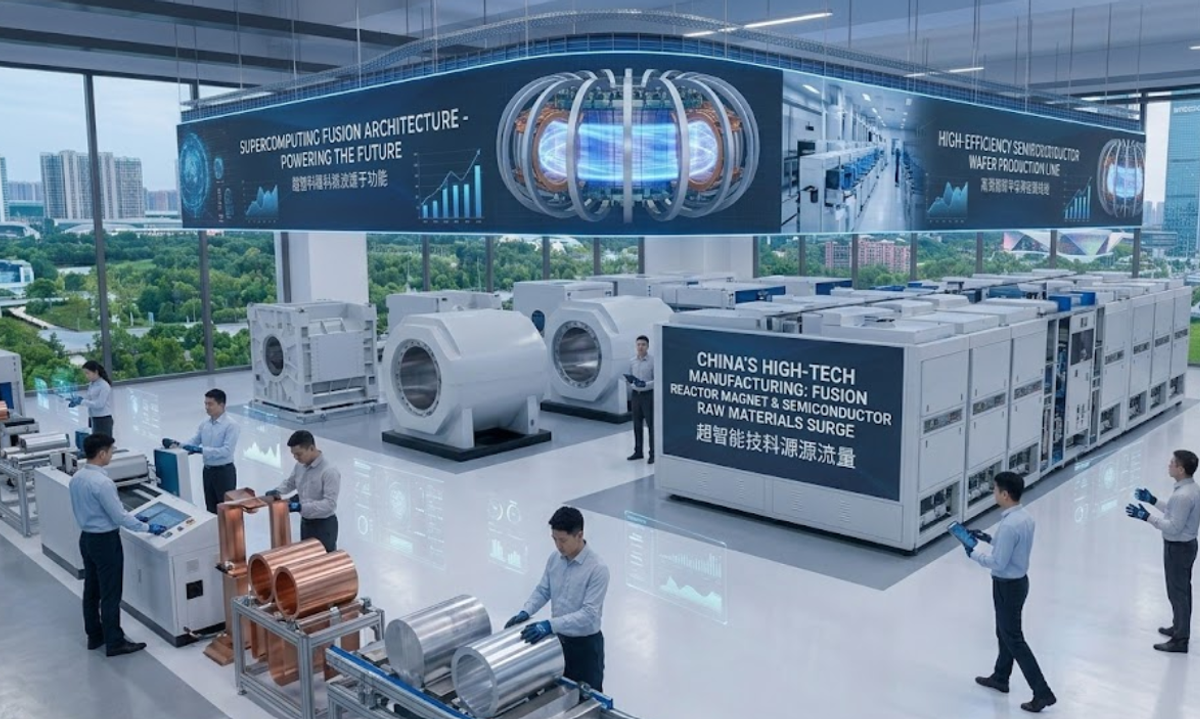
June 27, 2026, was an unusually packed day. China completed the world’s largest nuclear fusion reactor superconducting magnet test in 2026, posted high-tech manufacturing profit growth of 44.7%, and opened a new natural gas supply line to Xiongan New Area - all within 24 hours. If you follow the latest science breakthroughs or track industrial economics growth in China, there's a lot worth working through here.
China's High-Tech Manufacturing Profits Are Outrunning the Pack
Start with the economics. They set the context for everything else.
From January to May 2026, profits among China's large-scale industrial enterprises grew 18.8% year-on-year - 0.6 percentage points faster than the January-to-April rate. Manufacturing profits overall rose 20%. But high-tech manufacturing profits in 2026 climbed 44.7%, well ahead of the broader industrial trend and continuing to pull the rest of the sector upward.
The biggest driver was chips. The surge in global demand for high-end computing chips and memory chips pushed the electronics industry's profits up a striking 103.9% year-on-year. That one sector alone contributed 43.1% of total profit growth across all large-scale industrial enterprises. For anyone monitoring computing chip market demand, that figure tells you where the most intense market pressure is concentrated right now.
Analysts at China's National Development and Reform Commission pointed to faster domestic R&D cycles and improved product quality as key factors. B2B semiconductor and AI device raw material manufacturing trends showed it clearly too - copper, aluminum, and other base materials saw meaningful profit gains as demand from new energy and AI sectors kept pulling production higher.
This feeds directly into the global tech competition in 2026. Supply chain self-reliance isn't just a policy talking point anymore. It's showing up in the profit data.
The World’s Largest Nuclear Fusion Reactor Superconducting Magnet Test 2026: What You Need to Know
Now to the headline achievement.
China's National Major Science and Technology Infrastructure project - formally titled the "Comprehensive Research Facility for Key Systems of Fusion Reactor Mainframe" - hit a defining milestone on June 27. Its toroidal field superconducting magnet completed its final fabrication process and cleared full superconducting magnet acceptance testing by an expert technical panel. This is what the world’s largest nuclear fusion reactor superconducting magnet test 2026 refers to, and the specs are genuinely hard to put in perspective.
The magnet is 21 meters long, 12 meters wide, and 3.3 meters high. It weighs 582 tons. Compared to the equivalent component in ITER (the International Thermonuclear Experimental Reactor), this one is 1.3 times larger in volume and stores three times more energy - making it the world’s largest nuclear fusion magnet ever built. Eventually, 16 of these will be assembled into a complete toroidal magnetic field system.
But the supply chain story is equally significant. Song Yuntao of the Institute of Plasma Physics at the Chinese Academy of Sciences confirmed that the toroidal field superconducting magnet achieved 100 percent domestic production - specialized stainless steel, insulating materials, and superconducting materials, all sourced and manufactured entirely within China. This has real implications for the global energy technology supply chain, and it connects directly to the scale of government high-tech investment backing these projects at the national level.
A Second Fusion Milestone - Same Day
Here's where it gets even more interesting.
A separate major fusion project also hit a significant mark on June 27. The Compact Fusion Energy Experimental Device's high-temperature superconducting central solenoid coil magnet completed full-condition parameter testing on the same day. Compact Fusion Energy Experimental Device solenoid coil parameters met internationally leading performance levels across every measured criterion. And, like the toroidal field magnet, it achieved complete domestic production - breaking a foreign technological monopoly on this class of equipment that had held for years.
Song Yuntao called this component the most advanced superconducting magnet currently in existence and the critical enabling technology for eventually generating electricity from fusion reactions. Two fusion milestones. One day. Neither was accidental - both reflect years of coordinated R&D investment in China's fusion research program, increasingly supported by AI-powered engineering tools for design validation and complex system testing.
Xiongan's Natural Gas Supply Gets Its Second Source
Not everything on June 27 was fusion-related.
The State Pipeline Group confirmed that a dedicated natural gas supply line to Xiongan New Area officially entered operation. The Xiongan New Area natural gas supply pipeline project runs 5.8 kilometers, connecting the Renqiu distribution station on the Shaanxi-Beijing Second Pipeline to the terminal station in Gougezhuang Town, Xiong County. Designed annual transmission capacity: 3.16 billion cubic meters.
Combined with the already-operating Inner Mongolia West Pipeline, Xiongan now has a genuine dual gas source arrangement. That redundancy matters - it protects both industrial users and residents from single-source supply disruptions. Liu Gang of Beijing Pipeline Company described the goal as building a "multi-source, multi-directional, and interconnected gas supply pattern." The Xiongan new area clean energy infrastructure now has the backbone to support the zone's planned growth.
Why All Three Stories Belong Together
At first glance, these look like unrelated announcements. They're not.
Each one reflects the same underlying dynamic: industrial economic growth in China across a specific set of strategic sectors is compounding faster than headline numbers suggest. Chip profits are soaring. Fusion hardware is moving from lab design to physical component acceptance testing. Clean energy infrastructure is being built at a pace that matches stated policy goals. The deep-tech startup ecosystem is watching the fusion developments closely, since commercial fusion energy would fundamentally alter long-term energy cost structures for heavy industry.
These developments sit comfortably among the more significant global innovation milestones 2026 has produced. Alongside achievements like the world's fastest supercomputer and the 2026 technology industry rankings showing the hardware layer shifting quickly, June 27's announcements fit a pattern that's been building all year. And for anyone who followed recent cutting-edge hardware demonstrations at the enterprise level, real-world infrastructure milestones like these add useful context to what hardware progress actually looks like when it moves from demo floor to operational scale.
The Bigger Picture from June 27
The world’s largest nuclear fusion reactor superconducting magnet test 2026 is the most technically striking story from that day. But taken together with the profit surge and the pipeline launch, June 27 offered something more useful: a concrete snapshot of where China's industrial strategy is producing measurable results across energy, manufacturing, and infrastructure simultaneously. For anyone tracking the b2b advanced hardware infrastructure space, fusion technology supply chains, or chip market dynamics - these aren't announcements about plans. They're evidence of progress that's already happened.