Summary
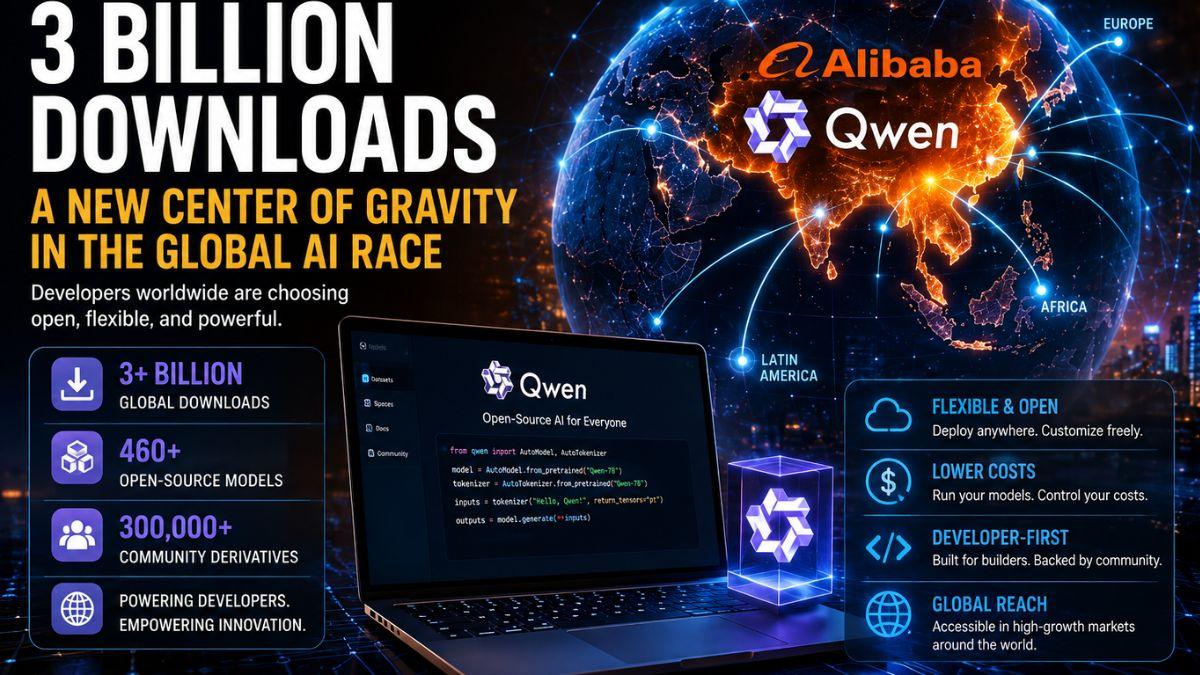
When you look at the current trajectory of artificial intelligence, you'll notice a massive shift in developer preference that actively challenges Western tech dominance. Recent ecosystem data reveals that Alibaba's Qianwen AI model family has surpassed 3 billion global downloads. This milestone, highlighted in a 2026 report from Hugging Face, highlights a structural transition in the US-China AI race. As you explore your enterprise foundation model options, you'll find Alibaba has successfully positioned Qianwen as a default daily workflow choice, backed by a sprawling ecosystem of over 460 open-source models and 300,000 community-built derivatives. By distributing this technology through cloud platforms directly into rapidly growing emerging markets, Alibaba is creating a self-reinforcing developer loop. This leaves US tech giants struggling to maintain their distribution dominance while trying to counter Meta's own open-source strategies.
Key Points
- Qwen has crossed 3 billion global downloads, highlighting the scale of Alibaba's open-model ecosystem.
- The ecosystem goes beyond one model: Alibaba has released hundreds of Qwen variants for different workloads and deployment needs.
- Community adoption is a major advantage, with more than 300,000 reported derivative models expanding the range of potential use cases.
- Alibaba's cloud distribution matters. Developers can access Qwen models alongside infrastructure instead of building the entire deployment stack from scratch.
- Open models are challenging the closed-API approach by giving businesses more control over deployment, customization and potentially long-term costs.
- The US-China AI competition is increasingly about distribution, not just who produces the highest benchmark score.
- Meta, Nvidia and other Western companies are also pushing open-weight strategies, showing that developer mindshare has become a strategic battleground.
- Emerging markets could be especially important as cloud availability and lower-cost AI deployment make open models easier for local developers to adopt.
- 3 billion downloads have limits as a metric. They don't automatically translate into production deployments, enterprise revenue or lasting customer loyalty.
- The next test is commercial adoption: Qwen will need to turn developer interest into sustained enterprise usage and revenue.
- Regulation could become a bigger issue as open models move into sensitive business applications, particularly around provenance, safety and AI supply chains.
- The bigger shift: the most successful AI model may not always be the one with the best benchmark. It could be the one developers can deploy, customize and afford most easily.
Introduction & Core News Development
The global market for foundational AI models has experienced a massive shakeup. While you might have previously associated open-source leadership almost exclusively with Silicon Valley, the latest deployment figures suggest that the developer center of gravity is sliding fast toward Hangzhou. Alibaba has confirmed that its Qianwen series—known in developer circles simply as Qwen—has logged over 3 billion downloads worldwide.
Don't mistake this for a mere vanity metric. When you evaluate the health and longevity of any software ecosystem, you've to look at how many engineers are actually building on top of those core architectures. By putting out 460 distinct model versions, Alibaba didn't just release code; they handed you a modular toolkit designed to let your engineering team fine-tune systems for hyper-specific tasks without needing a supercomputing budget. Compare this scale to download figures reported for Google's Gemma (418 million) or Meta's Llama series (227 million) within the same period. The scale of Alibaba’s global penetration becomes impossible to ignore. You're looking at a deliberate strategy that prioritizes accessibility and sheer volume, effectively democratizing high-end foundation models for teams who find closed APIs too restrictive, expensive, or prone to sudden policy shifts. And fast.
Background & Industry Context
To understand why this shift is happening now, you've to look back at how the US-China AI race has played out over the last few years. For a long time, your enterprise probably relied on proprietary, pay-walled APIs from dominant Western outfits like OpenAI or Anthropic. But as trade tensions flared and export controls on advanced semiconductors grew more and more strict, Chinese tech leaders were forced to build under a different set of engineering constraints.
Alibaba realized early on that if you can't guarantee endless access to the latest Western silicon, your software stack has to become incredibly lean, efficient — and portable. While domestic rivals like DeepSeek focused on matching raw benchmark performance to turn heads, Alibaba set its sights squarely on the distribution engine. They integrated their AI models deep into their existing global cloud infrastructure. So, if you're a developer working in high-growth corridors across Southeast Asia, Latin America, or Africa, the path of least resistance is to adopt the pre-integrated, high-performance tools within the Alibaba cloud. This distribution playbook has triggered the wave of open-source AI adoption we're seeing reshape local technology ecosystems today. Check out our in-depth report on US-China AI race for additional background.
Technical Breakdown & Architecture
How does an AI model family actually rack up 3 billion downloads? It doesn't happen by accident; it comes down to architectural modularity and developer-first licensing. When you deploy a model like Qwen, you aren't dealing with a rigid, one-size-fits-all black box. Instead, you're pulling highly containerized, pre-trained weight sets that your developers can instantly adapt through parameter-efficient fine-tuning techniques like LoRA.
Alibaba intentionally built these models across a wide spectrum of parameter sizes. You can grab lightweight 0.5-billion parameter models designed to run locally on low-power edge devices, or scale up to massive, mixture-of-experts (MoE) architectures designed for heavy-duty enterprise tasks. This flexibility is the real differentiator. Because these models are optimized to be lightweight and highly interoperable, you can drop them into your current Kubernetes clusters or on-premise hardware with very little friction.
Even better, the presence of over 300,000 derivative models on community registries means that for almost any niche industry use case you encounter, someone has probably already built, tested — and shared a specialized version. You aren't just downloading base weights; you're tapping into a global hive mind of engineers who have already solved the latency and optimization bottlenecks you're currently trying to figure out.
Business Impact & Strategic Implications
For your business, the rise of an open-source powerhouse like Alibaba carries major strategic implications. If you're a CTO, CIO, or lead architect, you've to constantly weigh the hidden risks of proprietary APIs against the operational freedom of open-source frameworks.
Going with Alibaba’s ecosystem dramatically lowers your platform risk. When you build on a standard backed by 3 billion downloads, you're investing in an architecture that isn't going to disappear behind a restrictive pricing tier or get shut down due to corporate restructuring. Plus, your long-term inference costs become far more predictable when you run your own fine-tuned model instances on dedicated infrastructure. While US tech giants face mounting Wall Street pressure over the massive capital expenditures required to keep their closed systems running, open-source architectures iterate at the speed of the global developer community, spreading the optimization workload across thousands of independent teams.
Industry Perspective & Ecosystem Dynamics
The defensive moves from Western tech incumbents tell you everything you need to know. You've likely watched Meta, Nvidia, and even Microsoft push out more and more capable open-weight models recently. This isn't out of altruism; it's a direct counter-strategy. They know that if they lose the hearts and minds of day-to-day developers, they lose the long-term enterprise software market.
The battle has shifted. It's no longer just about who can claim the highest synthetic benchmark score on paper; it's about whose platform is the most practical and sticky. Alibaba’s ability to weave its AI offerings directly into its massive e-commerce, logistics — and cloud ecosystems gives them an incredibly strong distribution moat. It proves that physical hardware constraints aren't an absolute barrier to entry. Through smart software optimization, efficient attention mechanisms, and aggressive distribution, Chinese engineering teams are delivering world-class AI capabilities that are becoming indistinguishable from the proprietary models built by heavily funded Western research labs. Few saw this coming.
GlobalByte Perspective
Alibaba’s Qwen milestone is worth watching because the 3 billion-download figure says more about developer adoption than benchmark scores do. The real strength of the ecosystem appears to be its scale: hundreds of open models, a huge number of community derivatives, and distribution through Alibaba’s cloud infrastructure.
From the GlobalByte News perspective, this is where the AI competition is changing. The question is no longer simply which company has the most powerful model. Developers also care about cost, flexibility, deployment options, licensing, and how easily a model can be adapted to a specific job.
Qwen’s growth suggests that Alibaba has understood that part of the competition particularly well. By making models available to developers across different markets and use cases, Alibaba is building an ecosystem around Qwen rather than treating it as a single AI product.
But the 3 billion-download milestone shouldn't be treated as proof that Alibaba has overtaken every Western AI company. Downloads don't tell us how many models are actively used in production, how much enterprise revenue they generate, or how long developers stay with them. Those numbers will matter much more over time.
The bigger takeaway is that AI distribution is becoming as important as AI capability. If open models continue gaining developers at this pace, companies that control the developer ecosystem could have an advantage that lasts well beyond the next model release.
Future Outlook & Strategic Roadmap
Next, you should expect the open-source model wars to heat up. Western firms will likely accelerate their own open-weight releases to stop their developer mindshare from slipping away to Asian alternatives. Yet, the momentum is clearly on the side of the open-source community right now.
Meanwhile, keep an eye on the changing regulatory environment. As these open-source models become deeply embedded in critical enterprise applications, global regulators will pay much closer attention to data provenance, safety guardrails, and model supply chains. You'll want to make sure your organization is prepared for a future in which compliance audits of AI weights become standard practice, regardless of whether those weights came from Silicon Valley or Hangzhou. Over the next few quarters, Alibaba will likely roll out even more specialized, industry-specific fine-tuning pipelines to lock in corporate customers, cementing the Qianwen ecosystem as a foundational piece of global enterprise infrastructure.