Summary
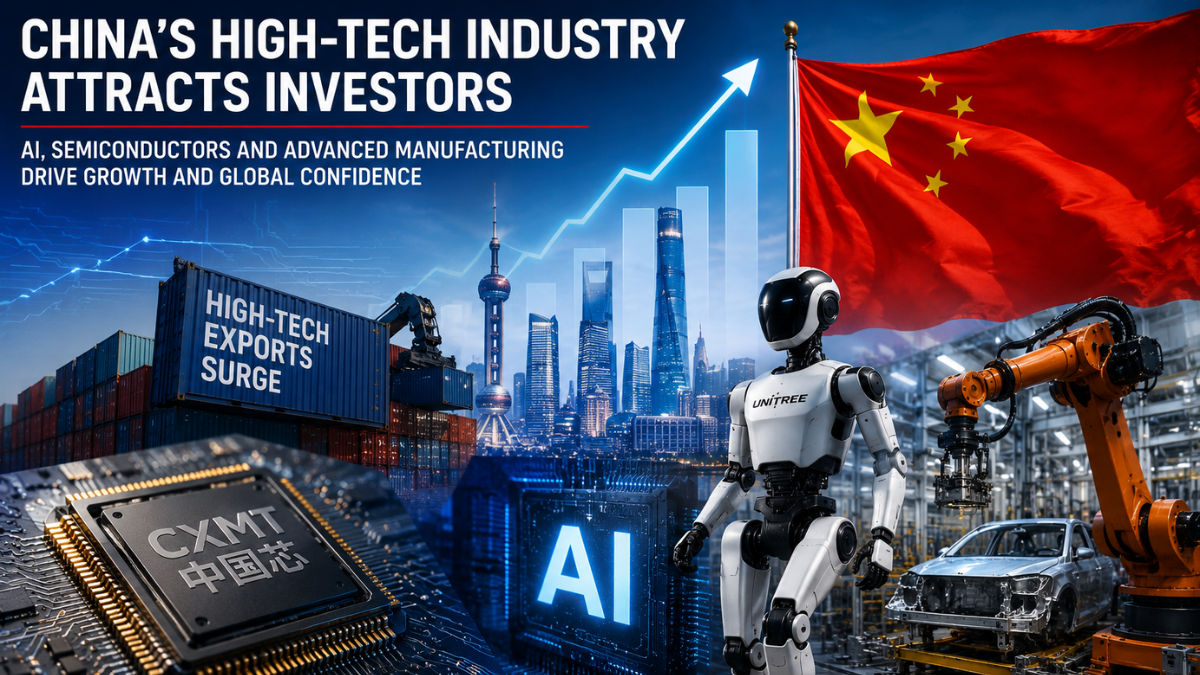
China high tech industry foreign investment AI semiconductor trends are drawing attention because the story is no longer limited to one promising company or one policy announcement. You’re looking at faster exports, lower-cost AI models, major chip listings, and robotics companies preparing to raise billions.
That mix has caught the eye of global investors. But it also comes with real economic pressure points.
Key Points
- High-tech exports are becoming a bigger part of China's growth story: Reported July growth of more than 50% shows how quickly technology-related trade is expanding.
- AI is becoming more accessible: Lower-cost models from Chinese AI companies could encourage wider business adoption and create demand across the AI supply chain.
- Semiconductors remain a major investment theme: CXMT's huge market debut shows the level of investor interest in China's domestic memory-chip industry.
- CXMT's first-day surge needs perspective: A 465.82% jump is striking, but one trading session does not establish long-term business value.
- Robotics is moving toward the public markets: Unitree's planned 6.1 billion yuan fundraising shows that investors are increasingly looking at robotics as a major industrial opportunity.
- International investors are paying closer attention: Positive views from major financial institutions suggest China's technology sector is receiving more attention beyond domestic markets.
- Energy and skilled workers matter: China's ability to support AI infrastructure with large energy supplies and a deep technical workforce could remain an important competitive advantage.
- The domestic economy remains the weak spot: Strong technology exports do not automatically solve weak household consumption or pressure on some businesses.
- Valuations deserve caution: Rapidly rising technology stocks can create expectations that companies may struggle to meet.
- The real test is earnings: If AI, semiconductor and robotics companies can turn growing demand into sustainable profits, the investment story becomes much stronger.
- Policy will remain important: Fiscal spending, bond issuance and broader economic support could influence how far the technology-led recovery spreads.
- The bigger picture: China is building a connected high-tech ecosystem rather than relying on one sector alone. AI feeds semiconductor demand, chips support AI infrastructure, and both increasingly connect with robotics and advanced manufacturing.
Why China high tech industry foreign investment AI semiconductor is gaining momentum
China’s high-tech industry is attracting foreign investment across artificial intelligence, memory chips, robotics, and advanced manufacturing. The appeal is simple enough: investors see companies building products at scale while China develops a deeper domestic technology base.
Recent trade data added fuel to that view. China high tech exports 50 percent increase figures showed high-tech product exports rose by more than 50% year over year in July 2026, far ahead of the 17.8% increase in total exports.
That gap matters. It suggests that AI hardware and chip-related demand may be doing more than merely lifting a few headlines. China semiconductor supply chains are becoming a more visible part of the country’s export story, particularly as AI servers, memory, and computing equipment gain importance.
The headline is blunt: China high tech export growth surges past 50 percent driven by AI and chips.
AI costs, energy, and the appeal of Chinese technology companies
Why are global investors attracted to China's high-tech industry? Growth potential is part of it, obviously. So is cost.
Nomura’s Rob Subbaraman has pointed to abundant energy supply and a skilled workforce as advantages for China’s expanding AI industry chain. Energy isn’t the flashiest investment topic, but AI data centers consume enormous amounts of power. A reliable supply can affect the cost of training and operating models. That’s one reason China's AI computing market deserves attention alongside model developers.
China AI startups DeepSeek Moonshot AI investment is another area investors are tracking. Companies such as DeepSeek and Moonshot AI are trying to make advanced AI cheaper to use, which could encourage businesses to adopt it sooner.
How do companies like DeepSeek and Moonshot AI lower AI costs? They can reduce the computing resources needed for model development and deployment, then offer capable tools at more accessible prices. That doesn’t guarantee profits, of course. It does make adoption easier.
China AI sector growth, China's digital economy expansion, and cross-border AI cooperation all shape the wider investment case. AI adoption rarely happens in isolation. It spreads through software, hardware, industrial applications, and international partnerships.
China high tech industry foreign investment AI semiconductor meets the public market
Chipmaker CXMT turned into a major test case for China’s technology-focused capital markets. The ChangXin Memory Technologies CXMT STAR Market IPO put a domestic memory-chip manufacturer in front of public investors at a moment when AI is driving intense demand for memory.
On its first day of trading, CXMT shares reportedly surged 465.82%, pushing its market value above 3.2 trillion yuan. That is why the phrase Memory chip maker CXMT market cap hits 3.2 trillion yuan after STAR Market debut became such a powerful market narrative.
How did CXMT stock perform on its STAR Market listing day? It rose 465.82%. A remarkable debut, though a first-day surge isn’t the same thing as a long-term valuation argument.
The Tema ETF CXMT memory chip investment weighting reached 10.56% in the Tema Memory ETF on the company’s listing day. MSCI China All Shares Index CXMT inclusion followed, giving the company wider visibility among index-tracking investors.
For anyone watching a China semiconductor memory chip manufacturing stock, those moves matter because they bring institutional demand into the picture. China's chip investment drive, the AI chip localization strategy, and China's tech listing rules offer useful context for how that demand developed.
Robotics is joining the investment conversation
China robotics sector advanced manufacturing investment is getting harder to ignore. Unitree Robotics, known for developing robots, is preparing for a mainland stock market listing.
Unitree Robotics mainland stock market IPO 6.1 billion is the number investors are focused on. The company plans to issue shares at 150.8 yuan per share, representing 10% of its charter capital, and could raise roughly 6.1 billion yuan.
How much capital is Unitree Robotics planning to raise in its IPO? About 6.1 billion yuan.
The proposed listing fits a broader theme: Unitree Robotics plans 6.1 billion yuan IPO to expand advanced robotics manufacturing. And robotics doesn’t only mean factory floors. Automotive AI investment shows how machine intelligence, vehicles, chips, and manufacturing are increasingly connected.
Why Wall Street is raising its China outlook
Global financial institutions Chinese tech stocks are becoming more attractive as investors seek exposure outside the same handful of US megacap names. Chinese A-shares can offer sector diversification, especially for those wanting exposure to semiconductors, AI, and industrial automation.
Goldman Sachs CSI 300 Chinese equities forecast has become more positive during 2026. The bank raised its 12-month CSI 300 target twice, citing improving earnings prospects, supportive macro conditions, and liquidity.
Why did Goldman Sachs raise its target for the CSI 300 index? Its strategists expect better earnings conditions and see enough liquidity and policy support to sustain the market’s outlook. China's technology finance agenda is part of that broader backdrop.
Why are Chinese A-shares appealing to international investors? They offer exposure to a different set of companies and supply chains. That diversification is useful, although it doesn’t remove market or policy risk.
The risks investors shouldn’t brush aside
China high tech industry foreign investment AI semiconductor growth is compelling, but the macro picture is uneven. DBS economist Nathan Chow has warned that supply remains relatively high while demand is still weak. Household consumption and some corporate profits remain under pressure.
What are the economic risks facing China's high-tech recovery? Weak domestic demand, pressure on household spending, and uneven company profitability could limit how broadly the recovery spreads. If policy support arrives slowly, confidence can wobble fast.
There are regulatory considerations too. Investors assessing overseas exposure should understand foreign technology transfer rules, especially where sensitive technologies and cross-border operations are involved.
China semiconductor sector attracts international fund managers despite macro headwinds. That’s accurate, but it shouldn’t be read as a promise of smooth returns.
What investors should watch next
China's high-tech industry foreign investment in AI and semiconductors will likely depend on whether earnings can keep pace with excitement. Export data, AI adoption, CXMT’s trading after its debut, and Unitree’s IPO progress are all practical signals to follow.
China high-tech foreign investment in semiconductors and AI also depends on the policy response to weaker consumption. Analysts have called for faster budget spending, better use of bond issuance, and closer coordination between fiscal and monetary policy.
So, there’s opportunity here. There’s also plenty that can go wrong.
China high tech industry foreign investment AI semiconductor: A story still in progress
China high tech industry foreign investment AI semiconductor themes have real momentum behind them, from surging exports and lower-cost AI tools to CXMT’s blockbuster debut and Unitree’s planned robotics raise.
But investors should keep their eyes on the economic backdrop as closely as the technology headlines. The opportunity is clear enough. The execution still has to prove itself.
GlobalByte Perspective
China’s high-tech investment story is becoming harder to dismiss as a short-term market trend. AI, semiconductors, robotics and advanced manufacturing are starting to reinforce each other, creating an ecosystem that is attracting attention from both domestic and international investors.
The export numbers are probably the clearest starting point. High-tech product exports reportedly grew by more than 50% in July, far faster than overall exports. That suggests the technology sector is becoming a more important part of China’s trade engine, rather than simply benefiting from investor enthusiasm.
But the investment case goes beyond exports. Lower-cost AI models from companies such as DeepSeek and Moonshot AI could make AI adoption easier for businesses, while companies such as CXMT are giving investors direct exposure to China’s push for greater semiconductor independence. Unitree’s planned IPO adds another piece of the puzzle by showing how quickly robotics is moving from an engineering story into a capital-markets story.
The bigger question is whether this momentum can spread through the wider economy.
That is where the story becomes less straightforward. Strong technology exports and soaring valuations don't automatically mean household demand is recovering or that every technology company will generate strong profits. Weak consumption, excess supply and pressure on corporate earnings remain important risks.
Our view: China’s high-tech sector is becoming a genuine investment theme, not simply a collection of individual success stories. AI, chips and robotics are increasingly connected through the same manufacturing base, skilled workforce and infrastructure. But investors should separate technological progress from market performance. The technology story may be gaining strength; whether that translates into sustainable returns will depend on earnings, demand and how effectively policy supports the broader economy.