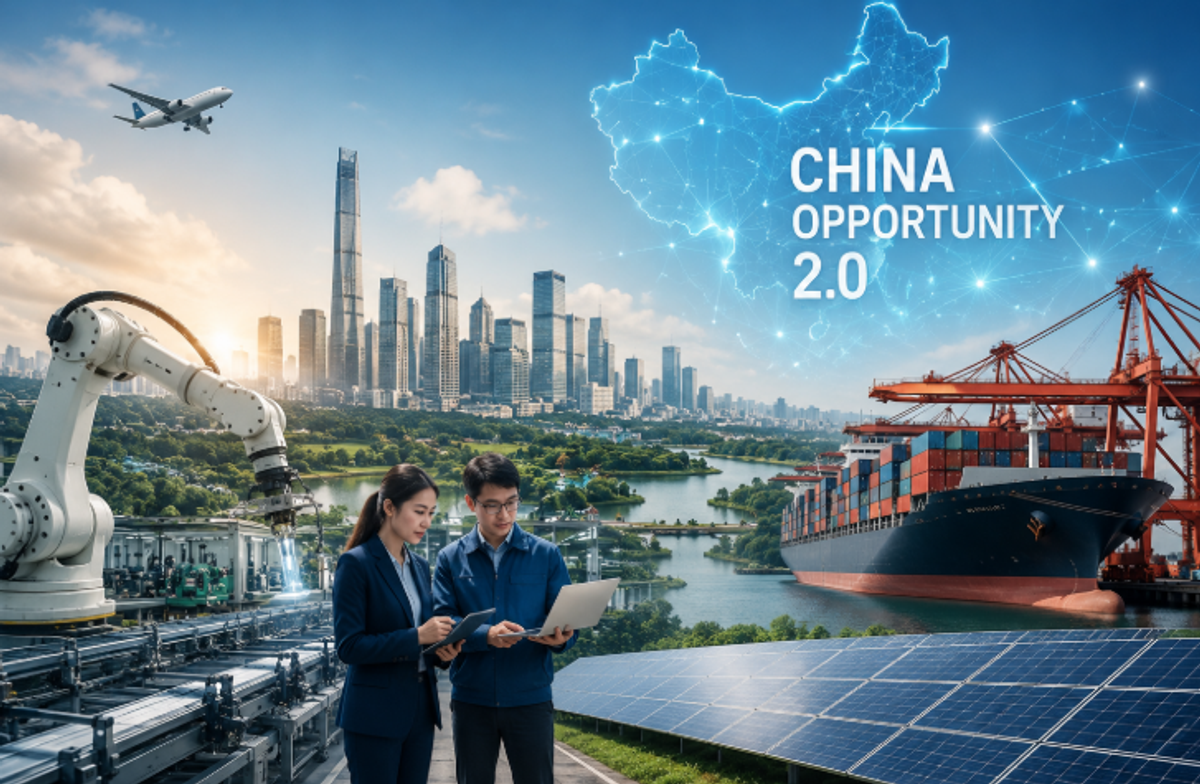
China Opportunity 1.0 ran on cheap labor, massive scale, and resource access. Everyone knows that story. But the China Opportunity 2.0 innovation industrial internet transition is something fundamentally different - it's about turning scientific breakthroughs into commercial products at a speed most economies genuinely can't match. If you're tracking global business strategy right now, that distinction matters more than almost anything else on the table.
From Factory Floor to Innovation Powerhouse: What Actually Changed
It's not just that China makes things cheaply anymore. That was always a partial picture.
As China enters the 15th Five-Year Plan period (2026-30), what's visible is an unusual combination running in parallel: economic stability, policy boldness, and accelerating innovation. Geopolitical tensions haven't disappeared - nobody serious pretends they have - but they haven't reversed the underlying structural momentum either.
Private capital is a big part of the story. At a National Development and Reform Commission conference in Nanjing, authorities pledged to sharpen financing mechanisms and improve services for private investors. Capital is flowing into high-tech industries and new infrastructure at a pace that reflects real market confidence, not just top-down rhetoric. The 2026 digital economy innovations on display this year offer a clear snapshot of where that investment is actually landing.
China's open-source AI surge is part of this story, too. So is Chinese AI model development, which has moved fast enough to surprise even close industry watchers.
China Opportunity 2.0 and the Industrial Internet: The 2030 Blueprint
Here's where the China Opportunity 2.0 innovation industrial internet transition gets very concrete.
Central authorities recently released industrial internet development guidelines with clear 2030 targets: 50,000 industrial 5G networks, five globally influential platforms for industrial subsectors, and full coverage across 207 sectors. The plan lays out 18 specific tasks spanning infrastructure, innovation, applications, security, and industry ecosystems.
What do 50,000 industrial 5G networks actually look like? Think factories, logistics hubs, and energy grids operating on near-real-time connectivity. That's physical infrastructure transformation, not a software update. And targeting five globally influential platforms means China isn't just aiming for broad participation - it's aiming for sector leadership.
The signature advantage making all of this credible is speed. Rapid industrialization of innovation - the ability to compress the gap between prototype and mass production into weeks rather than years - is China's most distinctive edge right now. A pharmaceutical company can shrink lab-to-supply-chain timelines dramatically. A hardware startup can go from concept to factory floor faster than anywhere else. That's a structural advantage, and it compounds over time.
Why Multinationals Are Moving Deeper In, Not Pulling Back
This part surprises some people.
Given the noise around China-West relations, you'd expect a retreat. Some companies have pulled back. But many multinationals are doing the opposite - building R&D centers and innovation hubs inside China specifically because they can't afford to miss what's happening there.
The Volkswagen case is the one everyone keeps citing, and for good reason. The question German leadership is actually wrestling with isn't whether to exit China. It's how to integrate into China's innovation system and channel its Chinese market experience back into supporting German production. Think about that for a second. The direction of knowledge transfer is starting to reverse.
Across pharmaceuticals, manufacturing, and consumer tech, the move from "Made in China" to "Created in China" is real and accelerating. China's AI chip industry is one place to see this playing out in hard technology. For emerging tech startups thinking about where to scale or which innovation networks to tap, this context is directly relevant.
Multinationals staying in China aren't ignoring the geopolitical risk. They're making a calculated judgment that staying inside the system is worth more than the comfort of staying out.
Wang Wentao's Europe Engagements and What They Signal
Commerce Minister Wang Wentao's intensive Europe trip wasn't a formality. The outcomes were specific.
In Brussels, China and the EU established a trade and investment consultation mechanism covering trade balance, export controls, intellectual property protection, and WTO reform - while naming AI, the green transition, and services as future cooperation engines. The emphasis was clear: expand balanced trade rather than restrict commerce. That framing matters because it shapes what both sides are willing to put on the table going forward.
China's open trade strategy is the broader framework here. Wang's separate talks with his German counterpart produced commitments to revive institutional economic dialogue based on reciprocity and predictability - unglamorous language, but in trade diplomacy, predictability is a real currency.
In London, a jointly organized "Export to China" initiative brought together over 100 British companies and dozens of Chinese partners across life sciences, energy, advanced manufacturing, and automotive. Accelerating discussions on a China-UK bilateral services trade agreement is now also on the agenda, which reflects where both sides see near-term commercial upside.
China's services trade hit 3.1 trillion yuan ($456.6 billion) in the first five months of 2026 alone, up 6% year-on-year. That steady expansion reflects a structural shift: services are becoming both a growth engine and a signal of how mature China's innovation-driven economy is becoming.
Competition Without Rivalry: Why the Framing Matters
None of this eliminates competition. It shouldn't.
China and its major trading partners will compete across AI, clean energy, pharmaceuticals, and advanced manufacturing. You can see it clearly in ongoing AI industry coverage, in the rapid capability gains visible in areas like China's satellite capabilities, and across the broader landscape of science and tech breakthroughs now emerging from Chinese institutions and companies at scale.
But competition doesn't have to be zero-sum. The biggest challenges of the next decade - AI governance, clean energy transition, advanced healthcare - genuinely require deep collaboration across borders. Managed competition is not the same thing as permanent antagonism.
Here's the historical parallel worth keeping in mind. When China joined the WTO in 2001, many domestic companies feared the coming of foreign competition. That exposure turned out to be one of the most powerful innovation catalysts in modern economic history. Companies that adapted thrived; those that didn't got left behind. The same dynamic is now running in the other direction.
Those framing this moment as "China Shock 2.0" are looking at disruption. Those willing to adapt may find something considerably more useful: a genuine China Opportunity 2.0 innovation industrial internet transition that offers real commercial upside - if you're paying attention and willing to engage with it seriously.